
Clinical picture. M., a woman in her late thirties presenting with generalised anxiety and a longstanding conviction that relaxation techniques are useless for her, had abandoned diaphragmatic breathing after a single difficult attempt during an acute worry spiral. Her therapist introduced the five-column worksheet and asked her to rate her anxiety before and immediately after each practice attempt across the following two weeks, restricting trials to moments when distress was at a 5 or 6 out of 10 rather than already at its ceiling. Across seven entries, M. recorded an average pre-to-post drop of 2.5 points; she had been applying the skill too late and for under a minute. Reviewing the data together in session, she revised her position from "breathing does nothing" to "breathing helps if I catch it early enough," which gave the intervention a workable rationale going forward.
Coping Strategy Effectiveness: PDF Worksheet, Tools and Exercises
A visual PDF worksheet helping clinicians show patients how to measure whether a coping skill actually works, using structured before/after emotion ratings and a clear session debrief protocol.
Clinical vignettes
Slow Breathing Dismissed Too Quickly
Identifying a Competing Behaviour
Clinical picture. T., a man in his mid-twenties with recurrent depressive episodes, reported that the grounding technique his previous clinician had taught him produced no relief during evenings alone at home. His current therapist used the worksheet to track three variables across five situations: the target emotion and its rated intensity before and after the skill, the skill used, and any concurrent behaviour. T.'s entries revealed that he was running a five-senses grounding exercise while simultaneously scrolling through social media, a pattern he had not noticed until he saw it written across several rows. When he repeated the exercise with the phone face-down, post-skill ratings dropped by an average of three points, and he stopped attributing the earlier failures to the technique itself.
"Nothing ever works for me." Almost every clinician has heard this from a patient who has, in fact, been using coping skills between sessions. The problem is rarely the skills themselves; it is the absence of any systematic way to test them. This PDF worksheet on coping strategy effectiveness gives you a concrete visual support to bring that test into the session itself.
Use this resource with your patients
Handout, exercises and materials ready to use, right inside SessionFuel.
Why Coping Skill Evaluation Resists Verbal Explanation
When patients conclude that a skill is ineffective, they are typically reasoning from mood-congruent memory, not from data. A single high-distress episode colours the entire week's experience, the skill gets quietly dropped, and the formulation stalls. Explaining this mechanism verbally during a session is one thing; watching a patient actually absorb it as a rule they can apply independently is another.
The added difficulty is that the question "did it help?" is deceptively simple. Without a structure, patients compare a vague "before" feeling to an equally vague "after" feeling and find the contrast unreliable. They also frequently apply skills at peak distress (too late), for thirty seconds (too short), or alongside maladaptive coping patterns running in parallel, such as avoidance or substance use. None of this surfaces unless there is a measurement frame in place before the skill is tried.
What the Fiche Contains: A Visual Measurement Frame for the Session
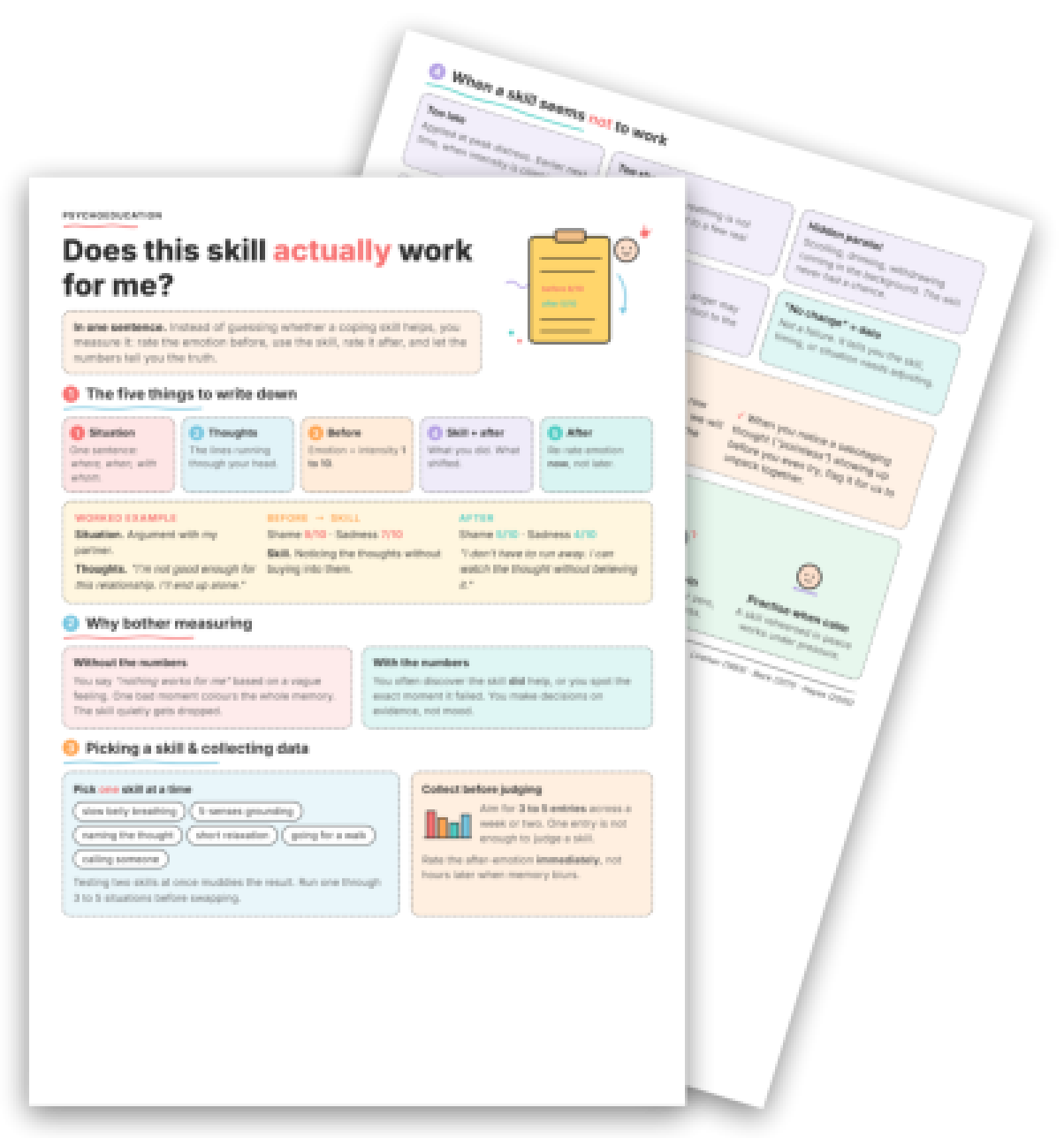
The fiche PDF organises data collection around five fields: situation (one sentence, context only), thoughts active at the time, emotion plus intensity rated 1 to 10 before the skill, the skill used and what shifted, and a second emotion rating taken immediately after, not hours later. A worked example runs through the whole sequence: shame 9/10 and sadness 7/10 before "noticing the thoughts without buying into them", dropping to shame 5/10 and sadness 4/10 after. The patient's own reflection is captured verbatim: "I don't have to run away. I can watch the thought without believing it."
The visual layout does something an oral explanation cannot: it externalises the before/after gap as a number pair the patient can see, return to, and compare across entries. A drop from 9 to 5 written on the page is far more persuasive than a clinician's assurance that the skill helped.
The fiche also includes a "Why bother measuring" panel that contrasts reasoning without numbers (one bad moment colours the whole memory; the skill gets dropped) against reasoning with numbers (the skill often did help, or the exact failure point becomes visible). A dedicated section, "When a skill seems not to work", names six specific reasons: timing too late, duration too short, a hidden parallel behaviour (scrolling, withdrawing), a sabotaging belief that biases the after-rating, a wrong tool for the emotion type, and the reframe "No change = data, not failure." This last point is particularly useful for patients with perfectionist coping profiles who interpret any non-zero score as proof the effort was worthless.
A "To discuss in session" checklist closes the fiche, prompting patients to bring entries where the drop was unexpectedly large, sequences of two or three flat results, and any sabotaging thought that preceded the attempt. This turns the worksheet into a structured agenda item rather than passive homework.
> Key point: The worksheet is a visual support that facilitates the explanation in session, not a questionnaire patients fill out alone. You walk through the structure together, establish the measurement logic on the page, and hand it to the patient as a data-collection protocol for the week ahead.
750+ clinical tools
A library built with and for clinicians, ready to use in session and extend between appointments.
Access all the toolsWhen and How to Introduce It
This fiche fits naturally in the skills-building phase of a CBT or ACT protocol, once at least one coping skill has been introduced but before the patient has formed a fixed opinion about its utility. It is especially indicated when you hear global dismissals ("nothing works"), when avoidance patterns are being maintained by a belief that distress is unmanageable, or when graded exposure work is starting and you need a parallel self-monitoring structure.
A natural framing: "Rather than asking yourself next week whether it helped, I'd like you to measure it. Here's how we're going to do that." Walk through the five fields in session using a recent example. If the patient uses defusion techniques, grounding exercises, or any skill from a coping skills repertoire for depression, the fiche can be calibrated to any of them. Instruct patients to rate the after-emotion immediately, before memory blurs.
At the next session, debrief the entries using the "To discuss in session" prompts already printed on the fiche. Flat results become diagnostic, not discouraging: they point to timing, duration, or tool mismatch. With adolescents, consider pairing it with the coping strategies resource for younger patients to match the skill vocabulary to developmental level. For patients tracking anxiety progress across the care plan, the before/after ratings integrate directly into a broader self-monitoring routine.
The fiche does not replace the therapeutic formulation; it feeds it. Three to five entries across ten days give you and your patient real evidence to work with, far more persuasive than clinical intuition on either side.
Use it with your patients
Share this tool in the mobile app and follow the work between sessions.
Sources
- Lazarus, R. S., Folkman, S. (1984). Stress, Appraisal, and Coping. Springer Publishing Company.
- Linehan, M. M. (2015). DBT Skills Training Manual, Second Edition. The Guilford Press.
Your session continues in your patients' pocket
Use with a patientYour resources, available everywhere
The handouts, exercises, programs and audios above: you choose which ones to make available to your patients, in the mobile app dedicated to them.
And far more than a library
The app goes well beyond resources, to support your patients every day:
Related categories
Explore other clinical resources by category.
Anxiety
Clinical hub for anxiety disorders: CBT and ACT worksheets, psychoeducation sheets, and exercises for assessment and treatment across the anxiety spectrum.

Mood
Evidence-based worksheets and clinical tools for mood disorders: CBT, ACT, and positive psychology resources for psychologists and therapists.

Emotions
Clinical resources on emotion regulation: worksheets, coping tools, CBT, REBT, and ACT exercises for therapists working across diagnoses and age groups.

Cognition
Printable cognitive therapy worksheets and clinical tools for therapists: CBT, ACT, schema work, defusion, distortions, and belief restructuring.

Build awareness
Clinical worksheets and tools to build awareness in therapy: cognitive distortions, schemas, emotions, ACT and CBT resources for practitioners.

Regulate
Clinical resources for emotion regulation: worksheets, ACT exercises, and psychoeducation tools for affect regulation across diagnoses. For clinicians.