
Clinical picture. A., a man in his early forties, presented with persistent low mood and irritability following what he described as an unfair performance review that blocked his promotion. He had been rehearsing the perceived slight for weeks, with little variation in his thinking. The clinician introduced the five-question exercise as between-session homework, asking A. to work through each prompt in writing before the next appointment. When he returned, his written responses revealed, for the first time, that he could name specific emotions beyond anger, including shame and helplessness, and he had identified two concrete steps he could take: requesting documented feedback from his manager and updating his professional profile. The exercise did not resolve his grievance, but it interrupted the ruminative loop and shifted the session toward problem-solving rather than complaint rehearsal.
Perceived Injustice in Therapy: A Guided Cognitive Exercise
Help patients move from injustice rumination to emotional awareness, perspective-taking, and structured action with this five-question autonomous homework exercise.
Clinical vignettes
Workplace Grievance, Stalled Rumination
Adolescent Perception of Parental Favouritism
Clinical picture. L., a sixteen-year-old referred for mood dysregulation, repeatedly returned to the conviction that her parents treated her younger sibling with less strictness, which she experienced as proof that she was valued less. The clinician offered the written exercise as a structured way to examine that belief outside the session, framing it as a personal investigation rather than a therapeutic assignment. L. completed questions one through three with notable detail, articulating sadness and loneliness alongside the anger she usually led with. Her response to question four was brief but significant: she noted that she could choose how she spoke to her parents about the rules rather than withdrawing. Subsequent sessions used her written answers as a shared reference point, making the therapeutic work more grounded and less reliant on her in-session account alone.
Why perceived injustice is hard to work with clinically
Perceived injustice is one of the most charged presentations in outpatient practice. The patient arrives convinced that something fundamentally wrong has been done to them, and they are often right, at least partially. That partial validity is exactly what makes the work clinically delicate: you cannot simply challenge the appraisal without invalidating a real experience, yet unchecked injustice rumination feeds the same loops that erode wellbeing and close off action.
Verbal explanation rarely moves this needle. When a clinician points out alternative readings in real time, the patient has not had space to arrive there themselves. The moral conviction behind "this is unfair" is often bound up with rigid rules about how the world should function, the kind of demanding standards that the Demandingness in REBT: From Rigid Rules to Preferences exercise addresses directly, as well as "Should" Statements thinking. A written, structured reflection completed at the patient's own pace creates the distance that an in-session conversation cannot.
Use this resource with your patients
Handout, exercises and materials ready to use, right inside SessionFuel.
What this exercise contains
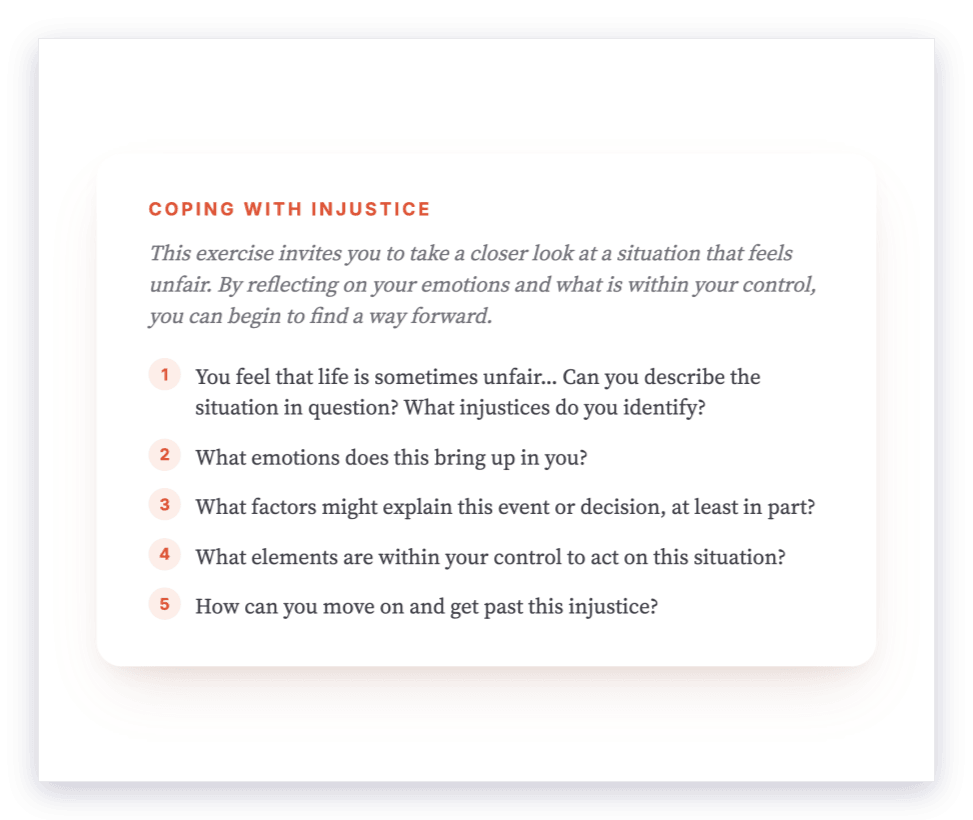
The exercise moves the patient through five ordered questions, each doing distinct clinical work.
The first question asks them to describe the situation and name the specific injustices they perceive, making the complaint concrete rather than diffuse. The second question turns attention to the emotional layer: what feelings does this actually produce? This step parallels the emotional slowing-down found in Feel, Reflect, Act Differently and draws on the same premise as Behavior, Emotion, Underlying Need, that the surface complaint sits above an unmet need worth naming.
The third question introduces perspective-taking under no pressure: what elements could at least partially explain this event or decision? This is not about excusing the situation but about building the kind of cognitive flexibility that Perspective-Taking and the Responsibility Pie Chart support structurally. The fourth question is the pivot: what is actually within the patient's control here? This maps directly onto the clinical work in Control, Influence, Accept, anchoring agency without minimizing the grievance. The fifth and final question asks how the patient can move forward, shifting from the stance of victim of an injustice to an active agent choosing their next move.
This image is a static preview listing the five questions. The full guided exercise, with patient-facing instructions and dedicated space for written responses, is experienced by the patient on their own inside the app, not in this image.
This exercise is available to patients through the mobile application that is the patient-side interface of SessionFuel: the clinician assigns it as homework, and the patient then completes it directly on their phone, on their own, between two consultations.
Key insight: A structured written sequence lets patients move from raw grievance to proportionate appraisal and actionable next step, a progression that spontaneous venting almost never produces on its own.
750+ clinical tools
A library built with and for clinicians, ready to use in session and extend between appointments.
Access all the toolsUse it with your patients
Share this tool in the mobile app and follow the work between sessions.
How to integrate this as between-session homework
This exercise suits a wide range of profiles: adolescents processing school or peer conflicts, adults navigating workplace frustrations, patients with externalizing patterns, or anyone presenting with persistent resentment and a sense of powerlessness. It also works well alongside Guided Anger Self-Reflection when the injustice narrative is wrapped in anger, and alongside Frustration Tolerance when the patient's distress tolerance is particularly low.
To introduce it between sessions, a brief framing is enough: "Before our next appointment, I'd like you to take some time with these questions about the situation you described. Write down whatever comes to you, there's no right answer." No rehearsal is needed.
When the patient returns, the written responses give the next session a precise entry point. Question three, partial explanations, is often where the most clinically useful movement has happened, or where resistance reveals a schema worth exploring, for instance through Schema-Focused Cognitive Restructuring. Question four frequently opens the work on control and influence directly. And where a patient has genuinely struggled with question five, that difficulty is itself informative, pointing toward active acceptance work or a deeper look at the evaluating thought utility question of whether holding onto this injustice is actually serving them.
The exercise does not resolve the grievance. It creates the internal movement that makes resolution possible.
Your session continues in your patients' pocket
Use with a patientYour resources, available everywhere
The handouts, exercises, programs and audios above: you choose which ones to make available to your patients, in the mobile app dedicated to them.
And far more than a library
The app goes well beyond resources, to support your patients every day:
Related categories
Explore other clinical resources by category.

Anxiety
Clinical hub for anxiety disorders: CBT and ACT worksheets, psychoeducation sheets, and exercises for assessment and treatment across the anxiety spectrum.

Mood
Evidence-based worksheets and clinical tools for mood disorders: CBT, ACT, and positive psychology resources for psychologists and therapists.

Identity
Clinical resources for self-identity work in therapy: CBT, ACT, schema tools for clinicians addressing self-concept, core beliefs, and identity disruption.

Emotions
Clinical resources on emotion regulation: worksheets, coping tools, CBT, REBT, and ACT exercises for therapists working across diagnoses and age groups.

Behaviours
Clinical hub for behaviors in therapy: worksheets and tools for coping, eating disorders, CBT formulation, and maladaptive behavioral patterns.

Cognition
Printable cognitive therapy worksheets and clinical tools for therapists: CBT, ACT, schema work, defusion, distortions, and belief restructuring.