
Clinical picture. M., a man in his early forties, was referred following repeated escalations with his partner; he described every argument as something she had started. In session, the clinician introduced the pie-chart exercise from the psychoeducation sheet, asking M. to assign slices to all contributing factors in a recent blowup, including his own fatigue, his tone, and the timing of his remarks. M. resisted at first, stating that attributing any slice to himself felt like "letting her off the hook." Over two sessions he was able to identify a modest but concrete slice of his own contribution, which opened a small but workable conversation about what he could change. The therapist did not frame this as fault reassignment; the goal was restoring leverage, not redistributing blame.
Externalizing: PDF Worksheet, Tools and Exercises for Clinical Practice
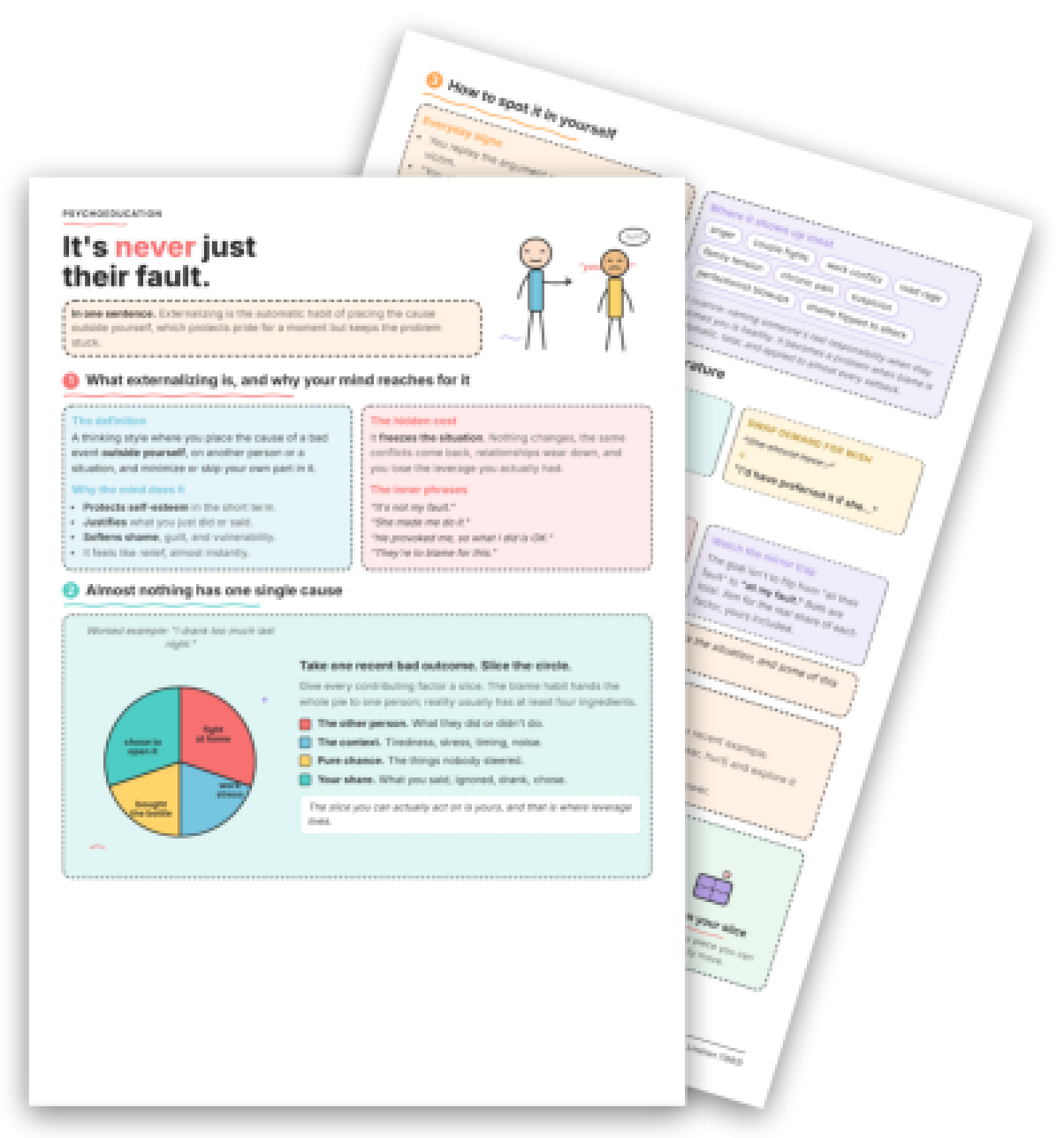
A printable PDF fiche with visual tools and exercises helping clinicians explain, map, and work through the automatic blame habit in CBT and schema therapy sessions.
Clinical vignettes
Externalizing in Couple Conflict
Externalizing After a Workplace Incident
Clinical picture. P., a woman in her mid-thirties presenting with chronic work-related stress, described a formal complaint against her as entirely the product of a colleague's jealousy. The clinician introduced the concept of externalizing as a normal protective reflex, normalizing its short-term function before examining its cost, using language drawn from the informational sheet. Together they mapped the situation: the colleague's behaviour, the team's broader dynamics, an ambiguous email P. had sent under pressure, and a deadline she had missed. Identifying her own slice did not diminish the colleague's role; it gave P. a specific behaviour she could address in a mediation meeting. She reported leaving that session feeling less stuck, though the workplace situation remained unresolved.
Patients who externalize habitually rarely walk in asking to examine their blame patterns. They come in with stalled conflicts, chronic resentment, or relationship wear, and the externalizing itself stays invisible to them. Naming it verbally often triggers defensiveness before any curiosity can develop. This fiche PDF gives you a structured visual scaffold to introduce the concept without the patient feeling accused, and without you having to choose between honesty and alliance.
Use this resource with your patients
Handout, exercises and materials ready to use, right inside SessionFuel.
Why externalizing resists verbal explanation in session
Attributional bias toward external causes is protective by design. Both Beck's cognitive model and Weiner's attribution theory converge on the same short-term payoff: locating the cause outside oneself softens shame, justifies recent behavior, and delivers near-instant relief. That relief makes the pattern ego-syntonic. Patients don't come in motivated to question it because, from the inside, it doesn't feel like distortion; it feels like clarity about who is at fault.
Trying to challenge this verbally creates a double bind. The patient either agrees abstractly without any genuine self-recognition, or reads your framing as accusation, which narrows the therapeutic relationship before the work has started. Self-protective cognitive distortions resist purely conversational challenge in ways that all-or-nothing thinking or catastrophizing often do not, because at least those patterns cause visible distress. Externalizing, by contrast, brings relief.
There is also a genuine clinical nuance that oral explanation frequently collapses: healthy attribution (accurately naming another person's real responsibility when harm occurred) is not the same as automatic, totalizing blame. Without a visual that separates the two, patients who have genuinely been wronged hear any challenge to their attribution as invalidation. The fiche holds both possibilities in the same frame.
What the fiche contains: five panels that make the invisible visible
The sheet is organized into five concise panels the clinician works through with the patient during the session, not a questionnaire the patient fills in alone.
- Panel 1 names the definition and its psychological functions: protecting self-esteem, justifying behavior, softening shame and guilt. The phrase "it feels like relief, almost instantly" tends to produce recognition before resistance.
- Panel 2 is the clinical core: a pie-chart worked example using the situation "I drank too much last night," sliced into four causal ingredients: the other person, the context, pure chance, and the patient's own share. The diagram makes explicit in three seconds what a verbal explanation takes minutes to convey. The fiche names it directly: "the blame habit hands the whole pie to one person; reality usually has at least four ingredients."
- Panel 3 lists everyday behavioral signs of externalizing: replaying arguments as the sole victim, "you always / you never" language, near-instant certainty about fault, bristling at any suggestion of personal contribution. It also maps the situations where externalizing concentrates most: couple conflict, road rage, workplace friction, anger cycles, perfectionist blowups, and shame flipped to attack.
- Panel 4 offers three concrete language swaps grounded in the same logic as the I-Messages framework: owning the feeling rather than attributing it, softening the absolute, and converting demand to preference. These feed directly into assertive communication work if that is already part of the care plan.
- Panel 5 presents a side-by-side cost-benefit comparison between what blaming gives (protected pride, clean story, no guilt to sit with) and what it actually costs (stalled problems, damaged closeness, no leverage). It also names the mirror trap explicitly: the goal is not to flip from "all their fault" to "all my fault." Both are total attributions, and both are errors.
> Key point: the fiche is a visual support that facilitates the explanation of externalizing in session. It is not a self-administered intake form. It is a psychoeducation scaffold the clinician navigates with the patient, panel by panel, leaving them with a concrete reference to return to between sessions.
750+ clinical tools
A library built with and for clinicians, ready to use in session and extend between appointments.
Access all the toolsWhen and how to propose the fiche
The sheet fits best from the second or third session onward, once a working case formulation is in place and alliance is solid enough to name a self-protective maintaining factor without rupturing the frame. It is most indicated in presentations involving chronic anger (anger management skills), recurring couple conflict, occupational friction, or persistent relational stagnation where the patient's own contribution is systematically minimized.
A low-inference introduction: "I'd like to look at something with you about how we all tend to explain difficult events. It's a very human habit, and I think it's showing up in some of what you've been describing." Framing externalizing as universal before it is personal preserves the alliance and invites curiosity rather than defensiveness.
Work through the pie-chart panel together using a real, recent example the patient brings. The instruction to "slice your own circle" is the functional pivot of the session. If time allows, walk through the language swaps in panel 4 before closing; otherwise, assign that panel as between-session reading. For patients who present with guilt and excessive self-blame rather than outward blame, flag the mirror trap explicitly: total self-attribution is the same cognitive error running in the opposite direction. The sheet also pairs well with perceived injustice work, with identifying automatic thoughts, and with the personalization and self-blame reappraisal exercise once the patient begins taking their own slice seriously.
The fiche doesn't replace the relational work; it gives the patient a shared vocabulary and a visual structure they can return to when the pull to externalize is strongest.
Use it with your patients
Share this tool in the mobile app and follow the work between sessions.
Sources
- Beck, A. T., Rush, A. J., Shaw, B. F., Emery, G. (1979). Cognitive Therapy of Depression. Guilford Press.
- Burns, D. D. (1980). Feeling Good: The New Mood Therapy. William Morrow and Co..
Your session continues in your patients' pocket
Use with a patientYour resources, available everywhere
The handouts, exercises, programs and audios above: you choose which ones to make available to your patients, in the mobile app dedicated to them.
And far more than a library
The app goes well beyond resources, to support your patients every day:
Related categories
Explore other clinical resources by category.

Emotions
Clinical resources on emotion regulation: worksheets, coping tools, CBT, REBT, and ACT exercises for therapists working across diagnoses and age groups.

Relationships
Clinical worksheets and tools on relational functioning: attachment, schemas, assertiveness, and communication skills for therapists. Printable PDF resources.

Cognition
Printable cognitive therapy worksheets and clinical tools for therapists: CBT, ACT, schema work, defusion, distortions, and belief restructuring.

Understand
Clinical hub for the therapeutic aim 'Understand': worksheets and tools to build patient insight across CBT, ACT, schema therapy and more.

Build awareness
Clinical worksheets and tools to build awareness in therapy: cognitive distortions, schemas, emotions, ACT and CBT resources for practitioners.

Restructure
Clinical hub for cognitive restructuring worksheets: distortion identification, belief disputation, ABC model, and schema work for evidence-based practice.