
Clinical picture. R., a woman in her late thirties, presents with generalised anxiety and recurrent low mood. She holds a senior role at work but describes persistent certainty that she is underqualified, reporting: "I feel like a fraud every morning, so I clearly do not belong there." When her therapist introduced the emotional reasoning framework from the psychoeducational sheet, R. was asked to place her feeling on one side of a two-column worksheet and to list observable facts on the other. She identified several years of positive performance reviews and a recent promotion, none of which she had been weighing against the felt sense of fraudulence. By the end of the session she could not yet dismiss the feeling, but she acknowledged that it had been functioning as a verdict rather than as a signal worth examining.
Emotional Reasoning: PDF Worksheet, Tools and Exercises
A printable PDF worksheet with clinical tools and exercises to make emotional reasoning visible in session and help patients separate feeling from fact.
Clinical vignettes
Feeling Incompetent as Evidence of Incompetence
Nocturnal Catastrophising After a Terse Message
Clinical picture. T., a man in his mid-forties seen for CBT following a depressive episode, described a pattern of interpreting brief text replies from colleagues as confirmation that he had caused offence. One evening he received a one-line response from his line manager and spent several hours certain he was about to lose his job. In the following session, his therapist used the sheet's "honest path" diagram to make the missing step visible: T. had moved directly from "their reply felt cold" to "they must be furious," with no intervening check. He noted, unprompted, that the conviction had peaked around 2 a.m. and had softened considerably by morning, which matched the sheet's observation that verdicts tied to emotional reasoning tend to shift with mood state rather than with new information. This observation gave T. a concrete anchor he could use between sessions when the same pattern arose.
Patients who fuse emotional state with external evidence rarely notice they're doing it. You hear it as apparent certainty: "I know they're angry with me," "I felt the danger," "I just know things are falling apart." Unpacking emotional reasoning verbally, in real time, tends to produce polite nodding with zero conceptual shift. This fiche PDF gives you a visual scaffold to make the mechanism visible and nameable during the consultation itself.
Use this resource with your patients
Handout, exercises and materials ready to use, right inside SessionFuel.
Why Emotional Reasoning Resists Verbal Explanation
When you describe the bias orally, patients frequently hear a version of "your feelings are wrong," which triggers defensiveness rather than curiosity. The actual mechanism is subtler: the emotion is genuine, but it is being used as data about external reality rather than as information about an internal state. That distinction is genuinely hard to hold under cognitive load, especially for patients whose affect-regulation is already taxed.
As the CBT cognitive model makes explicit, emotional reasoning is one of the most self-sealing cognitive distortions: the stronger the feeling, the more convincing the conclusion, which is precisely when evidence-checking becomes least likely. The bias appears across presentations, generalized anxiety, social anxiety, low self-esteem, depressive cognition, and it frequently co-occurs with mind reading and arbitrary inference, where assumed internal states in others feed right back into the same loop.
Correcting the belief without naming the mechanism leaves the process intact. Patients need a label and a diagram, not just a counterargument.
750+ clinical tools
A library built with and for clinicians, ready to use in session and extend between appointments.
Access all the toolsWhat the Fiche Contains: a Visual Tool for In-Session Explanation
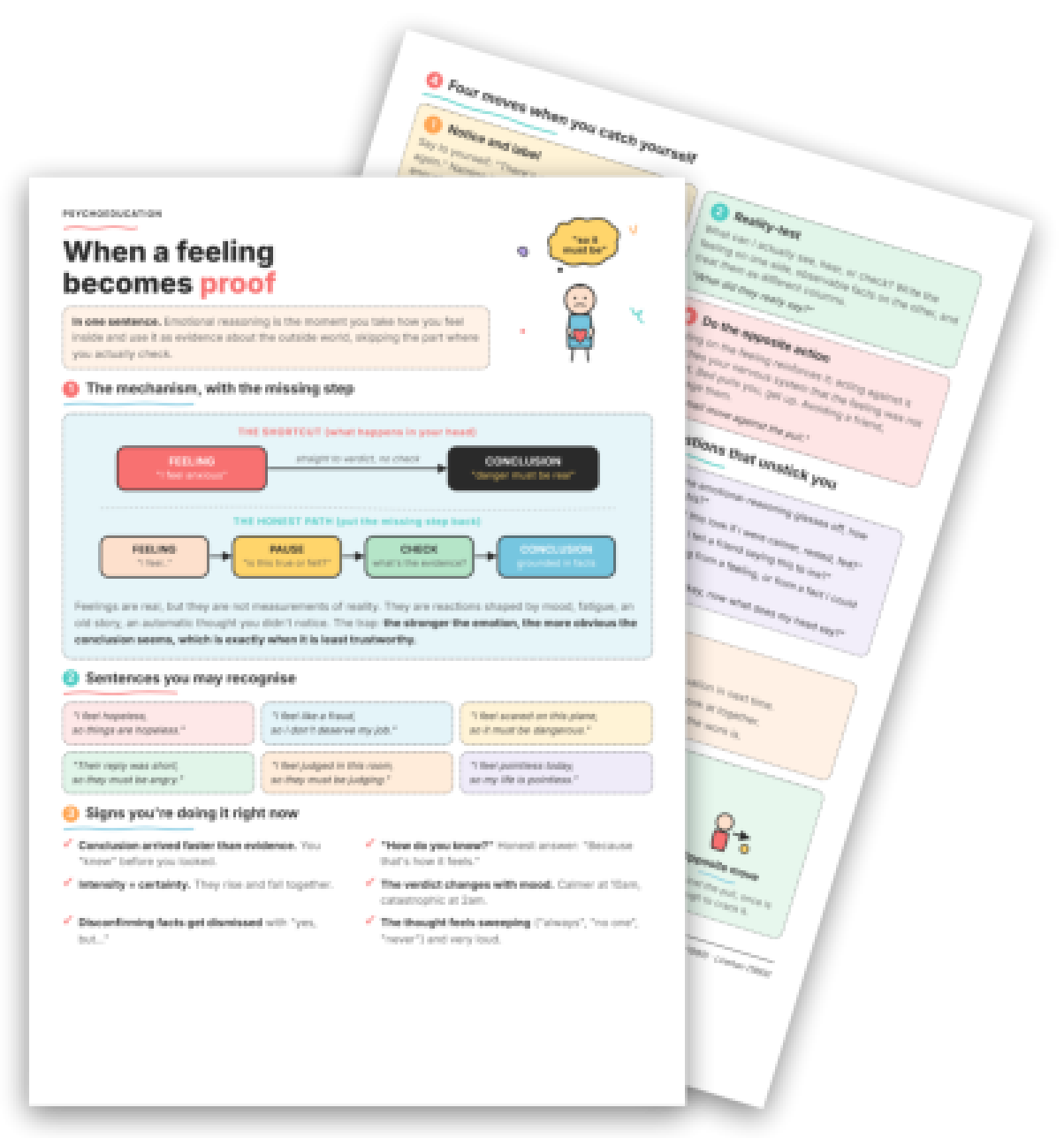
The fiche opens with a one-sentence definition worth quoting verbatim: "emotional reasoning is the moment you take how you feel inside and use it as evidence about the outside world, skipping the part where you actually check." That precision alone saves five minutes of circular explanation.
Panel 1 renders the mechanism as a two-path diagram: "the shortcut" (feeling straight to conclusion, no check) set against "the honest path" (feeling, then a deliberate pause, then evidence-checking, then a grounded conclusion). The visual contrast does something an oral description cannot: it makes the missing step spatially obvious, as a gap the patient can point to.
Panel 2 offers six ready-to-recognise sentences: "I feel like a fraud, so I don't deserve my job"; "I feel pointless today, so my life is pointless". Showing these to the patient is faster than constructing examples from scratch and consistently produces recognition rather than abstraction.
Panel 3 lists five signs the process is active, including the clinically useful observation that verdicts shift with time of day ("catastrophic at 2am, shrunk by 10am"). This maps directly onto diurnal mood variation you may already be tracking.
Panel 4 details four concrete moves: noticing and labelling ("there's my emotional reasoning again"), reality-testing by separating feeling from observable fact, state-shifting before revisiting the thought, and opposite action grounded in Linehan's DBT work. Panel 5 draws the Feeling versus Fact distinction explicitly: "He didn't reply for two hours" (fact) versus "I feel he's angry with me" (feeling). Panel 6 closes with six unsticking questions, "Heart says X. Okay, now what does my head say?", that double as in-session Socratic prompts.
> To remember: the fiche is a visual support that facilitates the in-session explanation of emotional reasoning; it is not a self-administered questionnaire. You use it to anchor the concept, name the mechanism together, and leave the patient with a concrete reference between appointments.
Use it with your patients
Share this tool in the mobile app and follow the work between sessions.
When and How to Introduce It
The fiche fits naturally once a pattern of affect-driven conclusions has emerged in the formulation, typically from session two or three onward. For patients with automatic thought monitoring already in place, it slots alongside their thought record as a supplementary lens. For those newer to cognitive work, it functions as a clear entry point before more structured cognitive restructuring exercises or the ABC model.
A low-threshold introduction: "I've noticed something in what you've been describing. Can I show you a diagram? I think it might name what's happening." Showing Panel 1 first, then asking which path their recent examples followed, produces faster uptake than any verbal definition.
Debrief it in the following session by asking which of the Panel 2 sentences felt closest, or whether the 2am-to-10am contrast appeared during the week. Patients prone to catastrophizing or all-or-nothing thinking tend to recognise themselves immediately in Panels 2 and 3, which accelerates shared case formulation.
One limit worth noting: for patients in acute distress or with active psychosis, the "feelings aren't facts" reframe requires careful scaffolding; the fiche is best held until a minimum of stabilisation is in place.
The fiche does not replace the therapeutic frame; it makes a notoriously self-sealing distortion visible enough to actually work with.
Your session continues in your patients' pocket
Use with a patientYour resources, available everywhere
The handouts, exercises, programs and audios above: you choose which ones to make available to your patients, in the mobile app dedicated to them.
And far more than a library
The app goes well beyond resources, to support your patients every day:
Related categories
Explore other clinical resources by category.

Anxiety
Clinical hub for anxiety disorders: CBT and ACT worksheets, psychoeducation sheets, and exercises for assessment and treatment across the anxiety spectrum.

Mood
Evidence-based worksheets and clinical tools for mood disorders: CBT, ACT, and positive psychology resources for psychologists and therapists.

Cognition
Printable cognitive therapy worksheets and clinical tools for therapists: CBT, ACT, schema work, defusion, distortions, and belief restructuring.

Understand
Clinical hub for the therapeutic aim 'Understand': worksheets and tools to build patient insight across CBT, ACT, schema therapy and more.

Build awareness
Clinical worksheets and tools to build awareness in therapy: cognitive distortions, schemas, emotions, ACT and CBT resources for practitioners.

Restructure
Clinical hub for cognitive restructuring worksheets: distortion identification, belief disputation, ABC model, and schema work for evidence-based practice.