
Clinical picture. A., a woman in her mid-forties, presented with a six-month history of low mood, fatigue, and social withdrawal following a professional setback. She described spending long evenings replaying the same self-critical thoughts without reaching any resolution, and she had difficulty articulating what triggered these episodes. The clinician introduced the first lesson of the rumination psychoeducation program, which frames repetitive negative thinking as an automatic response to distress rather than a character flaw. Working through the guided prompts between sessions, A. identified a specific trigger (receiving critical feedback at work) and noted that her mood reliably worsened after, not before, the rumination cycle began. At the next session she arrived with a clearer vocabulary for the pattern, which opened a more focused discussion about avoidance and the functional role her rumination was serving.
Rumination in Depression: A Psychoeducation Program
A structured 4-lesson autonomous program helping patients recognize ruminative loops, shift their content, and build a healthier relationship with their thoughts.
Clinical vignettes
Naming the Loop in Persistent Low Mood
Recognising Rumination Themes Over Time
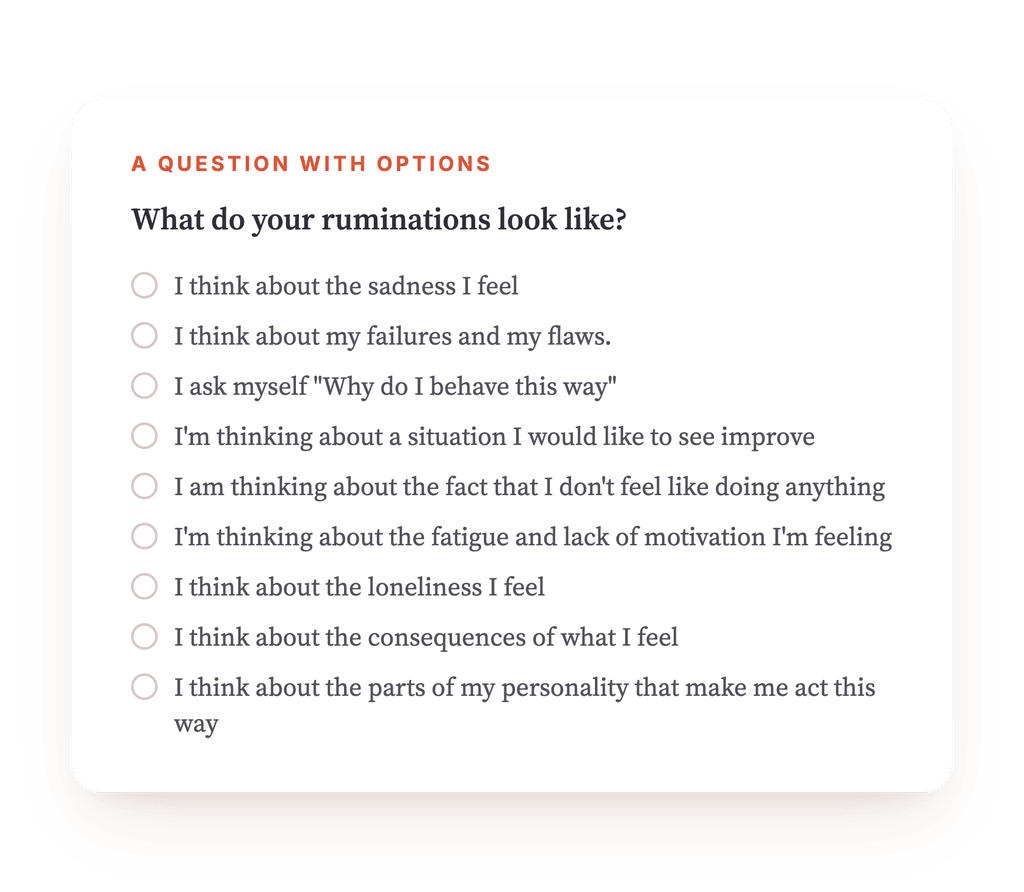
Clinical picture. T., a man in his early thirties with recurrent depressive episodes, reported that his thinking felt "stuck" but could not describe the content more precisely. His clinician assigned the second lesson of the program, which distinguishes three broad thematic areas of ruminative thought: the self, the environment, and the future. T. completed the multiple-choice items and reflective prompts autonomously and returned having recognised that the majority of his loops centred on personal deficits rather than situational factors. This differentiation was modest but clinically useful: it allowed the clinician to target self-referential processing more directly in subsequent sessions, without the earlier ambiguity that had slowed progress.
Use this resource with your patients
Handout, exercises and materials ready to use, right inside SessionFuel.
What makes rumination so hard to address clinically
Patients who ruminate rarely arrive describing it that way. They say they "think too much," that they "can't stop," or that their mind "won't let them rest." The concept of ruminative thinking as a distinct, self-maintaining process, different from problem-solving, different from healthy reflection, is genuinely difficult to convey verbally, especially in the middle of a session when there is little time to slow down and map the mechanism.
The other challenge is that rumination is almost invisible to the person doing it. It feels effortful and purposeful, as though turning a problem over one more time might finally resolve it. Without a structured framework, patients often conflate constructive self-reflection with the loops that erode them. Oral explanation alone rarely closes that gap. A resource like Rumination: PDF Worksheet, Tools and Exercises for Clinical Practice can help open the conversation, but sustaining the work across several weeks requires something more scaffolded.
750+ clinical tools
A library built with and for clinicians, ready to use in session and extend between appointments.
Access all the toolsWhat this program contains
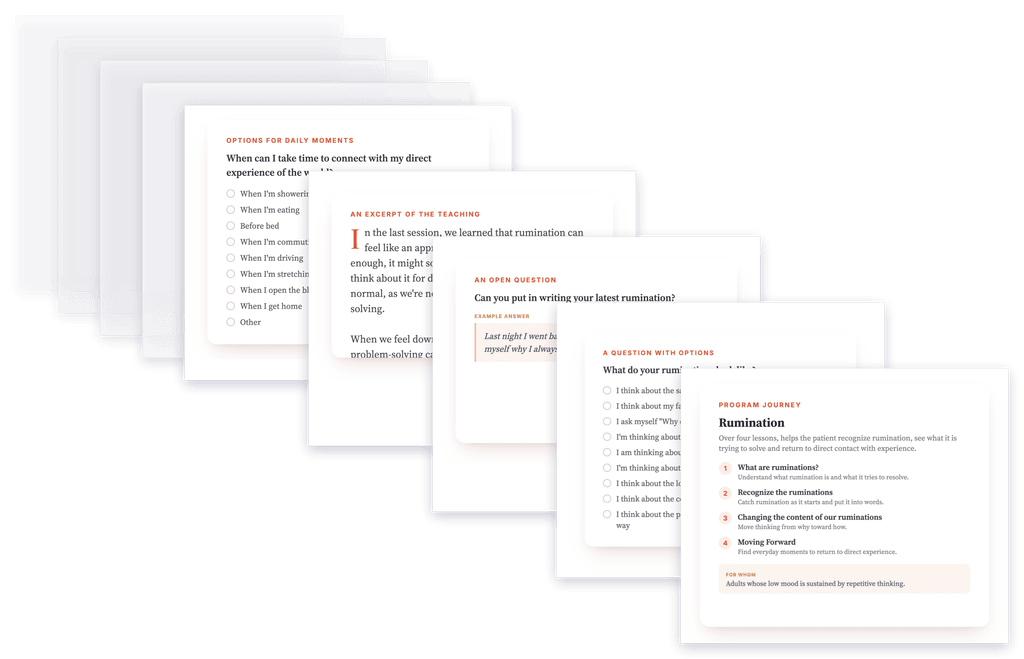
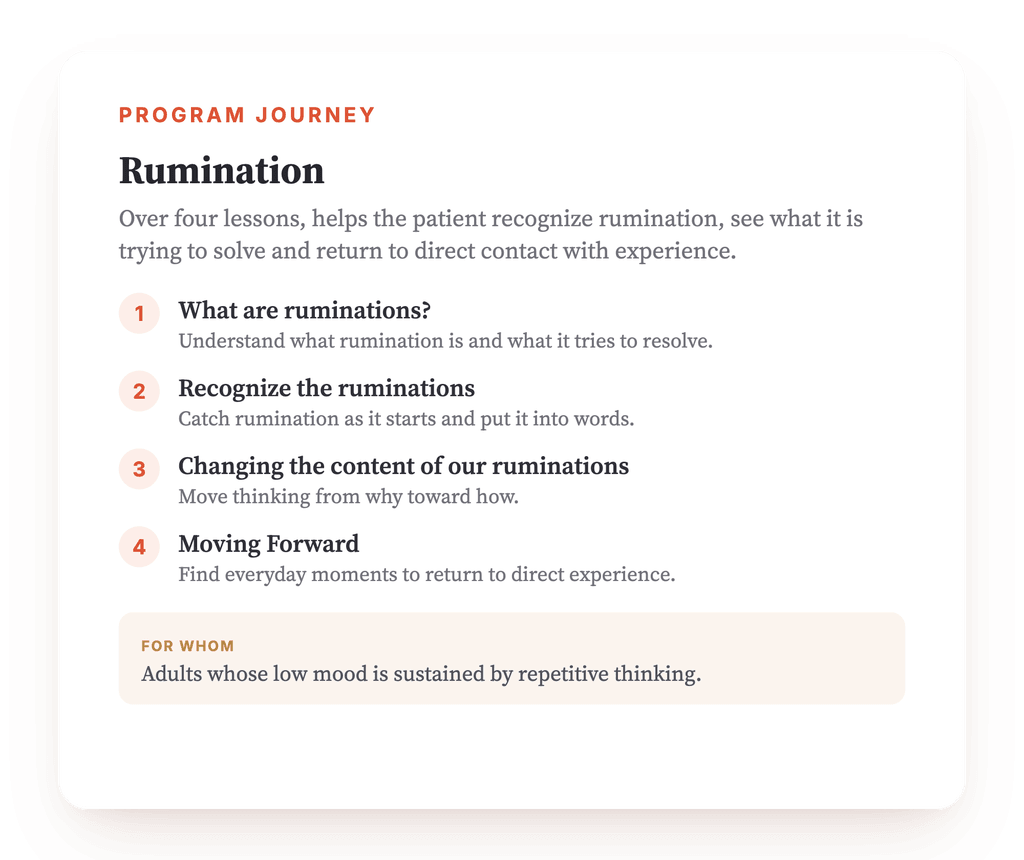
This four-lesson curriculum walks patients through the full arc of rumination work, one step at a time. Lesson 1 establishes the concept: what rumination is, why it appears as an automatic response to emotional pain, and how to identify personal triggers and emotional consequences. Patients are asked to write down a recent triggering situation and track their emotional state before and after the loop, which is the kind of observation that a fiche alone cannot sustain over time.
Lesson 2 sharpens recognition skills. Patients learn to distinguish rumination from problem-solving, map the three content domains (self, world, future), and put a recent loop into words. This connects naturally to the broader self-monitoring approach in Rumination: A Guided Self-Monitoring Exercise for Clinicians.
Lesson 3 is the most skills-dense. It introduces structured problem definition, action planning, the selection of positive distractions, and thought replacement work. The thought-suppression paradox is addressed directly, echoing what clinicians will recognise from Thought Suppression and Intrusive Thoughts: PDF Worksheet, Tools and Exercises.
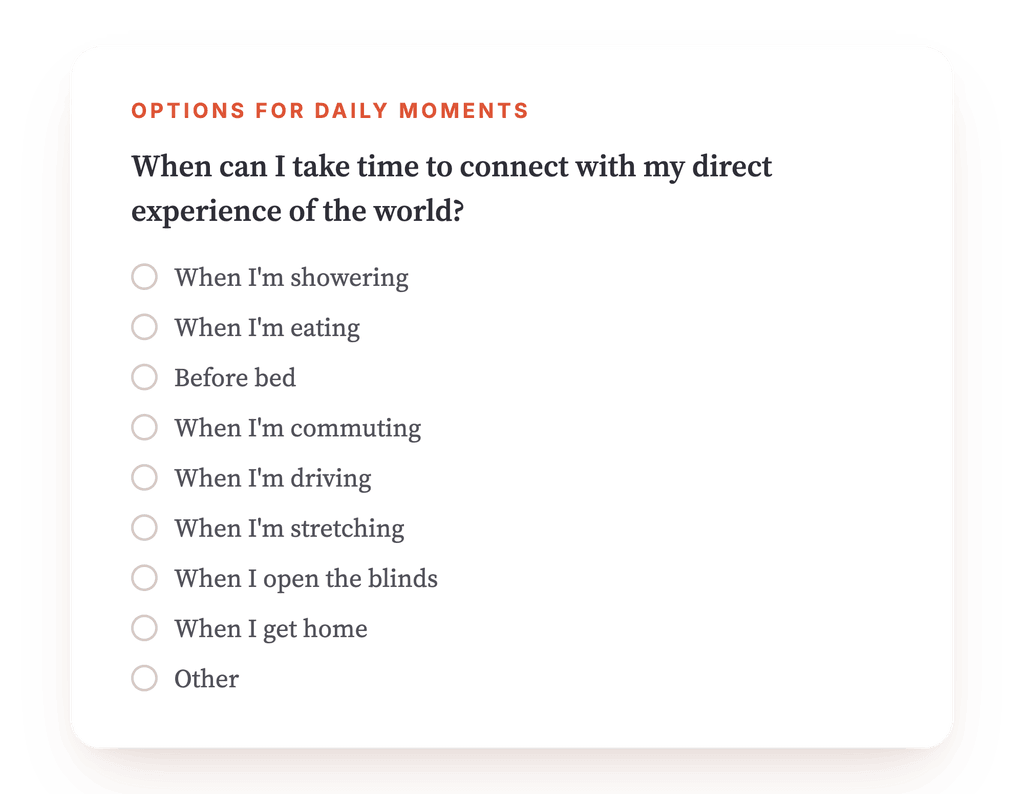
Lesson 4 shifts the frame entirely: rather than changing the content of thoughts, it builds a different relationship with them. Patients explore cognitive errors in their rumination, practice confronting avoided emotions, work on reconnecting with direct sensory experience, and develop self-compassion through a structured reframing prompt.
The preview images embedded below show the program overview map and two sample cards. These aperçus ne montrent qu'une fraction du programme: the full program is substantially richer, with many more steps, guided prompts, multiple-choice exercises, and psychoeducation panels than what is visible here.
This program is available to patients through the mobile application that is the dedicated patient-side interface of SessionFuel: the clinician assigns it directly from their SessionFuel account, and the patient then completes each lesson autonomously on their phone, between appointments.
Key insight: Rumination psychoeducation is most effective when it unfolds across time rather than in a single explanation, a step-by-step program gives patients the repeated, structured exposure that builds genuine metacognitive awareness.

Use it with your patients
Share this tool in the mobile app and follow the work between sessions.
How to integrate this program into your practice
This curriculum is designed as between-session homework: you assign it after a session in which rumination has been identified as a maintaining factor, and the patient works through the lessons on their own, bringing their written responses back to the next appointment.
It fits especially well with patients presenting with depression, chronic low mood, or the kind of repetitive thinking described in Stop Overthinking: PDF Worksheet, Tools and Exercises for Clinical Practice. It also pairs well with patients already working on emotional patterns in depression or self-image in the context of low mood.
To introduce it, a simple framing works: "Between now and next time, I'd like you to work through the first two lessons of this program on your phone. There are short texts, a few questions, and some writing prompts. Just do what you can." That sets realistic expectations and frames it as exploratory, not evaluative.
What patients produce, particularly the written trigger descriptions, the emotion tracking from Lesson 1, and the alternative-thought prompts from Lesson 3, provides rich clinical material. Rather than debriefing the content generically, you can use their specific responses as the starting point for cognitive restructuring, pointing toward tools such as Restructuring Mental Ruminations: PDF Worksheet, Tools and Exercises or the Rumination Eraser guided meditation audio as complementary practice. For patients who engage well with acceptance-based framings, Lesson 4 opens the door naturally to distancing and decentering work and ACT defusion techniques.
Your session continues in your patients' pocket
Use with a patientYour resources, available everywhere
The handouts, exercises, programs and audios above: you choose which ones to make available to your patients, in the mobile app dedicated to them.
And far more than a library
The app goes well beyond resources, to support your patients every day:
Related categories
Explore other clinical resources by category.

Anxiety
Clinical hub for anxiety disorders: CBT and ACT worksheets, psychoeducation sheets, and exercises for assessment and treatment across the anxiety spectrum.

Mood
Evidence-based worksheets and clinical tools for mood disorders: CBT, ACT, and positive psychology resources for psychologists and therapists.

Cognition
Printable cognitive therapy worksheets and clinical tools for therapists: CBT, ACT, schema work, defusion, distortions, and belief restructuring.

Understand
Clinical hub for the therapeutic aim 'Understand': worksheets and tools to build patient insight across CBT, ACT, schema therapy and more.

Build awareness
Clinical worksheets and tools to build awareness in therapy: cognitive distortions, schemas, emotions, ACT and CBT resources for practitioners.

Restructure
Clinical hub for cognitive restructuring worksheets: distortion identification, belief disputation, ABC model, and schema work for evidence-based practice.