
Clinical picture. A., a 34-year-old teacher, presents with a moderate depressive episode of four months' duration, describing a persistent sense of being "stuck" despite having no clear precipitating loss. In the third session, the clinician introduces the four-petal worksheet and invites A. to map the previous weekend: she had cancelled a Saturday walk, spent the afternoon asking herself why she could not cope, and gone to bed convinced she was "fundamentally weak." Tracing the sequence aloud, A. noticed for the first time that her Sunday exhaustion arrived before any new stressor, driven instead by the Saturday spiral itself. She left the session with a single behavioural experiment: to take a ten-minute walk on the following Saturday before deciding whether to cancel social plans. At the next appointment she reported completing the walk; her mood rating for that afternoon was modestly but meaningfully higher than the previous week.
What Keeps Depression Going: PDF Worksheet, Tools and Exercises
A visual PDF worksheet mapping the four maintenance loops of depression, behaviour, rumination, automatic thoughts, and core beliefs, to use as a psychoeducation support in session.
Clinical vignettes
Recognising the Loop in Session
Shifting Focus From Why to What
Clinical picture. M., a 47-year-old logistics manager, had spent several months in what he called "analysing" his depression, searching for a root cause he could resolve. The clinician used the informational sheet to reframe this: rather than locating the origin of the fire, the work would target what was currently fuelling it. M. identified rumination as his dominant petal, recognising that his nightly "why am I like this" loops produced no new information and reliably worsened his mood by morning. He was sceptical that reducing one petal could matter without resolving the underlying question, and the clinician acknowledged this openly while suggesting a two-week observation period. By session five, M. reported that interrupting the evening loops with a brief structured activity had produced a small but consistent reduction in Monday morning dread, which gave him enough traction to begin addressing avoidance behaviours.
Explaining depression maintenance to a patient who keeps asking "but why am I like this?" is one of the more frustrating moments in early-phase work. The etiological question pulls the conversation backward, away from what the session can actually do. This PDF worksheet gives you a concrete visual anchor to redirect that question toward the modifiable loops keeping low mood alive right now.
Use this resource with your patients
Handout, exercises and materials ready to use, right inside SessionFuel.
Why the maintenance model resists verbal explanation
The classic error patients make when you describe depression's self-perpetuating loops is to treat each element as a separate symptom to fix sequentially. Withdrawal sounds like a bad habit. Rumination sounds like overthinking. Automatic thoughts sound like wrong ideas. Core beliefs sound like something from the distant past. Without a visual that shows all four simultaneously and arrows feeding back into a common centre, patients do not grasp that pulling on any single loop weakens the whole structure.
There is also a motivation problem. Patients arrive with a fairly fixed attribution: depression is something happening to them, not something currently being powered by identifiable, modifiable mechanisms. Hearing this distinction at the oral register rarely shifts it. Seeing it laid out as a labelled diagram does. The fiche turns an abstract clinical argument into a shared map you and the patient can both point at.
750+ clinical tools
A library built with and for clinicians, ready to use in session and extend between appointments.
Access all the toolsWhat the fiche contains, and why the visual layout carries the weight
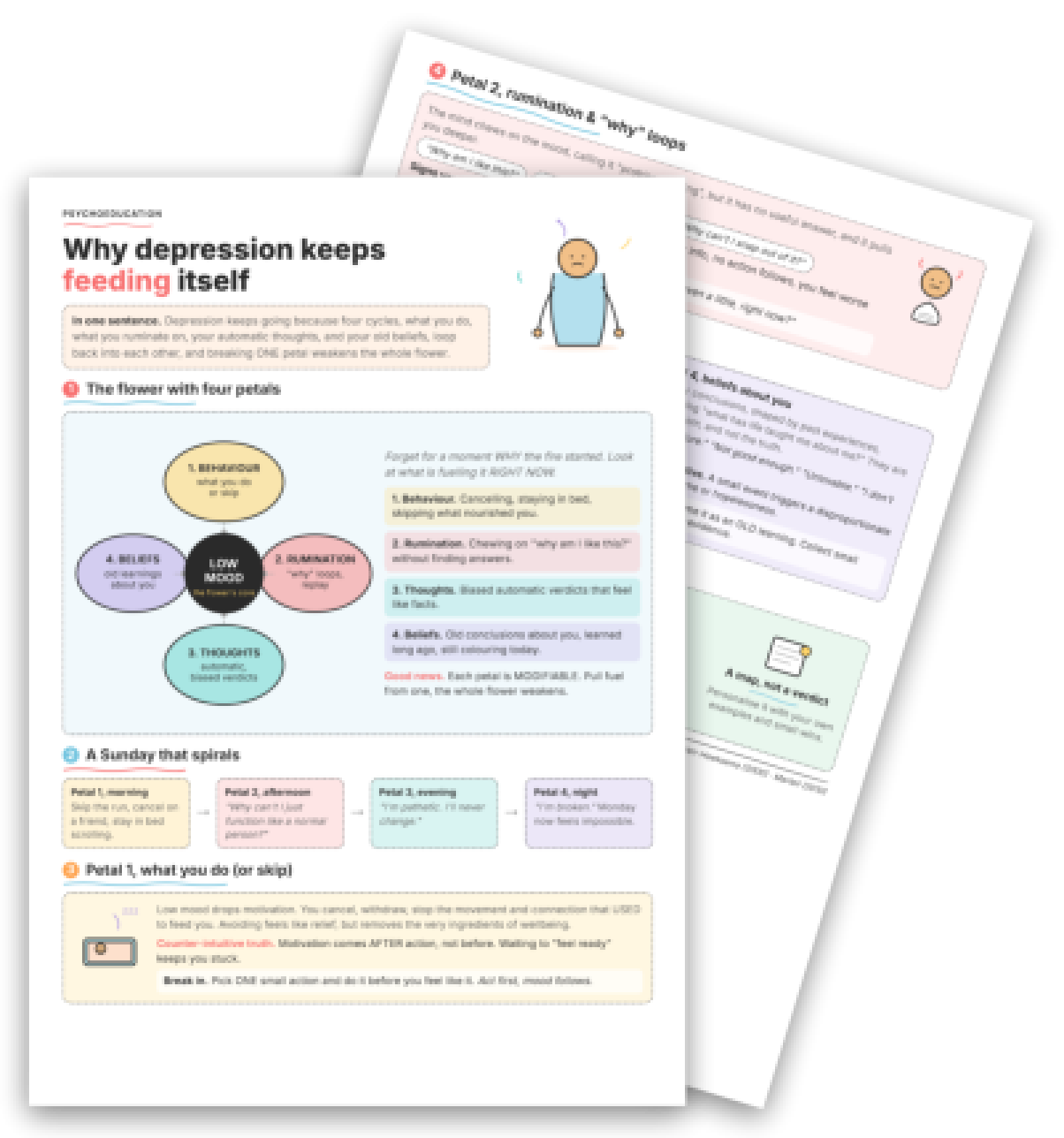
The fiche is built around "the flower with four petals": a central core labelled Low Mood surrounded by four labelled petals. Petal 1 is Behaviour (cancelling, withdrawing, stopping nourishing activities). Petal 2 is Rumination ("why" loops with no resolution). Petal 3 is Automatic Thoughts (biased verdicts that feel like facts). Petal 4 is Beliefs (old conclusions about the self, still colouring the present). Arrows connect each petal back to the centre and to adjacent petals.
What the diagram shows that a verbal explanation cannot: the simultaneity and reciprocity of the loops. A patient can scan the whole structure in one glance and immediately ask "which petal is mine?" That question alone reframes the conversation from cause-seeking to entry-point selection.
The fiche then walks each petal in turn. For behaviour, it names the behavioural activation principle directly: "Motivation comes AFTER action, not before." For rumination, it contrasts the pseudo-problem-solving quality of "why" loops with a workable alternative ("what could help, even a little, right now?"), a distinction developed further in constructive versus harmful rumination. For automatic thoughts, it lists the common biases ("jumping to the worst, filtering out the good, mind-reading, all-or-nothing, overgeneralising") and gives a three-step break-in: write the thought, ask fact or feeling, find one counter-piece of evidence. This maps directly onto tools like cognitive distortions work and thoughts and depression without requiring you to introduce them simultaneously.
For core beliefs, the fiche is precise about the clinical distinction that patients most often miss: "A small event triggers a disproportionate wave of shame or hopelessness." That single phrase has more psychoeducative traction in session than a paragraph on schema activation. You can pair it later with core beliefs work once the patient has the vocabulary.
A closing "Remember" panel condenses four take-home points: cycles, not character; one petal is enough; behaviour is the easiest entry point; the diagram is a map, not a verdict.
> Key point: the fiche is a visual support that facilitates the psychoeducation conversation in session, not a self-report form the patient completes alone. Its value is in giving clinician and patient a shared object to look at and discuss together, then for the patient to keep as a concrete reference between appointments.
Use it with your patients
Share this tool in the mobile app and follow the work between sessions.
When and how to propose the fiche
The optimal window is sessions two to four, after the initial anamnèse has surfaced the patient's own examples of withdrawal, rumination, and self-critical thinking, but before you move into active intervention. You have the raw material; the fiche organises it.
A low-labelling introduction: "I'd like to show you something that describes how depression tends to keep itself going. Have a look at this diagram and tell me which of these four elements feels most familiar to you." The patient's answer is your first formulation hypothesis.
For profiles with strong intellectual defences, the diagram also works as a shared reasoning tool rather than a top-down explanation. For patients with significant cognitive slowing, you can cover one petal per session, using the depression cycle recovery sheet as a companion tool.
Debrief prompt worth keeping: "If you had to pick one petal to work on this week, which one would feel like the smallest possible step?" This operationalises the "one petal is enough" principle, links directly to behavioral activation planning, and sets a realistic between-session experiment without overwhelming an already depleted patient.
Where the fiche has limits: patients in acute suicidal crisis, or those where psychoeducation risks reinforcing an intellectualising defence, may need the coping skills for depression work first before the model makes motivating sense. And if a patient presents with significant schema activation, the beliefs petal opens naturally into early maladaptive schema territory, which the depression psychoeducation program or four strategies to overcome depression sheet can extend.
The fiche does not replace case formulation, it supports the part of it you need to share clearly, early, and in a form the patient can return to on a Tuesday evening when the flower is in full bloom.
Your session continues in your patients' pocket
Use with a patientYour resources, available everywhere
The handouts, exercises, programs and audios above: you choose which ones to make available to your patients, in the mobile app dedicated to them.
And far more than a library
The app goes well beyond resources, to support your patients every day:
Related categories
Explore other clinical resources by category.

Mood
Evidence-based worksheets and clinical tools for mood disorders: CBT, ACT, and positive psychology resources for psychologists and therapists.

Cognition
Printable cognitive therapy worksheets and clinical tools for therapists: CBT, ACT, schema work, defusion, distortions, and belief restructuring.

Understand
Clinical hub for the therapeutic aim 'Understand': worksheets and tools to build patient insight across CBT, ACT, schema therapy and more.

Build awareness
Clinical worksheets and tools to build awareness in therapy: cognitive distortions, schemas, emotions, ACT and CBT resources for practitioners.

CBT
CBT worksheets, cognitive restructuring exercises & behavioral tools for clinicians. Evidence-based resources for every phase of cognitive behavioral therapy.

Anxiety
Clinical hub for anxiety disorders: CBT and ACT worksheets, psychoeducation sheets, and exercises for assessment and treatment across the anxiety spectrum.