
Clinical picture. M., a woman in her mid-thirties, presents with generalized anxiety and a persistent conviction that public spaces are unsafe. She reports that every commute confirms her fears, citing near-misses, hostile strangers, and a general atmosphere of threat. In session, the clinician introduces the selective attention psychoeducation sheet and walks through the self-confirming loop, inviting M. to locate her own prediction at the start of the cycle. She recognizes, with some surprise, that she cannot recall a single uneventful journey, not because none occurred, but because her torch had no reason to stop there. By the close of the session M. had not revised her belief, though she agreed to log one neutral or calm moment per commute as a small observational task, treating it as data rather than reassurance.
Selective Attention: PDF Worksheet, Tools and Exercises for Clinical Practice
A printable PDF worksheet, clinical tools and structured exercises to explain the attentional bias loop and help patients understand why their beliefs never update.
Clinical vignettes
Torch Metaphor in Anxiety
Social Filter and the Phone-Checker
Clinical picture. K., a man in his late twenties with a diagnosis of social anxiety disorder, describes a recent gathering where he left convinced the group found him dull. When the clinician asks what he noticed during the evening, K. describes one guest who looked at his phone twice and a brief lull in conversation. Using the worksheet's social example, the clinician maps this onto the attention-meaning-memory sequence, noting that K. had no recollection of the twenty minutes of engaged exchange that preceded the lull. K. acknowledged the logic of the model without fully accepting it emotionally, which the clinician normalized as a typical early response to psychoeducation. They agreed to revisit the loop in the next session with a specific recent interaction as material, rather than pressing for belief change prematurely.
Patients often accept the idea of selective attention without difficulty, then walk out of the session and behave exactly as before. The problem is not their motivation. It is that an oral explanation of attentional bias asks patients to hold an abstract loop in working memory while simultaneously applying it to their own experience. This fiche PDF externalises that loop as a visual object, freeing the session to focus on clinical meaning rather than cognitive load.
Use this resource with your patients
Handout, exercises and materials ready to use, right inside SessionFuel.
Why Selective Attention Resists Verbal Explanation
The clinical difficulty here is not conceptual complexity, it is invisibility. Attentional bias feels, from the inside, like accurate perception. The patient with generalised anxiety who clocks every ambiguous sound in a public space is not aware of filtering anything; they genuinely believe the street is dangerous. Telling them their attention is biased reads, initially, as dismissal.
The same dynamic appears across presentations. In social anxiety work, the patient's torch locks on the single phone-checker in the room; the twenty warm minutes of conversation simply fail to encode. In work with low mood, the mental filter for letdowns operates automatically, so the day becomes, as the fiche puts it, "a highlight reel of bad days". In each case, the patient is not misremembering, they are accurately reporting what their attention selected.
This is why oral psychoeducation alone rarely shifts the metacognitive position. Without a visible structure to point to, patients conflate the slice with the whole. The fiche creates a third object between you and the patient: a named mechanism, drawn out, that neither of you is personally responsible for.
What the Fiche Contains: A Visual Map of the Self-Confirming Loop
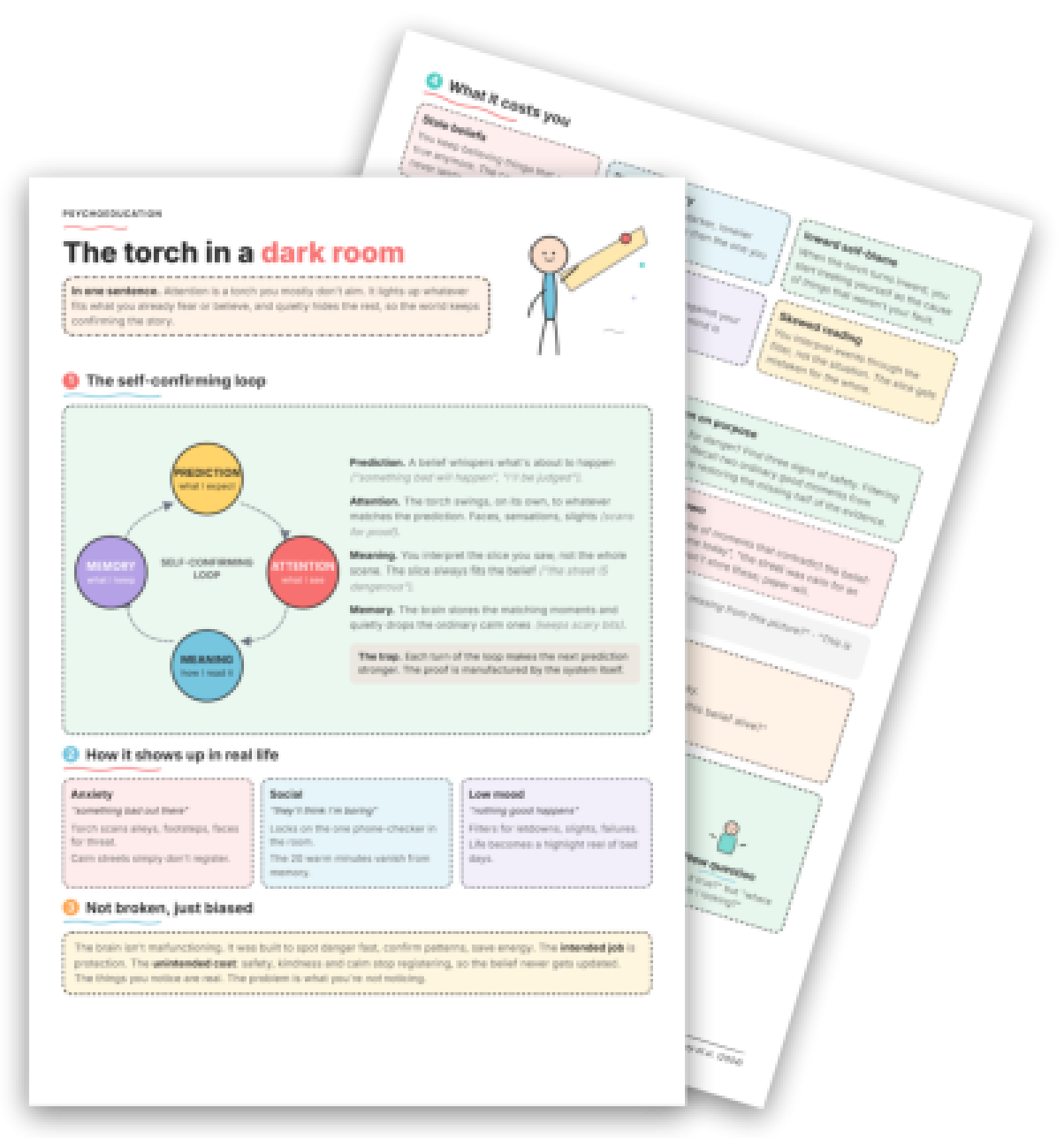
The fiche opens with a one-sentence anchor, "Attention is a torch you mostly don't aim," and builds immediately into its central section: the self-confirming loop. This four-stage cycle, Prediction, Attention, Meaning, Memory, is laid out as a closed diagram with a short gloss on each node. The visual layout shows, in a way that speech cannot, that the loop feeds itself: prediction selects the evidence that strengthens the next prediction.
A second section maps how the loop shows up across three clinical presentations, anxiety, social threat, and low mood, using paired examples: what the torch locks on, and what it quietly discards. This side-by-side format is particularly useful for patients who have previously dismissed cognitive distortion frameworks as too abstract; seeing the mechanism illustrated in their own presenting problem often produces immediate recognition.
The fiche then reframes the bias as adaptive, not pathological: "The brain isn't malfunctioning. It was built to spot danger fast, confirm patterns, save energy." This normalising move tends to lower defensive reactivity before you introduce the cost section, which names six specific consequences: stale beliefs, biased memory, inward self-blame, narrowed life, loss of control, and skewed reading. Each is precise enough to generate clinical discussion without requiring the patient to self-diagnose.
The final sections offer four torch-reclaiming strategies (naming the beam, widening on purpose, turning outward, writing it down) and a set of "To discuss in session" prompts designed to structure reflection. A closing panel of four brief phrases, including "This is the filter, not the facts", gives patients portable anchors between appointments, which pairs naturally with an assigned worry and attention capture exercise as between-session work.
> To retain: this fiche is a visual support that facilitates in-session explanation; it is not a self-administered questionnaire. Its function is to give attentional bias a shape patients can see, point to, and carry with them, not to replace your clinical formulation.
750+ clinical tools
A library built with and for clinicians, ready to use in session and extend between appointments.
Access all the toolsWhen and How to Introduce It in Session
The fiche fits naturally in early-to-mid psychoeducation, once the presenting problem is established and you have enough shared vocabulary to ground the loop in the patient's own material. Introducing it too early, before anamnèse is complete, risks a generic explanation; introducing it mid-treatment, once automatic thoughts or core beliefs are already in play, risks redundancy.
For patients engaged in schema-focused work, the fiche offers a clean bridge: the self-confirming loop operationalises how a schema generates its own confirming evidence. For patients prone to disqualifying positive information, the Memory node in the diagram often lands with particular force.
A useful introduction: "I want to show you a drawing of something that may explain why the belief hasn't shifted despite the evidence." Point to the Prediction-to-Attention arc first, then walk the loop. Debrief by asking where in the cycle the patient most recognises themselves, and which "missing half of the evidence" they never seem to encode. The daily gratitude exercise pairs well for patients who need a low-threshold behavioural entry point into widening the beam.
One limit worth noting: for patients presenting with intrusive thoughts or psychotic-spectrum features, introducing an attentional model requires careful calibration, the normalising framing is appropriate for anxiety and mood, less so where reality-testing work is the primary clinical focus.
The fiche does not replace the case formulation; it gives the formulation a shape the patient can take home.
Use it with your patients
Share this tool in the mobile app and follow the work between sessions.
Sources
- Wells, A., & Matthews, G. (1994). Attention and Emotion: A Clinical Perspective. Lawrence Erlbaum.
- Williams, J. M. G., Watts, F. N., MacLeod, C., & Mathews, A. (1988). Cognitive Psychology and Emotional Disorders. John Wiley & Sons.
Your session continues in your patients' pocket
Use with a patientYour resources, available everywhere
The handouts, exercises, programs and audios above: you choose which ones to make available to your patients, in the mobile app dedicated to them.
And far more than a library
The app goes well beyond resources, to support your patients every day:
Related categories
Explore other clinical resources by category.

Anxiety
Clinical hub for anxiety disorders: CBT and ACT worksheets, psychoeducation sheets, and exercises for assessment and treatment across the anxiety spectrum.

Trauma
Clinical hub on trauma and PTSD: assessment, differential diagnosis, treatment phases, and printable resources for practitioners. 155 chars.

Mood
Evidence-based worksheets and clinical tools for mood disorders: CBT, ACT, and positive psychology resources for psychologists and therapists.

Cognition
Printable cognitive therapy worksheets and clinical tools for therapists: CBT, ACT, schema work, defusion, distortions, and belief restructuring.

Understand
Clinical hub for the therapeutic aim 'Understand': worksheets and tools to build patient insight across CBT, ACT, schema therapy and more.

Build awareness
Clinical worksheets and tools to build awareness in therapy: cognitive distortions, schemas, emotions, ACT and CBT resources for practitioners.