
Clinical picture. A., a woman in her late thirties, presented with a longstanding history of social anxiety and a more recent depressive episode; she described both as entirely separate problems requiring different solutions. The clinician introduced the transdiagnostic psychoeducation sheet and invited her to read through the seven maintaining patterns between sessions. At the following appointment A. returned having circled biased thinking, rumination, and self-criticism, noting that all three appeared in both her anxiety and her low mood, often within the same hour. Rather than feeling overwhelmed by two diagnoses, she found it workable to focus on three named habits. This shared formulation became the organising frame for the rest of treatment.
Transdiagnostic Processes: PDF Worksheet, Tools and Exercises
A printable visual support to explain the seven maintaining processes shared across anxiety, low mood, and self-doubt, and use them as a shared clinical language in session.
Clinical vignettes
Naming the Pattern, Not the Diagnosis
Avoidance Recognised Across Presentations
Clinical picture. R., a man in his mid-forties, had been referred with health anxiety but reported in session that he had also stopped replying to most messages and was quietly withdrawing from a long-standing friendship group. When the clinician used the informational sheet to introduce avoidance as a transdiagnostic maintaining process, R. recognised the same mechanism operating in two areas he had treated as unrelated. He acknowledged that steering around medical news online and steering around social contact both produced brief relief followed by a tightening of the same loop. The conceptual overlap reduced his sense of having multiple intractable problems and supported agreement on a behavioural approach targeting avoidance across both domains.
Patients who carry multiple diagnoses, or who don't fit neatly into one, often struggle with disorder-specific psychoeducation: it explains their anxiety but not their low mood, their OCD but not the self-doubt underneath it. This PDF worksheet on transdiagnostic processes gives you a single, shared framework that cuts across presentations, reducing the time you spend re-explaining from scratch every time the clinical picture shifts.
Use this resource with your patients
Handout, exercises and materials ready to use, right inside SessionFuel.
Why transdiagnostic processes are hard to explain at the verbal level
The clinical insight here, grounded in the work of Harvey et al. and extended by Westbrook, is genuinely counter-intuitive for patients: the processes sustaining their distress are not disorder-specific. Avoidance, safety behaviors, biased attention, rumination, each of these drives anxiety, depression, panic, and self-doubt through the same basic mechanism. Most patients assume their anxiety is categorically different from their low mood. They experience them as separate problems, so they resist any suggestion that a single lens applies.
The second difficulty is the maintaining loop itself. Explaining verbally how biased attention feeds biased thinking, which feeds avoidance, which prevents disconfirmation, which deepens the bias, tends to land as abstract. Patients nod, but the causal chain rarely sticks after the session ends. A cycle of avoidance fiche or a CBT maintaining processes sheet can support isolated pieces of the picture; this worksheet holds the whole.
What the fiche contains: a visual map of seven patterns
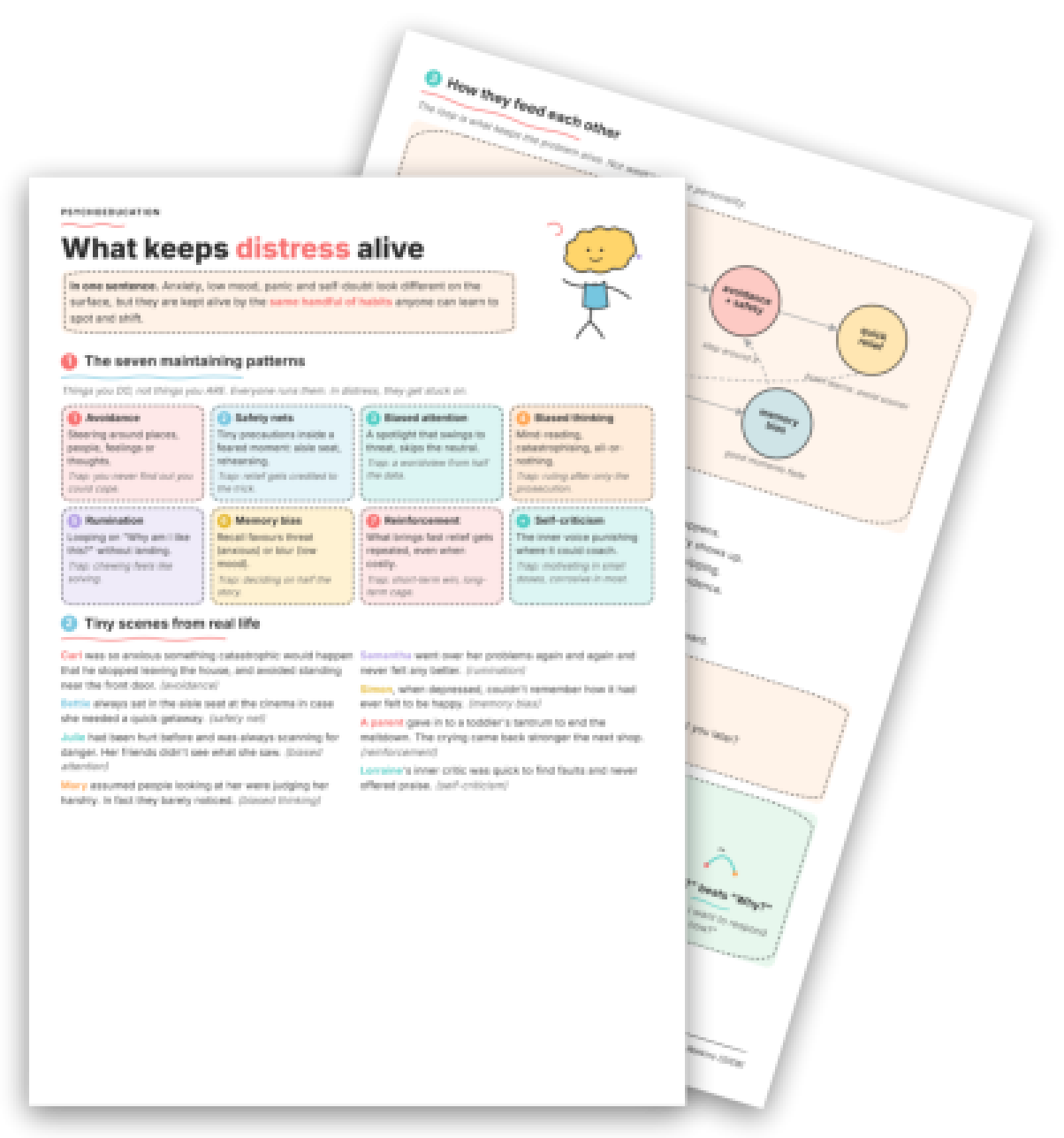
The fiche is built across six panels, and its clinical value is precisely that it makes the feedback loop visible, not just describable.
Panel 1 names the seven maintaining patterns, avoidance, safety nets, biased attention, biased thinking, rumination, memory bias, and reinforcement, with a trap framed beside each one. For instance, safety nets are described as "Tiny precautions inside a feared moment: aisle seat, rehearsing. Trap: relief gets credited to the trick." This is exactly the mechanism behind psychological safety crutches and social anxiety safety behaviors, named plainly enough that patients recognize it in themselves.
Panel 2 anchors each pattern in a brief character vignette (Carl, Bettie, Julie, and others), each linked to one process. These are not case studies; they are short behavioural snapshots that you can point to during session as you work through the fiche together.
Panel 3 is the loop diagram: it traces how biased attention generates threat-oriented thinking, which drives avoidance and safety moves, which generates short-term relief that reinforces the loop, while rumination and memory bias consolidate the whole structure. Showing this diagram is faster than explaining it, and patients can follow the arrows themselves.
Panel 4 pairs each process with a concrete softening move. For rumination, the fiche recommends swapping "Why?" for "How?", shifting from abstract self-questioning to concrete next steps, a distinction supported by Watkins's work on constructive versus unconstructive repetitive thought. For biased attention, it names "deliberate practice noticing the half of the scene you keep skipping."
Panel 5 offers three ready-to-use session questions, including "Which one or two of the seven feel most active in your life this month?" These anchor the debrief without requiring you to generate prompts on the spot.
> Key point: This fiche is a visual support that facilitates psychoeducation in session. You work through it with the patient; they leave with the map. It is not a self-administered questionnaire.
750+ clinical tools
A library built with and for clinicians, ready to use in session and extend between appointments.
Access all the toolsWhen and how to introduce it in session
The worksheet fits naturally at the formulation stage, once the presenting picture is clear and you are ready to build a shared model. It pairs well with a case formulation or a CBT cognitive model sheet as a complementary transdiagnostic layer.
For patients with comorbid presentations, introduce it with something like: "I want to show you a map of the patterns that tend to keep distress going, whatever form that distress takes, this will give us a shared language." The framing "things you DO, not things you ARE" (taken verbatim from the fiche) is worth stating aloud before handing it over; it pre-empts the resistance patients feel when they read a list that sounds like a list of flaws.
For adolescents or patients with cognitive distortions already on the table, start at Panel 1 and let them self-identify one or two patterns. For patients stuck in maladaptive coping loops, the reinforcement trap description often lands with particular force.
The "Remember" panel at the end (Processes, not traits. Pick one or two. Universal, not broken.) is worth reading aloud together as a closing normalising statement. Patients leave with a concrete reference, not a homework task.
The fiche does not replace disorder-specific tools, it contextualises them. Once a patient has the transdiagnostic map, a changing avoidance worksheet or a safety behaviors exercise slots into a framework they already hold.
Use it with your patients
Share this tool in the mobile app and follow the work between sessions.
Sources
- Harvey, A. G., Watkins, E. R., Mansell, W., Shafran, R. (2004). Cognitive Behavioural Processes Across Psychological Disorders: A Transdiagnostic Approach to Research and Treatment. Oxford University Press.
- Barlow, D. H., Farchione, T. J., Sauer-Zavala, S., Murray Latin, H., Ellard, K. K., Bullis, J. R., Bentley, K. H., Boettcher, H. T., Cassiello-Robbins, C. (2017). Unified Protocol for Transdiagnostic Treatment of Emotional Disorders: Therapist Guide (2nd ed.). Oxford University Press.
Your session continues in your patients' pocket
Use with a patientYour resources, available everywhere
The handouts, exercises, programs and audios above: you choose which ones to make available to your patients, in the mobile app dedicated to them.
And far more than a library
The app goes well beyond resources, to support your patients every day:
Related categories
Explore other clinical resources by category.

Anxiety
Clinical hub for anxiety disorders: CBT and ACT worksheets, psychoeducation sheets, and exercises for assessment and treatment across the anxiety spectrum.

Mood
Evidence-based worksheets and clinical tools for mood disorders: CBT, ACT, and positive psychology resources for psychologists and therapists.

Identity
Clinical resources for self-identity work in therapy: CBT, ACT, schema tools for clinicians addressing self-concept, core beliefs, and identity disruption.

Cognition
Printable cognitive therapy worksheets and clinical tools for therapists: CBT, ACT, schema work, defusion, distortions, and belief restructuring.

Understand
Clinical hub for the therapeutic aim 'Understand': worksheets and tools to build patient insight across CBT, ACT, schema therapy and more.

Build awareness
Clinical worksheets and tools to build awareness in therapy: cognitive distortions, schemas, emotions, ACT and CBT resources for practitioners.