
Clinical picture. M., a woman in her early thirties, presents with longstanding social anxiety and a pattern of avoidance that has begun to affect her professional relationships. She reports that work social events leave her exhausted and ashamed, though she cannot explain why attending them never seems to get easier. In session, a behavioral review reveals that she spends most of these gatherings scrolling her phone or texting, which she describes as "just something to do with my hands." The clinician introduces the psychoeducational sheet on safety behaviors, and M. recognizes the loop immediately: the phone relieves the spike of anxiety, she leaves feeling she "got through it," and her belief that she cannot manage unscripted conversation remains wholly untested. She agrees to map two other behaviors before the next session, framing this as observation rather than change.
Social Anxiety Safety Behaviors: PDF Worksheet, Tools and Exercises
A visual PDF worksheet, clinical tools, and psychoeducation exercises to help patients recognize the hidden maintaining cycle of safety behaviors in social anxiety.
Clinical vignettes
Phone as Shield at Work Events
Rehearsal and the Missed Conversation
Clinical picture. T., a man in his mid-forties referred for treatment-resistant low mood, discloses during assessment that social interactions require what he calls "a lot of preparation." He rehearses likely topics before any gathering and replays exchanges afterward, rating his performance in detail. The clinician uses the safety behaviors sheet to name the hidden cost: because T. is running mental scripts during conversation, he regularly misses what the other person has just said, producing the stilted exchanges he most fears. This reframe shifts T.'s attribution from stable personal deficiency to a modifiable behavioral pattern. He remains cautious about the implications for change, which is noted as clinically appropriate at this stage; the goal of the session is understanding, not yet exposure.
Explaining safety behaviors verbally in session rarely lands on the first try. Patients hear the concept, nod, and then defend their phone-checking at parties as "just what I do." This PDF worksheet gives you a visual structure to break that loop, and something concrete to leave in their hands afterward.
Use this resource with your patients
Handout, exercises and materials ready to use, right inside SessionFuel.
Why Safety Behaviors Are So Hard to Shift Without a Visual
The clinical sticking point is not comprehension, it is self-recognition. Most patients readily grasp the abstract idea that avoidance maintains fear. What they cannot see, without help, is that the behaviors they perform inside the feared situation carry exactly the same maintaining function. The Clark and Wells model (1995) framed this precisely, and the Clark & Wells Model of Social Anxiety lays out that full formulation. But in session, pointing to a model diagram does not tell the patient that gripping their glass or speaking very softly counts as avoidance.
The second obstacle is the ego-syntonic quality of many safety behaviors. When you name them, patients hear a criticism of their personality rather than a description of a mechanism. "But I'm just an introvert" or "I naturally talk a lot when I'm nervous" are the standard exits. A visual support that externalizes the mechanism, showing it as a loop rather than a character trait, does what your explanation alone cannot.
What the Fiche Contains
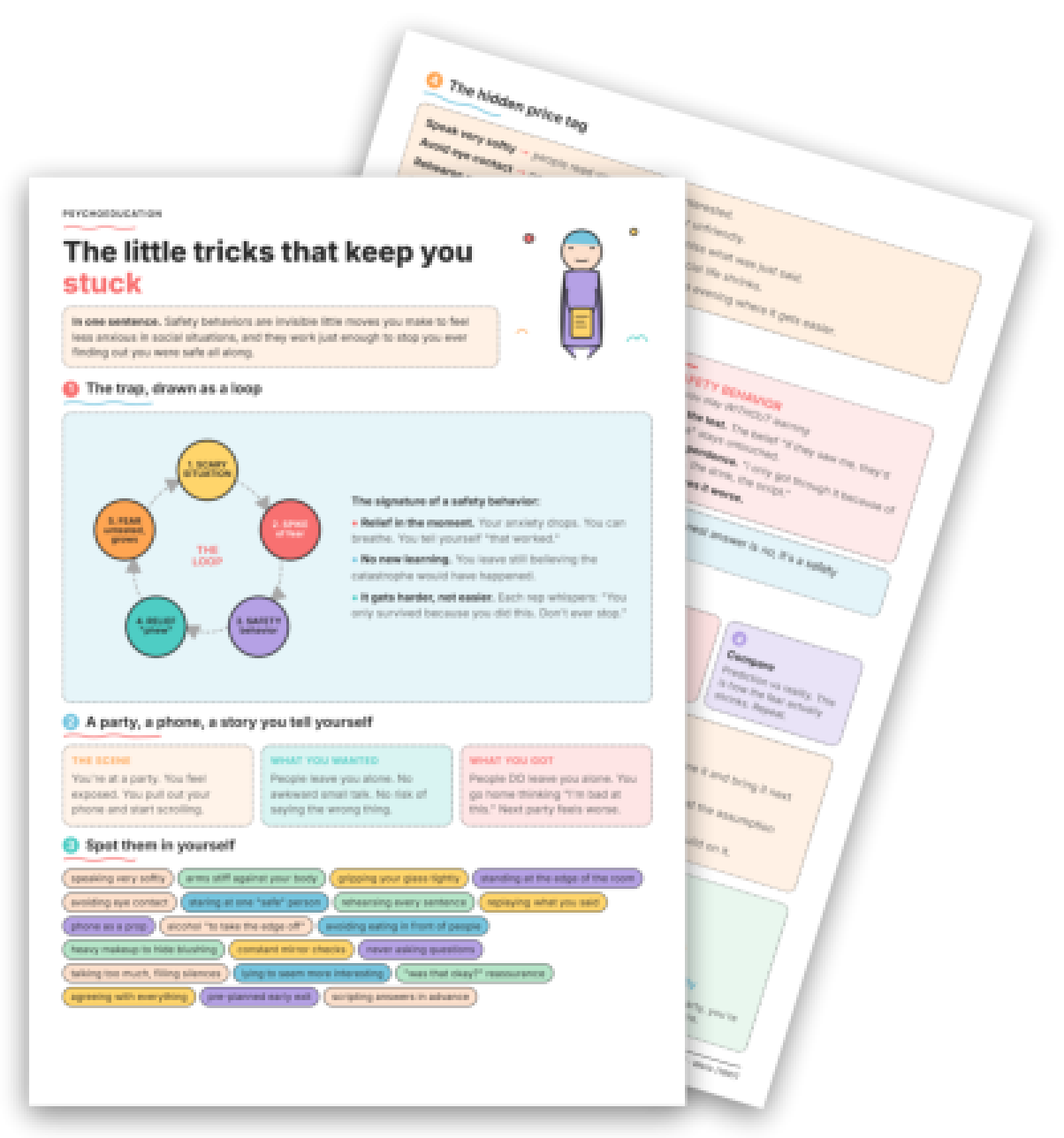
The worksheet is organized around six panels that you work through together, making it a psychoeducation tool for in-session use, not a take-home questionnaire to complete alone.
- Panel 1 draws the maintenance loop explicitly: scary situation → fear spike → safety behavior → relief → fear untested, grows. The visual makes the paradox undeniable.
- Panel 2 anchors the concept in a concrete scene: a party, a phone, a narrative that ends with "Next party feels worse", the kind of example patients recognize before you have finished reading it.
- Panel 3 is a checklist of twenty behaviors, from "speaking very softly" and "staring at one safe person" to "alcohol to take the edge off" and "scripting answers in advance." Its length matters clinically: patients who dismissed the first three items almost always pause at something on the list.
- Panel 4 maps each behavior to its unintended social cost, "Speak very softly → people read you as cold or uninterested", which opens the door to a behavioral experiment conversation.
- Panel 5 draws the explicit contrast between a real coping skill (one that tests the fear and builds evidence) and a safety behavior (one that avoids the test and builds dependence). The test question printed there, "If I had zero anxiety, would I still do this?", is one you can return to across several sessions.
- Panel 6 outlines a four-step drop-one-behavior protocol: pick one, predict specifically, drop it, compare prediction to reality. It feeds directly into a graded exposure hierarchy and complements the broader cycle of avoidance framework.
> Key takeaway: This fiche is a visual support that facilitates psychoeducation in session. The clinician uses it to make the maintaining mechanism visible and discussable, patients do not fill it in alone.
750+ clinical tools
A library built with and for clinicians, ready to use in session and extend between appointments.
Access all the toolsHow and When to Introduce It
The fiche sits naturally in sessions three to five of a CBT protocol for social anxiety disorder, once the formulation is established and the patient understands the basic fear-avoidance relationship. For patients already engaged with the social anxiety psychoeducation program, it works as a bridge toward behavioral work.
Introduce it without framing it as a confrontation. A workable opening: "I'd like to look at something together, a lot of what keeps social anxiety going happens inside situations, not just in the run-up to them. Let's see if anything here rings a bell." Then move through Panel 3 with the patient, watching for the moment they slow down. That pause is your entry point.
The fiche pairs well with safety behaviors in anxiety more broadly and with psychological safety crutches for patients who also use checking or reassurance-seeking. For those ready to act, Panel 6 connects directly to building an exposure hierarchy and the habituation psychoeducation sheet.
One contraindication worth naming: with patients who have high shame reactivity or a defectiveness schema, present the loop diagram first and anchor everything in mechanism language before asking them to self-identify behaviors. The fiche does not replace careful pacing, it makes the pacing easier by giving the conversation a structure both of you can point to.
The worksheet does not close the work on safety behaviors; it opens it. The debrief in the following session, prediction versus reality from Panel 6, is where learning actually consolidates.
Use it with your patients
Share this tool in the mobile app and follow the work between sessions.
Sources
- Clark, D. M., & Wells, A. (1995). A cognitive model of social phobia. Guilford Press.
- Salkovskis, P. M. (1991). The importance of behaviour in the maintenance of anxiety and panic: A cognitive account. Behavioural Psychotherapy, 19(1), 6-19.
- Piccirillo, M. L., Taylor Dryman, M., & Heimberg, R. G. (2019). Sub-types of safety behaviours and their effects on social anxiety disorder. PLOS ONE, 14(10), e0223165.
Your session continues in your patients' pocket
Use with a patientYour resources, available everywhere
The handouts, exercises, programs and audios above: you choose which ones to make available to your patients, in the mobile app dedicated to them.
And far more than a library
The app goes well beyond resources, to support your patients every day:
Related categories
Explore other clinical resources by category.

Anxiety
Clinical hub for anxiety disorders: CBT and ACT worksheets, psychoeducation sheets, and exercises for assessment and treatment across the anxiety spectrum.

Understand
Clinical hub for the therapeutic aim 'Understand': worksheets and tools to build patient insight across CBT, ACT, schema therapy and more.

Build awareness
Clinical worksheets and tools to build awareness in therapy: cognitive distortions, schemas, emotions, ACT and CBT resources for practitioners.

Exposure
Exposure therapy clinical resources for practitioners: worksheets, hierarchies, and psychoeducation tools for anxiety, PTSD, OCD, and avoidance-based presentations.

CBT
CBT worksheets, cognitive restructuring exercises & behavioral tools for clinicians. Evidence-based resources for every phase of cognitive behavioral therapy.

Trauma
Clinical hub on trauma and PTSD: assessment, differential diagnosis, treatment phases, and printable resources for practitioners. 155 chars.