
Clinical picture. A 34-year-old patient, referred to here as J., presented with chronic work-related exhaustion and a longstanding pattern of passive compliance: accepting additional tasks without objection, then feeling resentful and depleted by the end of each week. In session, the clinician introduced the assertiveness ladder as a structured worksheet, explaining the four communication styles and asking J. to identify her default, which she recognised immediately as passive. Together they constructed a personalised ladder, placing low-stakes situations at the base, such as declining a colleague's request to cover a lunch break, and positioning the target behaviour, telling her line manager she had reached full capacity, at the 75-rung mark. Over six weeks J. worked through the lower rungs sequentially; by session eight she reported having used a brief, calm refusal with her manager, noting that the anticipated retaliation had not materialised. The clinician acknowledged the outcome while framing it as one data point rather than a resolution, keeping expectations calibrated.
Assertiveness Ladder: PDF Worksheet, Tools and Exercises
A visual PDF worksheet clinicians can use in session to explain graduated assertiveness practice, build a personalized hierarchy, and give patients a concrete reference between appointments.
Clinical vignettes
Graded Practice for Workplace Refusals
Building Refusal Skills in Social Anxiety
Clinical picture. M., a 28-year-old graduate student, was seen for generalised social anxiety with a specific difficulty declining social invitations from his peer group; he routinely attended events he did not want to attend, then felt exhausted and irritable for days afterward. During a mid-treatment session the clinician introduced the assertiveness ladder worksheet, using the example ladder on the sheet as a reference point before shifting to M.'s own situations. M. placed turning down a free sample at a market stall at roughly the 30-rung mark and skipping an acquaintance's gathering at the 55-rung mark; refusing a close friend's repeated invitation sat near 80. He attempted the lowest rung that week and returned reporting mild discomfort but no catastrophic outcome, which allowed the clinician to use the experience as evidence against M.'s prediction that refusal would permanently damage relationships. Progress was slow and uneven on higher rungs, as the clinician had anticipated and normalised from the outset.
Teaching assertiveness in session is rarely the problem. The problem is the gap between intellectual acknowledgment ("I know I should speak up") and the first real conversation a patient actually manages differently. This PDF worksheet closes that gap by giving you and your patient a shared visual scaffold for graded assertiveness practice, built directly from the exposure logic rather than from generic advice.
Use this resource with your patients
Handout, exercises and materials ready to use, right inside SessionFuel.
Why assertiveness stalls at the explanatory stage
Patients presenting with assertiveness deficits rarely lack conceptual understanding. They can describe their avoidance, name the resentment that accumulates behind it, and articulate, often in clinical terms, what they would like to say. What they cannot do is sequence the work. Without a visible hierarchy, they either attempt the hardest conversation first and fail, or defer indefinitely under the cover of "not being ready."
There is a second, more specific obstacle: many patients conflate assertiveness with aggression. This misidentification is particularly stubborn in those presenting with approval-seeking schemas or subjugation patterns, where any firmness has historically felt dangerous. A verbal explanation of the four communication styles, however clear, rarely dislodges that equation. A side-by-side visual comparison does it faster.
The Assertiveness Ladder addresses both obstacles at once: it externalizes the exposure hierarchy and it makes the distinction between styles concrete before any practice begins.
What the fiche contains, and why the visual format matters
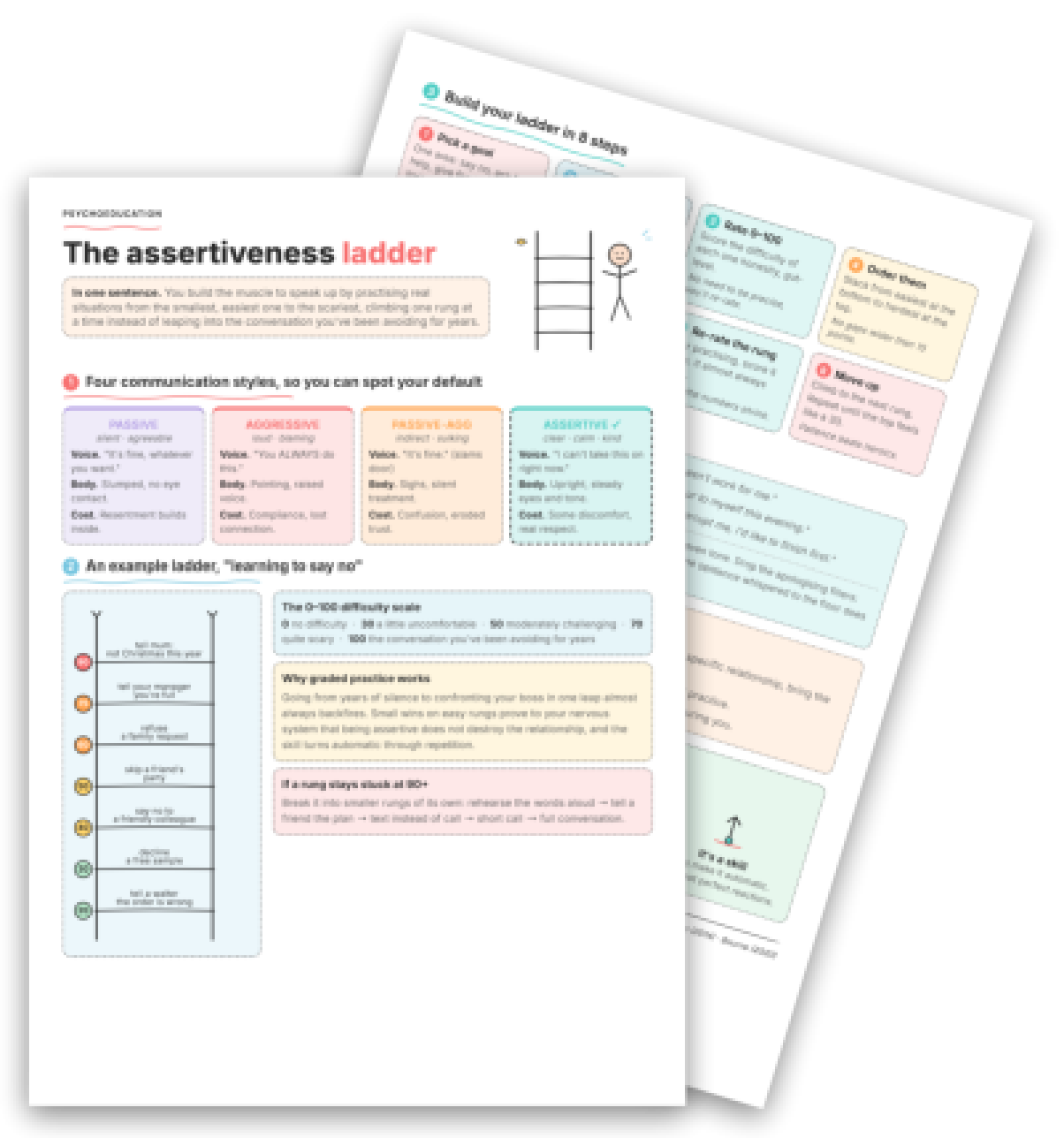
The sheet opens with a four-panel grid covering passive, aggressive, passive-aggressive, and assertive communication styles, each rendered with a sample phrase, a body posture description, and a cost. The passive panel reads "It's fine, whatever you want" against the assertive panel's "I can't take this on right now", with the associated somatic and relational costs laid out beneath each. Showing that grid to a patient produces a different conversation than reading the four styles aloud: they locate themselves in the layout rather than waiting for you to tell them where they sit.
The centerpiece is a graduated difficulty ladder anchored to a 0-100 scale (0 = no difficulty, 100 = the conversation avoided for years), illustrated by a worked example on "learning to say no" that runs from correcting a waiter's order at 20 to declining Christmas with a parent at 90. This single diagram makes the graded exposure rationale visible in a way that verbal framing rarely achieves: patients grasp immediately why they are starting at 20, not 90.
A third section walks through eight building steps: choosing a goal area (say no, ask for help, set a limit), brainstorming 8-12 real situations with specific people, rating each 0-100, ordering them with gaps no wider than 15 points, and tracking predictions against actual outcomes after each rung. The fiche also provides ready-made assertive phrases ("No, that doesn't work for me," "When you interrupt me, I'd like to finish first") and a body language section reinforcing that delivery matters as much as wording.
A closing "To discuss in session" prompt list flags exactly when patients should bring material back: when a rung stays stuck above 90, when the fear-outcome gap confuses rather than reassures, or when the default style in a specific relationship becomes clear.
> Key point: the Assertiveness Ladder is a visual support that facilitates the explanation of graduated assertiveness work in session. You use it to anchor the exposure logic, build the hierarchy together in real time, and leave the patient with a concrete reference between appointments. It is not a self-administered questionnaire.
750+ clinical tools
A library built with and for clinicians, ready to use in session and extend between appointments.
Access all the toolsWhen and how to introduce it
The fiche integrates naturally once the formulation has identified assertiveness deficits as a maintaining factor. It is relevant across a wide range of presentations: social anxiety, low self-esteem, approval-seeking patterns, and relational conflict where the patient consistently yields. Within frameworks, it maps cleanly onto Linehan's interpersonal effectiveness module (DBT), exposure-based protocols for anxiety, and schema therapy when subjugation or self-sacrifice schemas are driving avoidance.
Introduce it without labeling: "I'd like to look at a map together that we can use to plan the conversations you want to handle differently." Start with the four-style panel, ask the patient which voice they recognize, then build the ladder collaboratively. Treat the 0-100 ratings as working hypotheses, not fixed scores. The complementary resources on assertive communication and assertive body language can extend the same session if time allows, as can the Assertive Rights fiche for patients who struggle with the entitlement dimension.
Debrief focuses on the prediction-vs-outcome gap the fiche explicitly asks patients to track: "Write the prediction, then write what really happened." That gap is your primary psychoeducational lever for correcting the expectation that assertiveness destroys relationships. When a rung stays frozen, use the fiche's own suggestion to break it into sub-steps (rehearse aloud, text instead of call, short call, full conversation) rather than assigning vague homework.
One contraindication worth flagging: patients with marked perfectionism may over-engineer their ladder and defer the first rung indefinitely. Set a start date in session and set a review of the lowest rung as the only agenda item for the following appointment. For patients who freeze when confronted by aggressive communication styles, the dedicated fiche on asserting yourself with an aggressive person pairs well as a top-rung preparation tool.
The Assertiveness Ladder does not replace the therapeutic relationship or the case formulation; it makes the exposure logic portable and leaves the patient with something concrete to return to between sessions.
Use it with your patients
Share this tool in the mobile app and follow the work between sessions.
Sources
- Paterson, R. J. (2022). The Assertiveness Workbook: How to Express Your Ideas and Stand Up for Yourself at Work and in Relationships. New Harbinger Publications.
- Rakos, R. F. (1991). Assertive Behavior: Theory, Research and Training. Routledge.
Your session continues in your patients' pocket
Use with a patientYour resources, available everywhere
The handouts, exercises, programs and audios above: you choose which ones to make available to your patients, in the mobile app dedicated to them.
And far more than a library
The app goes well beyond resources, to support your patients every day:
Related categories
Explore other clinical resources by category.

Anxiety
Clinical hub for anxiety disorders: CBT and ACT worksheets, psychoeducation sheets, and exercises for assessment and treatment across the anxiety spectrum.

Mood
Evidence-based worksheets and clinical tools for mood disorders: CBT, ACT, and positive psychology resources for psychologists and therapists.

Identity
Clinical resources for self-identity work in therapy: CBT, ACT, schema tools for clinicians addressing self-concept, core beliefs, and identity disruption.

Relationships
Clinical worksheets and tools on relational functioning: attachment, schemas, assertiveness, and communication skills for therapists. Printable PDF resources.

Transitions
Clinical hub for life transitions: tools, worksheets and exercises to support psychosocial adjustment, role change and identity work in practice.

Exposure
Exposure therapy clinical resources for practitioners: worksheets, hierarchies, and psychoeducation tools for anxiety, PTSD, OCD, and avoidance-based presentations.