
Clinical picture. M., a woman in her early forties, presents with chronic work-related stress and a long pattern of passive responding when her line manager raises his voice during project reviews. She describes leaving meetings feeling humiliated, replaying the exchanges for hours afterward, and gradually doubting her own competence. The clinician introduces the psychoeducational sheet on asserting oneself with an aggressive speaker, focusing on the distinction between answering the content of an attack versus naming the form of address. M. practises the phrase 'I would appreciate a different tone' in a role-play, initially speaking very quietly; with repetition she maintains steady volume and eye contact without shifting into defensiveness. At the next session she reports having used a close variant during a meeting and, while her manager did not apologise, the exchange ended sooner and she left without the usual replay loop.
Asserting Yourself With an Aggressive Person: PDF Worksheet, Tools and Exercises
A visual PDF worksheet, concrete scripts, and clinical exercises to help patients stop defending content and start naming the form of aggressive speech.
Clinical vignettes
Redirecting Form Over Content at Work
Breaking a Defensive Justification Pattern
Clinical picture. T., a man in his late twenties, attends therapy following conflict with a partner who frequently uses dismissive, globally critical statements ('You always get things wrong'). His habitual response is to immediately supply counter-evidence, a pattern that reliably escalates the argument and leaves him exhausted. The clinician uses the worksheet to make visible how defending against content keeps T. in the position of the accused, with the partner effectively running the frame of the interaction. T. identifies 'I don't find it helpful to be spoken to that way' as a phrase that feels authentic rather than scripted, and the clinician notes his visible shift in posture when he says it aloud. In subsequent sessions T. reports applying this redirection on two occasions; escalation was shorter, and he describes a modest but meaningful sense of having kept his dignity intact.
Patients rarely struggle to understand assertiveness in the abstract. What defeats them is the moment they are actually spoken to with contempt: they either freeze into compliance or fire back with equal hostility. Neither response is what you spent three sessions building toward. This PDF worksheet on asserting yourself with an aggressive speaker is a visual support for in-session psychoeducation, designed to make the hardest part of assertiveness training concrete enough to actually stick.
Use this resource with your patients
Handout, exercises and materials ready to use, right inside SessionFuel.
Why This Concept Is So Hard to Convey Orally
The clinical block is almost always the form/content confusion. When a patient rehearses the scene in session, they replay the words that were thrown at them and immediately start drafting a counter-argument. That is the trap, and it is genuinely difficult to explain verbally without a clear visual frame.
Patients facing aggressive communication patterns typically oscillate between two endpoints: swallowing the attack entirely (passive) or escalating into reciprocal hostility (aggressive). The middle path, assertive self-positioning, is cognitively accessible but behaviourally foreign. They know they should "be assertive," but in the heat of a contemptuous exchange, the instruction disappears. The concept needs to be shown, not just described.
There is also a secondary difficulty specific to patients with social anxiety or strong approval-seeking schemas: any response that draws attention to the other person's tone feels like an escalation risk. They need to see, concretely, that naming the form is not an attack, it is a de-escalation.
750+ clinical tools
A library built with and for clinicians, ready to use in session and extend between appointments.
Access all the toolsWhat the Worksheet Contains: The Visual Architecture
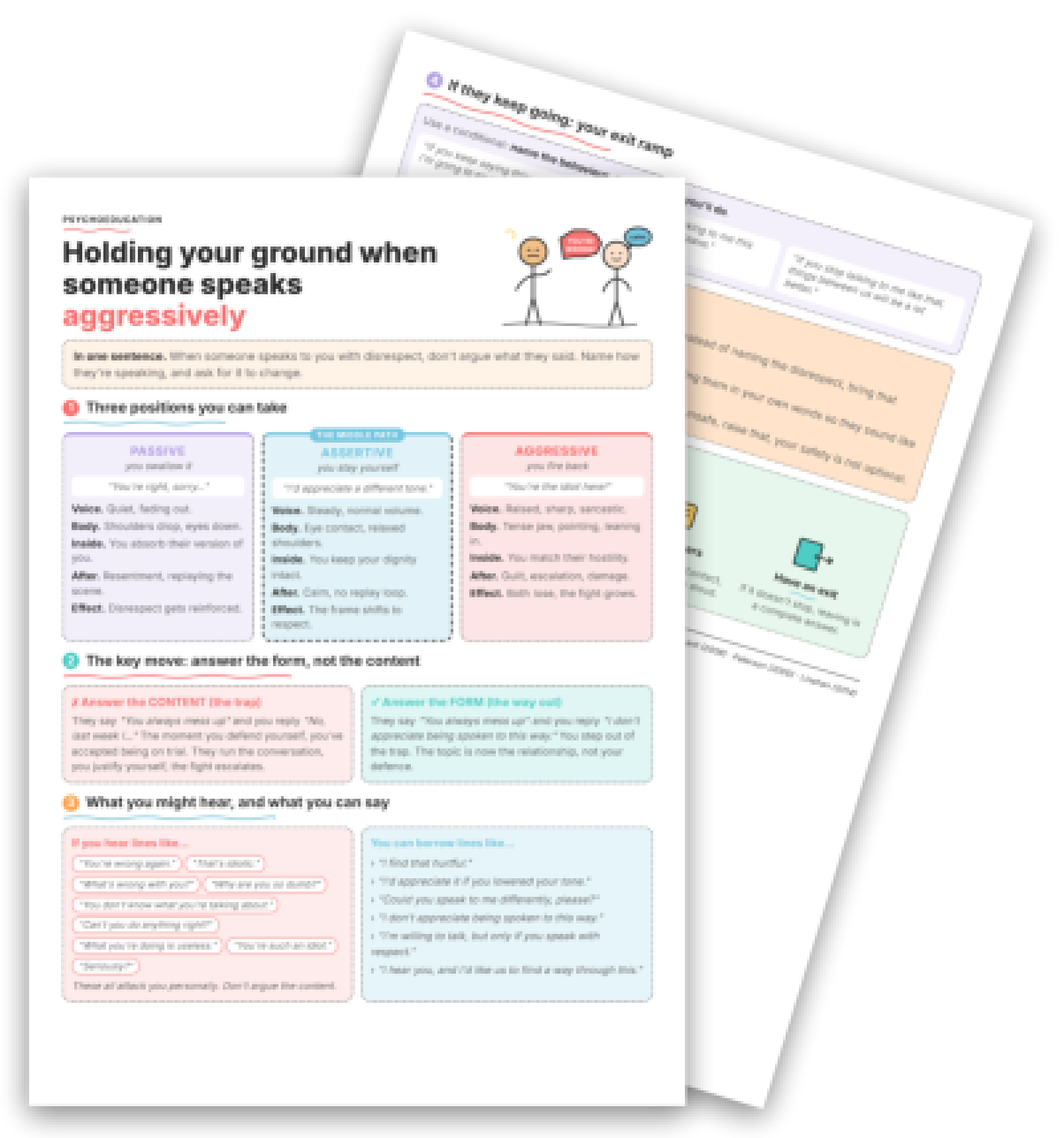
The fiche structures the concept across four panels that you can walk through with the patient in session, pausing at each.
Panel 1 lays out three behavioural positions side by side: passive ("You're right, sorry..."), assertive ("I'd appreciate a different tone."), and aggressive ("You're the idiot here!"). Each position is broken down across five dimensions: voice quality, body posture, internal experience, aftermath, and relational effect. The side-by-side format does something a spoken explanation cannot: it makes the cost of each position visible simultaneously, without the patient having to hold three separate descriptions in working memory.
Panel 2 makes the key clinical distinction explicit. It labels the content trap ("No, last week I...") and the form-based exit ("I don't appreciate being spoken to this way.") with a direct annotation: "The moment you defend yourself, you've accepted being on trial." This is the sentence worth pointing to in session. It crystallises months of assertiveness work into a single, transferable rule.
Panel 3 offers a list of typical aggressive openers ("You're wrong again," "What's wrong with you?" "Can't you do anything right?") alongside borrowable assertive replies, including "I'm willing to talk, but only if you speak with respect." These are not scripts to memorise; they are models the patient can rephrase in their own register. The worksheet also includes a "To discuss in session" block with three targeted prompts, supporting the debrief work you will do together.
Panel 4 covers the exit ramp: conditional statements that name the behaviour and name the consequence ("If you keep speaking to me this way, I'm going to leave."). For patients who struggle with interpersonal conflict resolution, seeing the exit framed as a complete and legitimate answer, not a failure, is often the reframe that shifts the whole conversation.
> Key point: the worksheet is a visual support that facilitates the in-session explanation of a concept patients routinely hear but cannot apply. It is not a self-administered questionnaire; it is what you open on the table, point at together, and leave with the patient as a concrete reference.
Use it with your patients
Share this tool in the mobile app and follow the work between sessions.
When and How to Introduce It
This fiche fits naturally into a session where you have already established a working formulation and introduced basic assertiveness skills. It is most productive after the patient has described a specific episode of aggressive speech, not before. Introducing it without a concrete trigger keeps it abstract.
For patients working through the Assertiveness Ladder, the worksheet maps onto the higher rungs: it is not about saying no to small requests, it is about holding your position under direct interpersonal pressure. With patients who struggle to use active listening without losing themselves in the other's frame, Panel 2 is the anchor point.
You can introduce it simply: "I want to show you something about what happens in your body and your words in that kind of moment, because I think seeing the three positions side by side will make it clearer than anything I could just say."
Debrief the panel on voice and body before the verbal scripts. Patients who have not practised the physical posture (steady eye contact, relaxed shoulders, normal volume) will find the words ring hollow when they try them. The fiche's reminder block covers exactly this: "Tone matters. Steady voice, eye contact, slow pace. Practise aloud."
One contraindication to name explicitly: if the patient is describing a situation where asserting themselves carries a genuine safety risk, the worksheet's own "To discuss in session" block flags this directly. Raise it before handing over the fiche, and pair it with work on anger management in the other person's context where relevant.
The fiche does not replace the relational and schema work behind chronic submissiveness or reactivity. Paired with resources on communication dynamics in close relationships or beliefs that damage relational patterns, it sits inside a larger care plan rather than standing alone. What it provides is precision: a patient who leaves the session able to point to the form/content distinction on a page they can keep is a patient who has something concrete to return to the next time the contemptuous voice appears.
Your session continues in your patients' pocket
Use with a patientYour resources, available everywhere
The handouts, exercises, programs and audios above: you choose which ones to make available to your patients, in the mobile app dedicated to them.
And far more than a library
The app goes well beyond resources, to support your patients every day:
Related categories
Explore other clinical resources by category.

Identity
Clinical resources for self-identity work in therapy: CBT, ACT, schema tools for clinicians addressing self-concept, core beliefs, and identity disruption.

Relationships
Clinical worksheets and tools on relational functioning: attachment, schemas, assertiveness, and communication skills for therapists. Printable PDF resources.

Build awareness
Clinical worksheets and tools to build awareness in therapy: cognitive distortions, schemas, emotions, ACT and CBT resources for practitioners.

Build skills
Skill-building resources for clinicians: printable worksheets and exercises for coping, assertiveness, and communication skills training in therapy.

CBT
CBT worksheets, cognitive restructuring exercises & behavioral tools for clinicians. Evidence-based resources for every phase of cognitive behavioral therapy.

Anxiety
Clinical hub for anxiety disorders: CBT and ACT worksheets, psychoeducation sheets, and exercises for assessment and treatment across the anxiety spectrum.