
Clinical picture. A, a woman in her late thirties, was referred following a depressive episode. She described feeling most distressed at family gatherings, which she found puzzling given that she was rarely physically alone. In session, the clinician introduced the informational sheet and invited her to read the distinction between aloneness and loneliness aloud, then paused at the appraisal trap section. A identified quickly with the inner script "something is wrong with me" and noted she had never considered that the script, rather than the feeling itself, was driving her withdrawal. By the following session she reported using the reframe "loneliness is a signal, not a verdict" on two occasions, with a modest but perceptible reduction in post-gathering shame.
Loneliness: PDF Worksheet, Tools and Exercises for Clinical Practice
A visual psychoeducation tool clinicians can use in session to distinguish loneliness from aloneness, reframe appraisal traps, and give patients a concrete starting point for connection.
Clinical vignettes
Naming the Appraisal, Not Just the Ache
Locating Loneliness After Relocation
Clinical picture. T, a man in his mid-forties, presented six months after relocating for work, reporting low mood and a vague sense of disconnection he struggled to label. The clinician used the textures-and-triggers section of the sheet as a starting point, asking T to circle any words on the list that felt familiar. He circled hollow ache, unseen, and restlessness, and pointed unprompted to "moving city" among the triggers. This brief exercise gave T a shared vocabulary to articulate what had previously felt formless, and the normalising framing appeared to reduce his reluctance to discuss the topic. Subsequent sessions could then move toward concrete steps rather than spending time establishing that the experience itself was legitimate.
Explaining loneliness verbally often produces polite nodding, not real recognition. Patients conflate being alone with feeling lonely, or they carry a covert belief that their loneliness is diagnostic of something shameful about them, and that belief rarely surfaces with oral explanation alone. This PDF worksheet gives you a structured visual to work from in session, so the psychoeducation lands rather than slides past.
Use this resource with your patients
Handout, exercises and materials ready to use, right inside SessionFuel.
Why Loneliness Resists Explanation in Session
The core clinical difficulty is the appraisal layer. The felt sensation of loneliness is not, in itself, what causes the most damage. What compounds it is the interpretation: "I'm broken / unlovable" versus "I'm wired for connection." When that interpretive step stays implicit, patients go home with the ache and the shame stacked on top, with no vocabulary to separate them.
A second difficulty: patients routinely present aloneness as loneliness and vice versa. Someone who isolates adaptively, a long walk, a quiet morning, may feel the same words apply, and someone sitting at a family dinner may not recognise that their hollow chest qualifies. Without a concrete visual distinction, oral explanation rarely shifts this confusion. You can name the difference a dozen times; seeing it mapped side by side does something different. This is where the defectiveness/shame schema and emotional deprivation territory often enters the room, and having shared vocabulary matters.
What the Worksheet Contains: A Visual Tool for In-Session Use
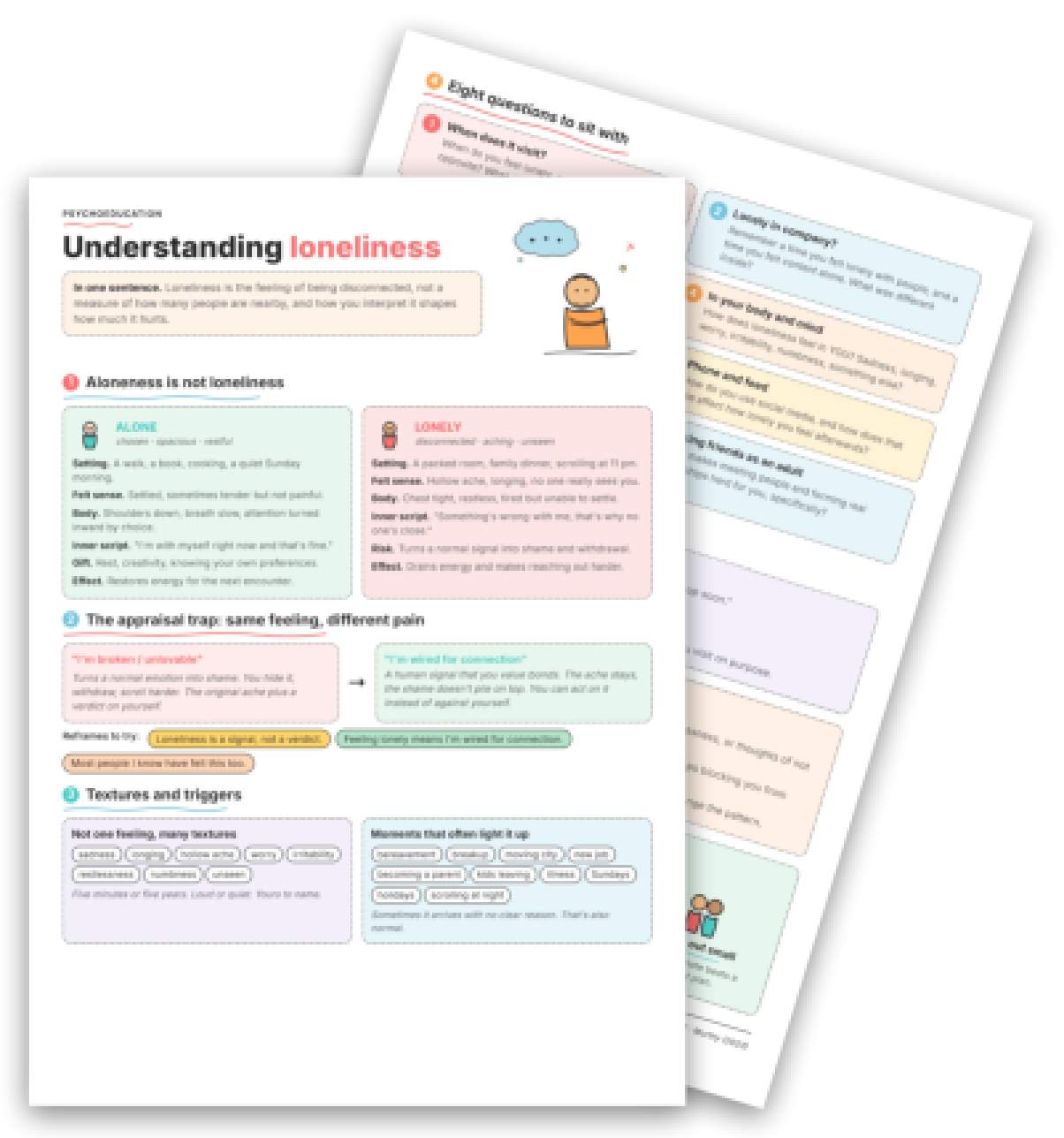
The fiche is structured across five panels, each designed to be walked through with the patient, not completed alone.
- Panel 1: Aloneness vs. Loneliness. A side-by-side comparison covering setting, felt sense, body cues, inner script, and effect on energy. The phrase "I'm with myself right now and that's fine" versus "Something's wrong with me" often stops patients mid-session. The visual layout makes the difference concrete in a way that a verbal explanation rarely does.
- Panel 2: The appraisal trap. Diagrams the fork between the shame-amplifying interpretation and the connection-signal interpretation, with three ready reframes: "Loneliness is a signal, not a verdict." Clinically, this maps cleanly onto cognitive distortion work and onto the interpretive biases you'd address in patients with social anxiety.
- Panel 3: Textures and triggers. Lists the full range of emotional textures (sadness, longing, irritability, numbness, restlessness) and common triggering contexts (bereavement, relocation, becoming a parent, scrolling at night). Useful for patients who insist they don't "feel lonely" because their presentation doesn't match the cultural image.
- Panel 4: Eight discussion questions. Organised for joint exploration in session: when does it visit, what is connected living for this patient, how does their phone use affect the ache, and, critically, do they read it as proof of flawedness. These questions integrate well with abandonment schema work or with being single reappraisal.
- Panel 5: Small experiments. Behavioural micro-tasks (send one voice note, name the feeling out loud, swap 15 minutes of scrolling for a walk) that connect naturally to screen time self-reflection work and activity menu planning between sessions.
> Key point: This worksheet is a visual support that facilitates explanation in session. It is not a self-help questionnaire the patient completes alone. Walk through it together, stop on Panel 2 if the shame loop is active, and let the patient take it home as a reference, not a task.
750+ clinical tools
A library built with and for clinicians, ready to use in session and extend between appointments.
Access all the toolsWhen and How to Propose It
The worksheet fits naturally from session two or three onward, once the presenting picture is clear. It is particularly well-suited to patients in life transitions (relocation, bereavement, parenthood, retirement), to those whose social comparison patterns drive withdrawal, or to patients with a flat sadness presentation that does not yet have a name.
A simple introduction: "I'd like to show you something that might give us a common language for what you've been describing. We'll look at it together, it's not a questionnaire."
After working through Panel 2 in session, a useful debrief question is: which interpretation do they default to, and where did that reading come from? That often opens core beliefs territory worth tracking across later sessions. Use the "To discuss in session" section at the bottom of the fiche as your clinical alert: persistent low mood, the shame loop blocking outreach, or passive scrolling that consistently worsens the ache, each signals a need to deepen the work rather than stay at psychoeducation level. Consider pairing with adaptive versus maladaptive coping work when avoidance is prominent.
The worksheet does not replace the formulation or the alliance. It makes the explanation clearer and leaves the patient with a visual anchor they can return to between sessions.
Use it with your patients
Share this tool in the mobile app and follow the work between sessions.
Sources
- Cacioppo, J. T., & Patrick, W. (2008). Loneliness: Human Nature and the Need for Social Connection. W. W. Norton & Company.
- Rokach, A. (2025). Loneliness or Solitude: How Are They Different?. OBM Neurobiology.
- Office of the Surgeon General, U.S. Department of Health and Human Services (2023). Our Epidemic of Loneliness and Isolation: The U.S. Surgeon General's Advisory on the Healing Effects of Social Connection and Community.
Your session continues in your patients' pocket
Use with a patientYour resources, available everywhere
The handouts, exercises, programs and audios above: you choose which ones to make available to your patients, in the mobile app dedicated to them.
And far more than a library
The app goes well beyond resources, to support your patients every day:
Related categories
Explore other clinical resources by category.

Anxiety
Clinical hub for anxiety disorders: CBT and ACT worksheets, psychoeducation sheets, and exercises for assessment and treatment across the anxiety spectrum.

Mood
Evidence-based worksheets and clinical tools for mood disorders: CBT, ACT, and positive psychology resources for psychologists and therapists.

Identity
Clinical resources for self-identity work in therapy: CBT, ACT, schema tools for clinicians addressing self-concept, core beliefs, and identity disruption.

Relationships
Clinical worksheets and tools on relational functioning: attachment, schemas, assertiveness, and communication skills for therapists. Printable PDF resources.

Transitions
Clinical hub for life transitions: tools, worksheets and exercises to support psychosocial adjustment, role change and identity work in practice.

Understand
Clinical hub for the therapeutic aim 'Understand': worksheets and tools to build patient insight across CBT, ACT, schema therapy and more.