
Clinical picture. A and B, a couple in their late thirties, presented with recurring arguments about household tasks that reliably escalated into mutual withdrawal. In session, A described the conflict in global terms: "He never helps, he just doesn't care." The clinician introduced the four-slot NVC structure and invited A to rework the statement, separating observable fact from interpretation. A arrived at: "When I saw the dishes still in the sink on three mornings this week, I felt tired and a bit lonely, because I need to feel we are running this home together. Would you be willing to do the dishes on weekday evenings before 10 pm?" B, who had previously disengaged when blamed, was visibly more receptive to this version and agreed to try for one week. The exchange did not resolve the underlying tension, but it gave both partners a repeatable format for raising grievances without triggering defensiveness.
Nonviolent Communication (NVC): PDF Fiche, Tools and Exercises
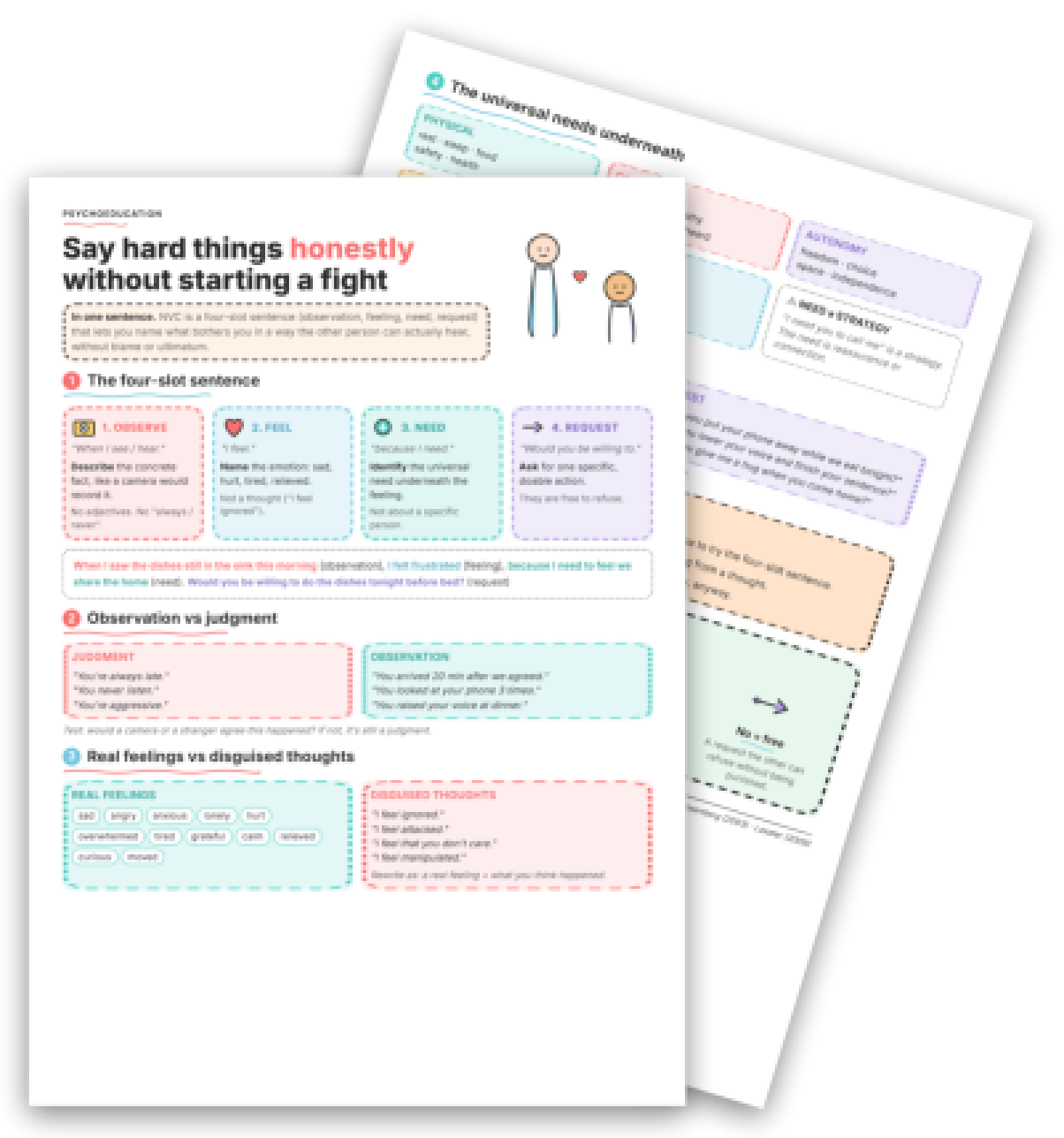
A structured PDF fiche with five visual panels to teach the NVC four-step framework in session, making observation, feeling, need, and request concrete and immediately usable.
Clinical vignettes
NVC in Couples Work: Dishes and Distance
Psychoeducation Around a Workplace Rupture
Clinical picture. C, a 44-year-old in individual therapy for anxiety, reported intense distress after a colleague publicly cut off her contribution in a team meeting. Her initial framing was "I feel attacked and invisible, which proves no one respects me here," blending emotion, interpretation, and global inference. The clinician used the informational sheet to distinguish real feelings from disguised thoughts, and helped C identify "hurt" and "embarrassed" as the actual affective states, with an underlying need to be heard. C practised drafting a request to her colleague: "When you spoke over me before I finished, I felt embarrassed, because I need my input to be considered. Would you be willing to let me complete my point next time?" C decided not to deliver the statement immediately, but found the exercise useful in reducing the rumination that had occupied her between sessions. The work shifted her focus from a global attribution about the workplace to a specific, addressable interaction.
Patients who hear the NVC framework explained verbally almost always nod at the wrong moment: they grasp the four labels (observation, feeling, need, request) but collapse the distinctions that make each slot clinically meaningful. This PDF fiche is a visual support designed to hold those distinctions in place during the explanation, giving both clinician and patient a shared reference to return to across sessions.
Use this resource with your patients
Handout, exercises and materials ready to use, right inside SessionFuel.
Why NVC Resists Oral Explanation in Session
The framework sounds deceptively simple until patients try to apply it. The failure modes are consistent and predictable. Patients routinely produce disguised thoughts where a feeling is required ("I feel ignored," "I feel attacked"), conflate a strategy with a genuine need ("I need you to call me"), or issue what functions as a demand while sincerely believing it is a request. Each of these errors is invisible to them without an external structure to check against.
Explaining the difference between observation and judgment verbally works well enough in the abstract. The moment a clinician asks the patient to apply it to a recent argument, the distinction dissolves. The same applies to the need step: without a taxonomy, patients default to person-specific complaints rather than universal underlying states. Assertive communication work faces the same problem, as does anything adjacent to I-messages training: the concept is easy to restate, hard to execute. A visual scaffold changes that.
What the Fiche Contains
The fiche is organised into five panels, each targeting one recurring breakdown point.
- Panel 1 lays out the four-slot sentence with the exact prompt for each step ("When I see / hear..."; "I feel..."; "because I need..."; "Would you be willing to..."), plus a worked example with the dishes-in-the-sink scenario.
- Panel 2 contrasts observation with judgment in two columns ("You're always late" vs. "You arrived 20 min after we agreed"), and provides the camera test: "Would a camera or a stranger agree this happened? If not, it's still a judgment."
- Panel 3 separates real feelings from disguised thoughts with a two-column list. Patients can see at a glance that "sad," "hurt," and "anxious" are feelings, while "I feel manipulated" or "I feel that you don't care" are thoughts wearing a feeling label.
- Panel 4 maps universal needs across five domains (physical, connection, autonomy, meaning, play and ease) and flags the key distinction: "I need you to call me" is a strategy. The need is reassurance or connection. This pairs naturally with behavior, emotion, and underlying need work, and the emotion wheel can serve as a complementary resource for step 2.
- Panel 5 contrasts demands with requests, ending with a clinical litmus test: "If you'd punish, sulk, or retaliate when they say no, it was a demand, not a request."
The fiche closes with three "To discuss in session" prompts that structure the debrief naturally, without requiring the clinician to improvise follow-up questions.
> Key point: this fiche is a visual support that facilitates the NVC explanation during the session itself, not a self-directed questionnaire. The panels guide the clinician's psychoeducation and leave the patient with a concrete reference to take home.
750+ clinical tools
A library built with and for clinicians, ready to use in session and extend between appointments.
Access all the toolsWhen and How to Introduce the Fiche
The fiche is most useful once the presenting relational pattern is established: typically from session two or three onward, after the initial case formulation is in place. It is particularly well suited to patients presenting with chronic couple conflict (consider pairing it with the four horsemen and their antidotes or the fair fighting rules), aggressive communication patterns, or difficulty with assertiveness (complement with the DBT DEAR MAN skill or active listening skills depending on what the patient lacks most). It also integrates well into couples communication programs and alongside work on expressing vulnerability in relationships.
To introduce it without stigmatising the patient's current communication, you might say: "I want to show you a sentence structure that researchers have found changes how the other person hears a complaint. Let's look at it together." Walk through panels 2 and 3 first, since the observation-vs-judgment and feeling-vs-thought distinctions tend to generate the most immediate recognition. Debriefing the three "To discuss in session" prompts in a follow-up appointment tracks where the patient got stuck when they tried the framework at home.
One contraindication worth naming: in situations involving active interpersonal conflict with significant power asymmetry or coercive control, NVC's "they are free to refuse" framing needs to be explicitly contextualised before the patient leaves with the fiche.
The fiche does not replace the therapeutic frame; it makes the explanation sharper and leaves the patient with a usable tool rather than a memory of what was said.
Use it with your patients
Share this tool in the mobile app and follow the work between sessions.
Sources
- Rosenberg, M. B. (2015). Nonviolent Communication: A Language of Life (3rd ed.). PuddleDancer Press.
- Center for Nonviolent Communication (CNVC). The Four Components of NVC: Observations, Feelings, Needs, Requests.
- Center for Nonviolent Communication (CNVC). Nonviolent Communication: A Language of Life - Official CNVC Product Page.
- PuddleDancer Press. Research on NVC: Peer-Reviewed Studies on Nonviolent Communication.
Your session continues in your patients' pocket
Use with a patientYour resources, available everywhere
The handouts, exercises, programs and audios above: you choose which ones to make available to your patients, in the mobile app dedicated to them.
And far more than a library
The app goes well beyond resources, to support your patients every day:
Related categories
Explore other clinical resources by category.

Identity
Clinical resources for self-identity work in therapy: CBT, ACT, schema tools for clinicians addressing self-concept, core beliefs, and identity disruption.

Emotions
Clinical resources on emotion regulation: worksheets, coping tools, CBT, REBT, and ACT exercises for therapists working across diagnoses and age groups.

Relationships
Clinical worksheets and tools on relational functioning: attachment, schemas, assertiveness, and communication skills for therapists. Printable PDF resources.

Understand
Clinical hub for the therapeutic aim 'Understand': worksheets and tools to build patient insight across CBT, ACT, schema therapy and more.

Build awareness
Clinical worksheets and tools to build awareness in therapy: cognitive distortions, schemas, emotions, ACT and CBT resources for practitioners.

Build skills
Skill-building resources for clinicians: printable worksheets and exercises for coping, assertiveness, and communication skills training in therapy.