
Clinical picture. T., a 38-year-old project manager, presented with persistent tension toward a colleague he described as 'deliberately obstructive'; sessions had circled the grievance for three weeks without movement. The clinician introduced the structured exercise as a between-session task, asking T. to work through each prompt in writing before the next appointment. At question four, T. noted for the first time that his colleague may have withheld information because she feared losing credit for the project, a perspective he had not previously entertained. He returned to the following session visibly less rigid, reporting that he had initiated a brief conversation with her and that the tone had shifted; no resolution had been reached, but the interaction was no longer purely adversarial.
Interpersonal Conflict Resolution: A Guided Clinical Exercise
A structured between-session tool helping patients navigate active conflicts through perspective-taking, emotional regulation, and genuine compromise.
Clinical vignettes
Workplace Conflict, Regulatory Avoidance
Family Rupture, Partial Re-engagement
Clinical picture. M., a woman in her mid-fifties, had not spoken to her adult son in four months following a dispute over a family estate; she reported feeling both wronged and stuck. Her therapist offered the exercise as a way to examine the conflict at her own pace, outside the session. Working through question three, M. identified that her tendency to rehearse accusations before any conversation was actively preventing de-escalation, and that she had little awareness of this pattern until she wrote it down. Question five proved difficult: she initially listed no concessions, then revised the page twice overnight. At the next session she did not report reconciliation, but she had drafted a short, factual message to her son and had not sent anything impulsive in the weeks prior.
Why conflict is so hard to work through with words alone
When a patient arrives with an unresolved interpersonal conflict, they are rarely short of emotion. What they are short of is structured thinking. The heat of the dispute collapses their capacity to separate what they feel from what they want to say, to hold the other person's position alongside their own, and to locate a compromise they can actually live with. Talking about conflict in a consultation is useful; working through one in writing, with guided questions, is a different kind of cognitive labour.
The specific challenge is that emotional reactivity and perspective-taking pull in opposite directions during active conflict. Patients default to defending content and miss the relational layer entirely. Verbal explanation alone rarely installs the pause required to shift that dynamic. A structured written exercise creates the pause and gives it direction. Tools such as the Nonviolent Communication (NVC): PDF Fiche, Tools and Exercises or the Fair Fighting Rules: PDF Worksheet, Tools and Exercises for Clinical Practice can frame the theory; this exercise is where the patient applies it to their specific, live situation.
Use this resource with your patients
Handout, exercises and materials ready to use, right inside SessionFuel.
What this exercise contains
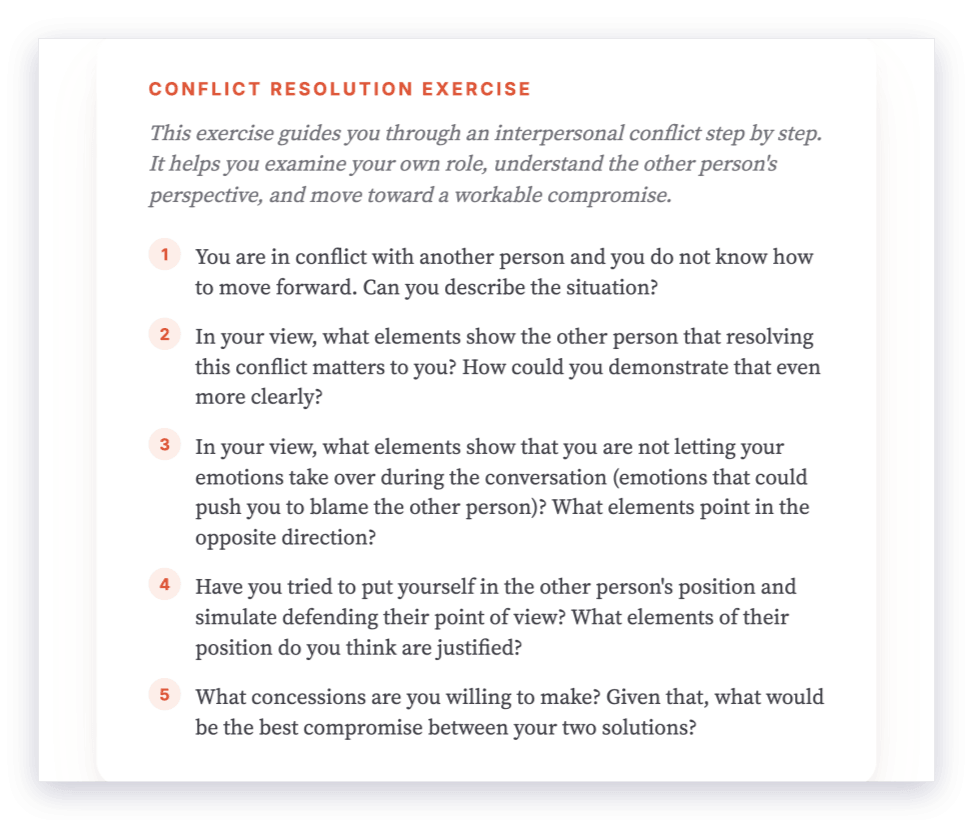
The exercise opens by asking the patient to describe the conflict situation in their own words (question 1). This narration step is not incidental: it slows the patient down and forces a degree of precision that raw emotion usually prevents.
Questions 2 and 3 then work two underexplored angles. Question 2 invites the patient to reflect on how they are signalling commitment to resolution and what more they could do. Question 3 asks them to examine both the elements that keep emotion in check and those that push them toward blaming. This mirrors the clinical work of the Anger Iceberg: PDF Worksheet, Tools and Exercises and the Feel, Reflect, Act Differently: PDF Worksheet, Tools and Exercises, but applied in real time to an ongoing conflict.
Question 4 is where perspective-taking becomes explicit: the patient is asked to actually simulate the other person's argument and identify what they genuinely find valid in it. This is structurally close to what the Conflict in Romantic Relationships: A Psychoeducation Program covers at the psychoeducation level, but here the patient must do the cognitive work themselves, autonomously, which is clinically quite different.
Question 5 brings the sequence to a concrete negotiation stance: what concessions is the patient willing to make, and what does the best available compromise look like given everything they have just written?
This exercise is available to your patients through the patient app of SessionFuel, the mobile application reserved for patients of clinicians who use SessionFuel. You assign it as homework directly from your account, and your patient then completes it on their own, on their phone, between sessions.
The image above lists the five questions in sequence. Note that this image is a static preview of the exercise structure only. The full guided experience, including patient-facing instructions and answer space for each question, is delivered autonomously through the app and does not appear here.
Key insight: The value of this exercise is not in the answers themselves but in the sequence: commitment to resolution, then emotional monitoring, then genuine perspective-taking, then compromise. Patients who skip that order rarely land on workable solutions.
750+ clinical tools
A library built with and for clinicians, ready to use in session and extend between appointments.
Access all the toolsHow to assign and use this as between-session homework
This exercise suits a broad range of presentations: couples therapy, individual work on relational conflict, assertiveness training, and anger management. It is particularly well-suited to patients who intellectually understand constructive conflict principles but repeatedly lose that understanding the moment a real dispute starts.
Introduce it between sessions when a patient raises an active, unresolved conflict. Frame it plainly: before the next appointment, complete these questions about that specific situation. You are not looking for resolution yet; you are looking for structured reflection. Pairing it with Relationship Conflict Resolution: PDF Worksheet, Tools and Exercises as a psychoeducational reference can help the patient understand why the sequence matters.
When the patient returns, their written answers become your primary clinical material. Question 3 is often the richest entry point: the gap between "what helps me stay regulated" and "what pushes me to blame" maps directly to the work. If the patient struggled with question 4, that difficulty is itself diagnostically valuable. It may open work on related patterns such as those explored in Need to Be Right: A Guided Exercise on Relational Conflict or Ego and Pride: A Guided Exercise on Competitive Self-Image.
For patients working on compromise specifically, this exercise pairs naturally with the Compromise in Relationships: A Psychoeducation Program. For those whose emotional flooding is the primary obstacle, the Guided Anger Self-Reflection: A Structured Clinical Exercise or the Identifying Emotional Triggers: PDF Worksheet, Tools and Exercises can precede or accompany this one.
Use it with your patients
Share this tool in the mobile app and follow the work between sessions.
Articulation with other clinical tools
When the conflict involves a relational pattern rather than a single episode, the exercise connects well upstream to Behavior, Emotion, Underlying Need: PDF Worksheet, Tools and Exercises and downstream to Soft Startups for Couples: PDF Worksheet, Tools and Exercises or How to Apologize: PDF Worksheet, Tools and Exercises for Clinical Practice. If the conflict touches a deeper perceived injustice, the Perceived Injustice in Therapy: A Guided Cognitive Exercise offers a complementary angle. The Four Horsemen and Their Antidotes: PDF Worksheet, Tools and Exercises can help patients recognize which destructive patterns their own conflict is reproducing before they attempt the conversation again.
Your session continues in your patients' pocket
Use with a patientYour resources, available everywhere
The handouts, exercises, programs and audios above: you choose which ones to make available to your patients, in the mobile app dedicated to them.
And far more than a library
The app goes well beyond resources, to support your patients every day:
Related categories
Explore other clinical resources by category.

Emotions
Clinical resources on emotion regulation: worksheets, coping tools, CBT, REBT, and ACT exercises for therapists working across diagnoses and age groups.

Relationships
Clinical worksheets and tools on relational functioning: attachment, schemas, assertiveness, and communication skills for therapists. Printable PDF resources.

Cognition
Printable cognitive therapy worksheets and clinical tools for therapists: CBT, ACT, schema work, defusion, distortions, and belief restructuring.

Build skills
Skill-building resources for clinicians: printable worksheets and exercises for coping, assertiveness, and communication skills training in therapy.
CBT
CBT worksheets, cognitive restructuring exercises & behavioral tools for clinicians. Evidence-based resources for every phase of cognitive behavioral therapy.

Solution-focused
Clinical hub for Solution Focused Therapy resources: worksheets, exercises and programs for goal-oriented, strengths-based practice across individual and couple work.