
Clinical picture. M., a man in his mid-forties, presented with chronic irritability and recurrent arguments with his wife over parenting decisions, which he described as clear-cut matters where she was simply wrong. In session, the clinician introduced the guided exercise, beginning with the first question: M. was asked to describe one specific disagreement in concrete terms rather than global accusations. Working through questions two and three, he identified that his insistence on being right was linked to a long-standing fear that yielding would signal weakness, and he slowly acknowledged that his wife's position reflected a different but coherent set of priorities around autonomy and risk. By the fourth question, he could articulate one concrete benefit of softening his stance, namely that arguments tended to end sooner and he felt less physically tense afterward, which gave the therapist a workable behavioural anchor for the following session.
Need to Be Right: A Guided Exercise on Relational Conflict
Help patients examine the compulsion to win arguments, explore value differences, and build genuine tolerance for another's viewpoint.
Clinical vignettes
Marital Conflict and the Need to Win
Workplace Dispute and Value Differences
Clinical picture. T., a woman in her early thirties, was referred following repeated interpersonal difficulties at work, centred on a prolonged dispute with a colleague over project methodology; she was certain her approach was objectively superior. The clinician used the exercise as a between-session task, asking T. to write responses to each of the four questions before the next appointment. Her written answers revealed that winning the argument had become tied to her professional identity and to a belief that competence must be visibly defended to be recognised. Question three proved most generative: T. noted, with some reluctance, that her colleague valued collaborative consensus whereas she valued efficiency, and that neither criterion was self-evidently correct. At review, she reported that reframing the conflict as a difference in values rather than a factual error had reduced her rumination noticeably, though she remained cautious about applying this perspective consistently.
The Clinical Knot: When Being Right Feels Non-Negotiable
Patients rarely arrive saying "I have a problem with needing to win." They arrive furious at a partner, estranged from a sibling, or locked in a standoff with a colleague, certain the other person is simply wrong. That certainty is the clinical problem, and it resists direct confrontation. Push back too early, and you become another person the patient needs to defeat.
What makes this pattern especially difficult to work with verbally is that the patient experiences their position as factual, not as one perspective among several. The emotional investment in being right often conceals deeper drivers: a need for control, a fragile self-worth that cannot absorb being wrong, or ego-driven relational patterns that erode closeness over time. Similar dynamics surface in perceived injustice rumination and in the tendency to devalue others as a way of shoring up one's own position. What a guided exercise can do that a conversation alone often cannot: create structured distance from the hot conviction, and open a crack for reflection.
Use this resource with your patients
Handout, exercises and materials ready to use, right inside SessionFuel.
What the Exercise Contains
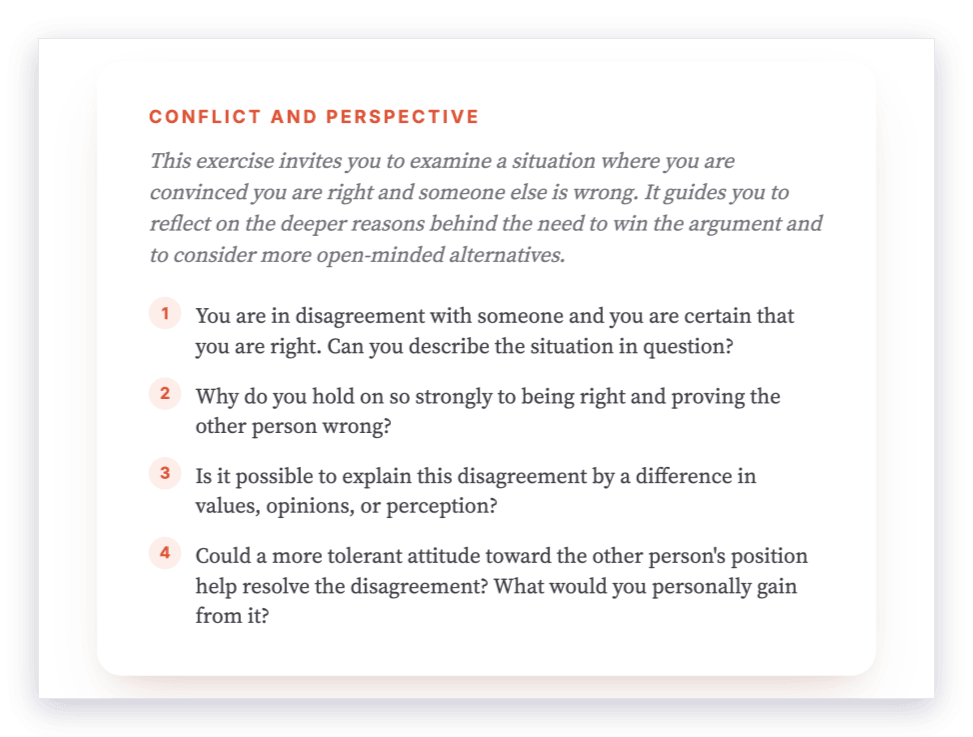
The exercise is built around four sequential questions that move the patient from description to motivation to reframing.
The first question asks patients to describe the disagreement specifically, who, what, what certainty they are carrying. This situational anchoring is deliberate: it grounds reflection in a real event rather than a generalized grievance.
The second question presses further: why does being right, and proving the other wrong, matter this much? This is where the work becomes genuinely clinical. The question surfaces the underlying motivational structure, whether it is pride, a demanding standard that others must share, a need for external validation, or something older. It connects naturally to the kind of absolute inner rules that REBT maps as rigid demands.
The third question introduces the reframe: could this disagreement be explained by a difference in values, opinions, or perception rather than one person being objectively right? This single move shifts the register from factual dispute to perspectival difference, echoing the work done by a perspective-taking framework and countering the global judgments that often accompany the need to be right.
The fourth question closes the loop by inviting the patient to consider what a more tolerant stance toward the other's position might actually yield for them personally. The personal-gain framing is strategic: it bypasses moral argument and asks the patient to evaluate the cost of their current position on purely pragmatic grounds.
The image above lists the four questions in order with a brief introductory note. It is a static visual preview only. The full guided exercise, with patient-facing instructions and space to write responses, is experienced by the patient autonomously in the app, not in this image.
This exercise is available to your patients through the mobile application that is the dedicated patient-side interface of SessionFuel: you assign it to a patient in your SessionFuel account, and they complete it directly on their phone, on their own, between appointments.
750+ clinical tools
A library built with and for clinicians, ready to use in session and extend between appointments.
Access all the toolsUse it with your patients
Share this tool in the mobile app and follow the work between sessions.
Integrating It as Between-Session Homework
This exercise fits patients who are stuck in a relational conflict, where sessions have mapped the dynamic but insight has not yet shifted behavior. It is particularly well suited to work on couple friction (alongside the Conflict in Romantic Relationships program or the Mental Load Imbalance exercise), to individual patients with a pattern of rigid "should" thinking applied to others, and to anyone whose interpersonal style tends toward winning rather than connecting.
To introduce it, you can be direct: "There's an exercise I'd like you to do before our next appointment. It asks you to look at one situation where you're convinced you're right, not to tell you that you're wrong, but to help us understand what's at stake for you in that conviction." Framing it as an act of curiosity rather than a challenge to their position lowers resistance significantly.
When the patient returns, the written responses open specific clinical territory. The answer to question two is often the most revealing: it shows whether the need to be right is primarily about self-worth, relational control, or a genuine values clash. Question three sometimes produces the patient's first real acknowledgment that the other person's position has its own internal logic. Question four, if the patient engages with it honestly, can be used to begin building the motivation for a behavioral shift that neither persuasion nor psychoeducation alone could create.
Key insight: The clinical lever in this exercise is not the reframe itself but the patient's own written answer to why being right matters so much, that answer is where the real schema work begins.
For patients whose conviction involves harsher relational moves, pairing this exercise with the Fair Fighting Rules fiche or the Aggressive Communication worksheet gives the next concrete step once reflection has opened.
Your session continues in your patients' pocket
Use with a patientYour resources, available everywhere
The handouts, exercises, programs and audios above: you choose which ones to make available to your patients, in the mobile app dedicated to them.
And far more than a library
The app goes well beyond resources, to support your patients every day:
Related categories
Explore other clinical resources by category.

Identity
Clinical resources for self-identity work in therapy: CBT, ACT, schema tools for clinicians addressing self-concept, core beliefs, and identity disruption.

Relationships
Clinical worksheets and tools on relational functioning: attachment, schemas, assertiveness, and communication skills for therapists. Printable PDF resources.

Cognition
Printable cognitive therapy worksheets and clinical tools for therapists: CBT, ACT, schema work, defusion, distortions, and belief restructuring.

CBT
CBT worksheets, cognitive restructuring exercises & behavioral tools for clinicians. Evidence-based resources for every phase of cognitive behavioral therapy.

Anxiety
Clinical hub for anxiety disorders: CBT and ACT worksheets, psychoeducation sheets, and exercises for assessment and treatment across the anxiety spectrum.

Trauma
Clinical hub on trauma and PTSD: assessment, differential diagnosis, treatment phases, and printable resources for practitioners. 155 chars.