
Clinical picture. M., a man in his early forties, was referred following repeated complaints from coworkers about dismissive, cutting remarks during team meetings. He presented with a driven, high-achieving style and limited insight into how his comments landed on others. The clinician introduced the five-question exercise as a between-session task, asking M. to focus on the most recent incident flagged by a colleague. At the next session, M. returned having written that he had been trying to impress his manager during that meeting and acknowledged, with some reluctance, that criticising a peer's proposal had felt briefly satisfying. This small opening allowed the clinician to begin exploring the link between his need to appear competent and the compulsive pull to diminish others when he felt his position was uncertain.
Putting Others Down: A Guided Self-Reflection Exercise
A structured five-question homework tool helping patients examine the habit of devaluing others and its roots in fragile self-worth.
Clinical vignettes
Belittling Colleagues, Fragile Self-Worth
Devaluing Others, Seeking Validation
Clinical picture. L., a woman in her late twenties presenting with recurrent relational difficulties, reported that several close friends had distanced themselves after describing her as condescending. She had partial awareness of the pattern but attributed it mostly to others being oversensitive. The clinician offered the guided self-reflection questions as written homework, inviting L. to answer honestly without filtering for a desired image. When she returned the following week, question five had produced the most material: she had written at length about how much weight she gave to others' opinions of her, and how putting friends down seemed to reduce that weight temporarily. Subsequent sessions used her written responses as a starting point to examine the relationship between self-acceptance and her habit of measuring herself against those around her.
Why this pattern is hard to address clinically
Few relational behaviors generate as much interpersonal friction as the tendency to belittle, dismiss, or devalue others, and few are as difficult to bring into the consulting room productively. Patients who engage in this pattern rarely present it as a problem they own. They describe conflict, broken relationships, and social feedback they find unfair. The link between devaluing others and an underlying struggle with self-worth is not intuitive to them, and a verbal explanation alone often triggers defensiveness.
Clinically, this behavior sits at the intersection of several overlapping constructs: entitlement and grandiosity patterns, compensatory coping in schema therapy, fragile self-esteem maintained by comparison, and interpersonal belief systems that read others as threats or as audiences. What makes it especially tricky is that the patient's need to put others down is almost always serving a function, typically, propping up a self-image that feels too precarious to stand on its own. Naming that function in session is one thing; having the patient sit with it and explore it honestly is another.
A guided written exercise, completed autonomously between sessions, removes the interpersonal heat of the consultation. It gives the patient a contained space to examine what they actually do, and why.
Use this resource with your patients
Handout, exercises and materials ready to use, right inside SessionFuel.
What the exercise contains
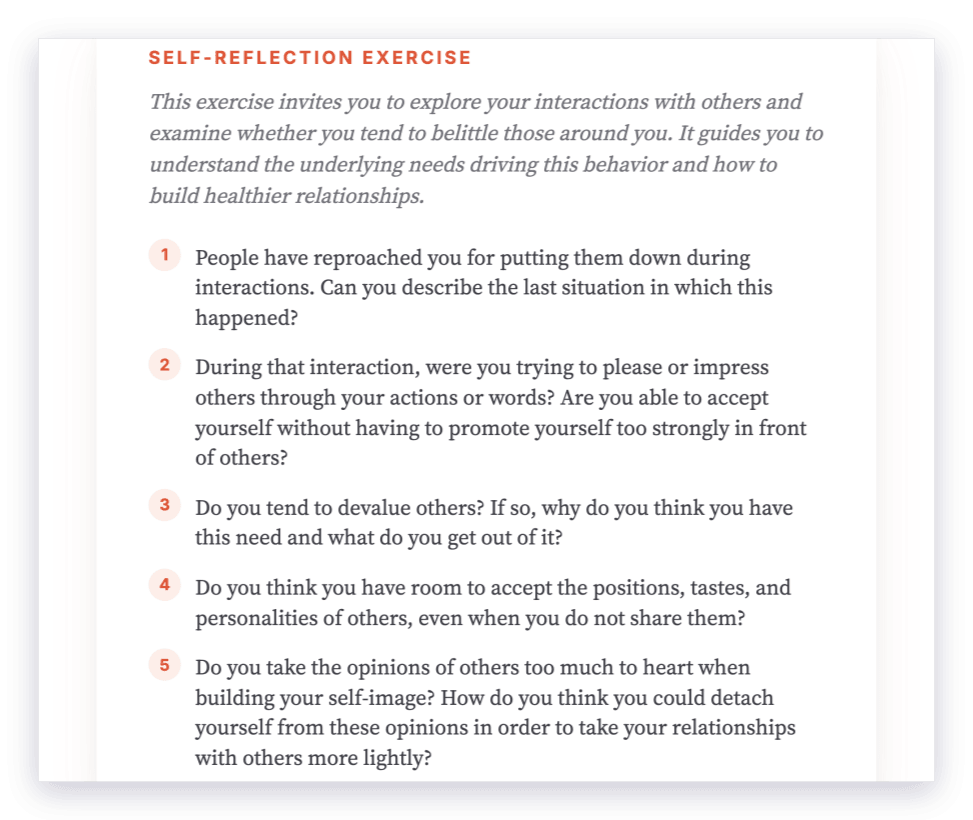
The tool moves through five structured questions, each targeting a distinct layer of the pattern.
The first question asks the patient to describe a concrete recent situation in which someone accused them of putting them down. Grounding the work in a real episode sidesteps abstraction and prevents intellectualization. The second question pushes directly into the self-worth dynamic: it asks whether, in that interaction, the patient was trying to please or impress, and whether they can accept themselves without needing to stand out. This is the pivot point of the exercise, connecting the interpersonal behavior to the approval-seeking schema underneath.
The third question asks patients to examine whether they habitually devalue others, and to name what they get from it, a rare and productive moment of self-scrutiny. The fourth broadens the lens to tolerance of difference: positions, tastes, personalities that are simply not theirs. Patients with a strong disqualifying-others filter often find this question uncomfortable in an informative way. The fifth closes the loop by returning to self-construction: how much does the patient rely on others' opinions to build their self-image, and what would it mean to hold those opinions more lightly?
Together, the five questions trace the arc from behavior to underlying need, which is exactly the clinical work you are trying to advance.
Note: this image is a static preview of the question list. The full guided exercise, with patient-facing instructions and space to write, is experienced by the patient autonomously in the app, not in this image.
This exercise is available to patients through the mobile patient app of SessionFuel: once you assign it, your patient receives it directly on their phone and completes it on their own, between appointments, without needing you to be present.
Key insight: When a patient devalues others, they are almost always also devaluing themselves, just louder, outward, and without realizing it. The exercise makes that loop visible.
750+ clinical tools
A library built with and for clinicians, ready to use in session and extend between appointments.
Access all the toolsUse it with your patients
Share this tool in the mobile app and follow the work between sessions.
How to integrate it as between-session homework
Assign this exercise between two sessions once the patient has acknowledged, however minimally, that others have reacted negatively to their behavior. You do not need full insight at the point of assignment, curiosity is enough.
It suits patients presenting with relational conflict, social feedback about arrogance or contempt, or patterns recognizable as entitlement schema, approval and admiration seeking, or constant social comparison. It is also useful with patients who intellectualize in session: the written format slows them down and catches what live conversation does not.
To introduce it, frame it neutrally: "People have been telling you something about how they experience you. This exercise gives you space to look at that on your own, without any pressure." Avoid framing it as corrective at this stage.
When the patient brings their responses back, the most clinically rich material will usually be in their answers to questions two and five, the self-worth and opinion-dependency items. Those are your entry points for schema maintenance work, for exploring 12 beliefs that damage relationships, or for opening a thread toward self-acceptance. The exercise on ego-driven and competitive patterns pairs naturally as a follow-up assignment if the patient shows readiness to go deeper.
A patient who returns having genuinely engaged with question three, the one asking what they gain from devaluing others, has already done significant therapeutic work. That answer is worth building an entire session around.
Your session continues in your patients' pocket
Use with a patientYour resources, available everywhere
The handouts, exercises, programs and audios above: you choose which ones to make available to your patients, in the mobile app dedicated to them.
And far more than a library
The app goes well beyond resources, to support your patients every day:
Related categories
Explore other clinical resources by category.

Identity
Clinical resources for self-identity work in therapy: CBT, ACT, schema tools for clinicians addressing self-concept, core beliefs, and identity disruption.

Relationships
Clinical worksheets and tools on relational functioning: attachment, schemas, assertiveness, and communication skills for therapists. Printable PDF resources.

Cognition
Printable cognitive therapy worksheets and clinical tools for therapists: CBT, ACT, schema work, defusion, distortions, and belief restructuring.

Build awareness
Clinical worksheets and tools to build awareness in therapy: cognitive distortions, schemas, emotions, ACT and CBT resources for practitioners.
CBT
CBT worksheets, cognitive restructuring exercises & behavioral tools for clinicians. Evidence-based resources for every phase of cognitive behavioral therapy.

Schema therapy
Schema therapy clinical resources for practitioners: worksheets, exercises, and programs targeting early maladaptive schemas, core beliefs, and schema modes.