
Clinical picture. M., a man in his late forties, was referred following a formal grievance he had filed against a junior colleague who had received a promotion he believed was rightfully his. He presented the situation with little curiosity about his own role, framing every organisational process that had excluded him as evidence of bad faith. In session, the clinician introduced the informational sheet on the entitlement schema and invited M. to read the "pure" flavour aloud, pausing at the line ordinary doesn't apply to me. M. was quiet for several seconds before noting, with some discomfort, that he had never heard his own thinking described so plainly. He did not endorse the pattern in full, but agreed to track moments during the week when a "no" produced a disproportionate physical reaction, which opened a workable entry point for schema exploration.
Entitlement Schema: PDF Worksheet, Tools and Exercises for Clinicians
A visual psychoeducation tool helping clinicians explain the entitlement pattern in session, name its three variants, and open productive therapeutic work.
Clinical vignettes
Pure Entitlement in a Workplace Conflict
Fragile Entitlement and Fear of Ordinariness
Clinical picture. T., a woman in her mid-thirties presenting with recurrent low mood and relational instability, described a persistent sense that she needed to be exceptional to be loved. She alternated between periods of visible high achievement and collapses of self-worth when she felt overlooked, a cycle that had cost her two significant relationships. The clinician shared the psychoeducational sheet on the entitlement schema and drew her attention to the fragile variant, particularly the phrase ordinary equals unloved. T. recognised the pattern quickly and located its origin in a childhood in which parental warmth had been strongly conditional on performance. She found the framing non-shaming, which allowed her to approach the underlying fear of being unremarkable as a clinical focus rather than defending against it.
Introducing the entitlement schema verbally in session tends to stall. Patients either agree too readily (intellectualising the concept without feeling its grip) or become defensive the moment they hear it framed as a character problem. This fiche PDF gives you a structured, non-shaming visual to anchor the psychoeducation and move the conversation somewhere genuinely useful.
Use this resource with your patients
Handout, exercises and materials ready to use, right inside SessionFuel.
Why the Entitlement Schema Is Hard to Explain in Session
The central difficulty is relational: naming entitlement as a pattern the patient holds often triggers the very dynamic you are trying to name. Patients operating from a pure entitlement mode may dismiss the framing as irrelevant to them; those with a fragile variant may hear a global indictment and cycle into shame or compensation. And many clinicians, managing the therapeutic alliance, soften the concept so much that nothing lands.
A second obstacle is that entitlement is phenomenologically opaque to the person carrying it. From the inside, the pattern does not feel like grandiosity; it feels like accuracy. The patient genuinely experiences a "no" as unfair, feedback as an attack, and peer success as a slight. Without a concrete visual map showing the cognitive, somatic, and relational features of the schema, the oral explanation rarely breaks through that felt certainty.
The fiche addresses this by framing the schema explicitly as a learned shape that can soften, not a moral verdict, which reduces reactivity and keeps the alliance intact while the clinical work begins.
750+ clinical tools
A library built with and for clinicians, ready to use in session and extend between appointments.
Access all the toolsWhat the Fiche Contains: A Visual Map for In-Session Explanation
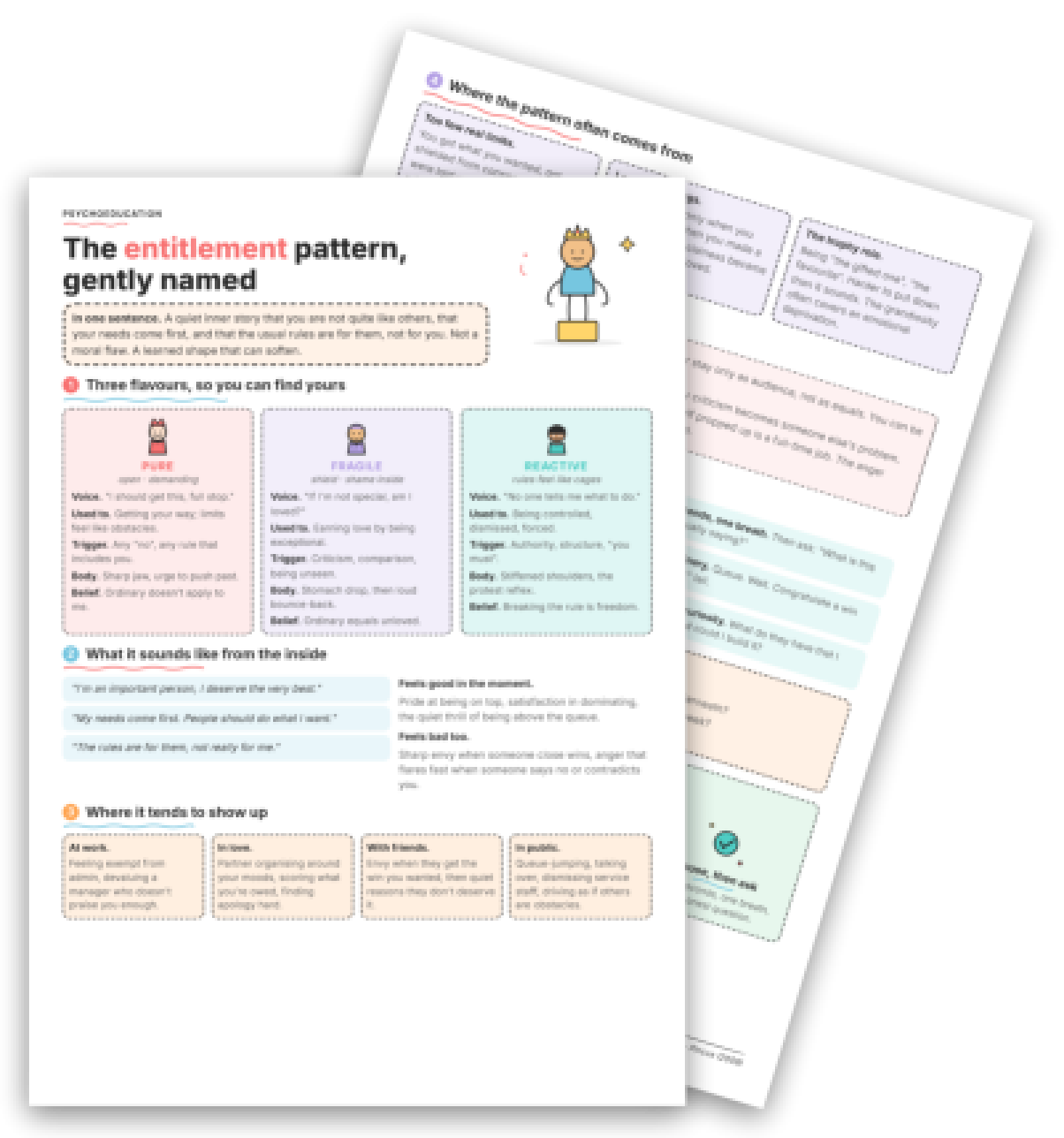
The printable organises content across six panels that you work through together with the patient, not a questionnaire they complete alone. The core of the visual support is a three-variant typology that immediately helps patients locate themselves:
- Pure (open and demanding): the voice "I should get this, full stop"; body cue of a sharp jaw and an urge to push past; triggered by any refusal or rule that includes them.
- Fragile (shield over shame): the voice "If I'm not special, am I loved?"; a stomach-drop followed by a loud bounce-back; triggered by comparison, criticism, or being unseen.
- Reactive (rules as cages): the voice "No one tells me what to do"; stiffened shoulders and a protest reflex; triggered by authority or imposed structure.
Rendering these three variants as parallel columns on a single page does something an oral explanation cannot: the patient sees their own variant without feeling uniquely pathologised. Patients who recognise themselves in the fragile column in particular often experience measurable relief, because the fiche makes visible the shame underneath the entitlement pattern that drove the compensation in the first place.
The subsequent panels map where the pattern shows up (work, love, friendships, public contexts), developmental origins (insufficient real limits, love conditionalised on achievement, the trophy role), hidden costs (relational thinning, stalled feedback integration, exhaustion of maintaining the superior self), and six concrete softening moves ranging from catching the somatic cue to clean apology. The closing section, To discuss in session, gives you three ready prompts: "When you notice the 'how dare they' heat rising, what does it usually protect underneath?"
> Key point: this fiche is a visual psychoeducation support that you use during the session to make a resistant concept legible; it is not a self-administered checklist, and its clinical value depends on the therapist-guided reading.
The layout pairs well with early maladaptive schema work and with exploration of schema coping styles. For patients where the entitlement pattern co-occurs with emotional deprivation, the developmental section of the fiche is particularly generative.
Use it with your patients
Share this tool in the mobile app and follow the work between sessions.
When and How to Introduce the Fiche in Session
Timing. The fiche fits best once the alliance is solid enough to sustain mild confrontation, typically from the third or fourth session onward, or at the point in a longer treatment where relational friction (in or outside sessions) has surfaced as a clinical theme.
Profiles. Consider it for patients presenting with recurring conflict at work or in couples, difficulty with apology, persistent envy, or patterns of devaluing others. It is also well suited for cases where ego-driven conflict or difficulty tolerating disagreement are central complaints.
Introduction. A low-reactivity framing: "I'd like us to look at something together. There's a pattern that develops very early, often in response to how we were loved. I want to show you a map of it and see which, if any, of the descriptions resonates." This positions the fiche as exploratory, not diagnostic.
Debrief. After reading through the three variants, ask which column (or combination) the patient recognises. Then move to the somatic cue panel and the developmental origins. The three To discuss in session prompts on the fiche are designed to carry the debrief directly into formulation work. For patients ready to work on assertive rather than aggressive communication, the six softening moves can anchor a concrete between-session behavioural target.
Limit. With patients presenting significant narcissistic rigidity, skip the pure-entitlement column first and enter through the hidden costs panel; direct early confrontation of the grandiosity rarely accelerates treatment.
The fiche does not replace the relational work; it gives both parties a shared vocabulary precise enough to get that work started.
Your session continues in your patients' pocket
Use with a patientYour resources, available everywhere
The handouts, exercises, programs and audios above: you choose which ones to make available to your patients, in the mobile app dedicated to them.
And far more than a library
The app goes well beyond resources, to support your patients every day:
Related categories
Explore other clinical resources by category.

Identity
Clinical resources for self-identity work in therapy: CBT, ACT, schema tools for clinicians addressing self-concept, core beliefs, and identity disruption.
Relationships
Clinical worksheets and tools on relational functioning: attachment, schemas, assertiveness, and communication skills for therapists. Printable PDF resources.

Understand
Clinical hub for the therapeutic aim 'Understand': worksheets and tools to build patient insight across CBT, ACT, schema therapy and more.

Build awareness
Clinical worksheets and tools to build awareness in therapy: cognitive distortions, schemas, emotions, ACT and CBT resources for practitioners.

Schema therapy
Schema therapy clinical resources for practitioners: worksheets, exercises, and programs targeting early maladaptive schemas, core beliefs, and schema modes.
Anxiety
Clinical hub for anxiety disorders: CBT and ACT worksheets, psychoeducation sheets, and exercises for assessment and treatment across the anxiety spectrum.