
Clinical picture. M., a woman in her mid-thirties, presented with recurrent relational distress: she described feeling certain that close friends were withdrawing from her, typically after minor delays in communication. The psychoeducation sheet on schemas was introduced in session four, after a pattern of disproportionate reactions had become visible across several examples she had brought. The clinician used the lens metaphor from the sheet to distinguish the raw event (a two-hour wait for a reply) from the emotional reading of it ("she is pulling away"), inviting M. to consider that the reading might have a history rather than a present cause. M. engaged cautiously but identified, unprompted, a similar feeling she had carried since early adolescence. No interpretation was pushed; the session ended with M. agreeing to notice, in the coming week, when a reaction felt larger than the event seemed to warrant.
What Are Schemas? PDF Worksheet, Tools and Exercises
A printable psychoeducation fiche, clinical tools and exercises to help patients grasp early maladaptive schemas during session.
Clinical vignettes
Naming the Lens, Not the Situation
When Thinking Harder Does Not Help
Clinical picture. T., a man in his late forties, had completed two previous courses of CBT for anxiety with only partial benefit; he reported frustration that he could identify his distorted thoughts clearly yet still felt overwhelmed in professional settings. During a psychoeducation segment, the clinician introduced the schema framework specifically to address why cognitive restructuring alone had not held: a schema was described not as a single thought but as a bundle of belief, body state, emotion, and layered memory. T. found the distinction useful and less self-critical than prior framings; he noted that the physical tightening he felt before meetings predated any conscious thought. This reframe shifted the clinical focus toward the somatic and historical dimensions of the pattern, opening a more productive line of collaborative inquiry.
Most patients who would benefit from schema-focused work understand the word "pattern" yet cannot locate themselves in one. The concept of early maladaptive schemas stays abstract until it lands experientially, and an oral explanation alone rarely gets it there. This fiche PDF gives you a visual scaffold to make the concept concrete during the session itself, not as homework the patient reads later.
Use this resource with your patients
Handout, exercises and materials ready to use, right inside SessionFuel.
Why Schemas Are Hard to Explain Without a Visual Support
The core clinical obstacle is epistemological: schemas are, by definition, invisible. The patient does not see the lens; they see through it. When you explain this verbally, they tend to hear you saying they have distorted thoughts, which maps straight onto a cognitive distortions framework they may already have encountered and found too intellectual to apply.
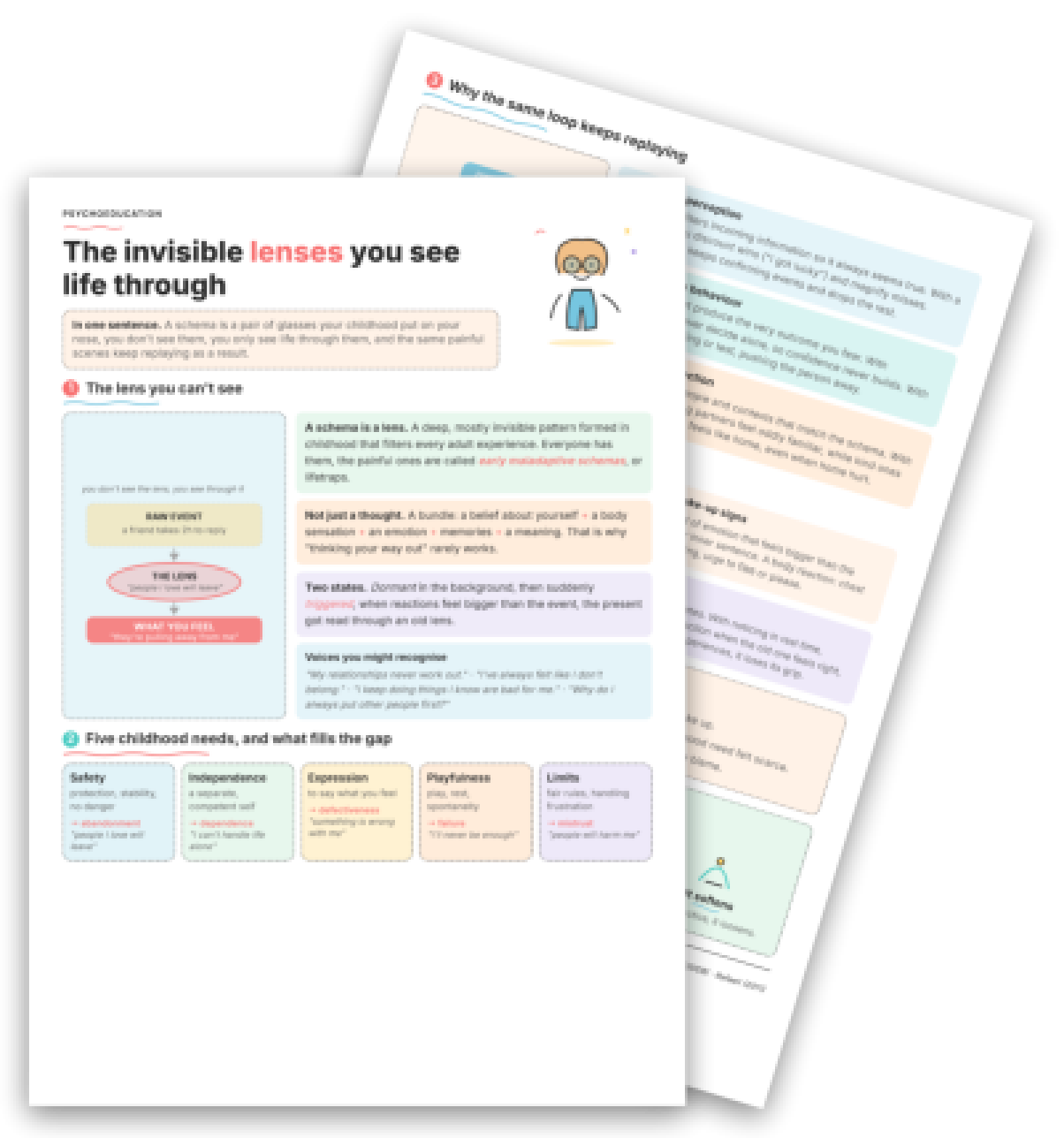
What makes schema psychoeducation different from standard cognitive restructuring is the bundled, multi-modal nature of the structure: a core belief about the self, a body sensation, an emotion, autobiographical memories, and an implicit meaning, all firing together. The fiche names this explicitly: "Not just a thought. A bundle." When this sits in front of the patient as a diagram rather than a sentence you speak, the distinction registers differently.
The second difficulty is the self-perpetuating loop. Patients often notice the emotional reaction but cannot see the three-phase cycle (distorted perception, self-defeating behaviour, toxic situation selection) that keeps it running. A clinical narrative of that cycle takes several minutes to build verbally and is fragile. Visually, it lands in seconds.
What the Fiche Contains: A Layered Visual Tool for Session Use
The fiche PDF is structured in four panels, each building on the last.
Panel 1 presents the core lens metaphor with a worked example: a friend who takes two hours to reply is read through the lens "people I love will leave", producing the felt meaning "they're pulling away from me." The patient does not see the lens; they see through it. Showing this diagram short-circuits the lengthy analogical work clinicians usually have to do.
Panel 2 maps five childhood unmet needs to their corresponding schemas: safety to abandonment, independence to dependence, expression to defectiveness, playfulness to failure, and limits to mistrust. This is drawn directly from Young's original five-domain model and gives patients an entry point that locates the schema in developmental experience rather than character pathology. You can cross-reference specific schemas with more focused resources such as the abandonment schema fiche, the defectiveness and shame schema, and the failure schema.
Panel 3 diagrams the self-reinforcing loop across three nodes: distorted perception, self-defeating behaviour, and toxic situation selection. Each node feeds the next. The visual format makes it possible to ask a patient to point to which node they recognise most clearly right now, which is harder to do with speech alone.
Panel 4 shifts to clinical application with four brief reframes (name it, catch the wake-up signs, not a character flaw, it softens slowly) and three structured discussion prompts explicitly labelled "To discuss in session."
> Key clinical point: this fiche is a visual support that facilitates the explanation in session. You use it to point, annotate, and anchor the vocabulary in real time. It is not a self-scoring questionnaire; it is a shared reference that stays with the patient between appointments.
750+ clinical tools
A library built with and for clinicians, ready to use in session and extend between appointments.
Access all the toolsWhen and How to Introduce the Fiche
The fiche fits naturally in the psychoeducation phase of schema-focused or third-wave CBT work, typically sessions two to four, once the presenting problems are mapped and the alliance is established. It is equally useful as a re-entry point later, when a patient is stuck in a recurrent pattern and needs a non-pathologising way to understand why.
For patients with unmet emotional needs as an organising formulation, the need-to-schema mapping in Panel 2 can anchor an entire case conceptualisation conversation. For patients already familiar with schema maintenance vicious cycles or coping styles in schema therapy, the fiche serves as a shared vocabulary card rather than a first introduction.
A useful framing when handing it over: "I want to show you something that might explain why this same situation keeps feeling the same way, even when the circumstances are different." Avoid naming the schema before the patient has engaged with the lens metaphor; let the visual do the orienting work first. Afterwards, you can deepen the session with schema bias tools, schema cognitive restructuring exercises, or a broader lens like the 12 ACT schemas and modes fiche.
One practical limit: patients in acute crisis, or those presenting with significant dissociation, may not be ready to engage with developmental formulation. In those cases, defer the fiche until the window for reflective work opens.
The fiche does not replace the relational and experiential work at the heart of schema therapy. It makes the entry into that work faster, clearer, and more collaborative.
Use it with your patients
Share this tool in the mobile app and follow the work between sessions.
Sources
- Young, J. E., Klosko, J. S., & Weishaar, M. E. (2003). Schema Therapy: A Practitioner's Guide. Guilford Press.
- Young, J. E., & Klosko, J. S. (1994). Reinventing Your Life: The Breakthrough Program to End Negative Behavior and Feel Great Again. Plume.
- Young, J. E. (1999). Cognitive Therapy for Personality Disorders: A Schema-Focused Approach (3rd ed.). Professional Resource Press.
- Arntz, A., Rijkeboer, M., Chan, E., Fassbinder, E., Karaosmanoglu, A., Lee, C. W., & Panzeri, M. (2021). Towards a Reformulated Theory Underlying Schema Therapy: Position Paper of an International Workgroup. Cognitive Therapy and Research.
Your session continues in your patients' pocket
Use with a patientYour resources, available everywhere
The handouts, exercises, programs and audios above: you choose which ones to make available to your patients, in the mobile app dedicated to them.
And far more than a library
The app goes well beyond resources, to support your patients every day:
Related categories
Explore other clinical resources by category.

Mood
Evidence-based worksheets and clinical tools for mood disorders: CBT, ACT, and positive psychology resources for psychologists and therapists.

Identity
Clinical resources for self-identity work in therapy: CBT, ACT, schema tools for clinicians addressing self-concept, core beliefs, and identity disruption.

Relationships
Clinical worksheets and tools on relational functioning: attachment, schemas, assertiveness, and communication skills for therapists. Printable PDF resources.

Understand
Clinical hub for the therapeutic aim 'Understand': worksheets and tools to build patient insight across CBT, ACT, schema therapy and more.

Build awareness
Clinical worksheets and tools to build awareness in therapy: cognitive distortions, schemas, emotions, ACT and CBT resources for practitioners.
CBT
CBT worksheets, cognitive restructuring exercises & behavioral tools for clinicians. Evidence-based resources for every phase of cognitive behavioral therapy.