
Clinical picture. A., a woman in her late thirties, presented with recurrent depressive episodes and a longstanding pattern of withdrawing from close relationships after any perceived criticism, however minor. In a mid-treatment session, her therapist introduced the informational sheet on Early Maladaptive Schemas as a shared reading exercise, asking her to mark the two or three entries that resonated most strongly. A. circled Defectiveness almost immediately, then sat quietly before saying that seeing it written in plain language made it feel less like a character flaw and more like something that had a name and a history. This reframe opened a productive discussion about the childhood experiences that had likely consolidated the schema, and she began to distinguish her schema-driven sense of being fundamentally flawed from her present-day adult appraisal of specific situations. The session did not resolve the pattern, but it shifted her stance from shame to something closer to curiosity.
Early Maladaptive Schemas: PDF Worksheet, Tools and Exercises
A visual PDF worksheet, clinical tools, and concrete exercises to bring schema therapy concepts to life in session and give patients a lasting psychoeducation anchor.
Clinical vignettes
Defectiveness Schema, Self-Recognition Through Psychoeducation
Self-Sacrifice and Subjugation Schemas, Overlapping Presentation
Clinical picture. T., a man in his mid-forties referred for burnout, described a career-long habit of absorbing colleagues' workloads, rarely declining requests, and feeling a vague resentment he could not fully articulate. His therapist offered the schema psychoeducation sheet at session four, framing it not as a diagnostic exercise but as a way to map the emotional logic underneath the behaviour. T. marked both Self-Sacrifice and Subjugation, then noted with some surprise that they felt like two sides of the same coin: giving compulsively on one side, and a background fear of retaliation if he refused on the other. The therapist used this to introduce the idea of schema perpetuation, explaining how both patterns can reinforce each other across years without either being consciously chosen. T. left with a clearer language for what he had previously described only as being too nice, which he found marginally less overwhelming than the undifferentiated exhaustion he had brought into the room.
Explaining early maladaptive schemas verbally tends to produce polite nodding and little genuine recognition. The concept sits at the intersection of developmental history, embodied affect, and automatic behavior, which makes it hard to grasp from a spoken definition alone. This fiche PDF gives you a structured visual support to present the schema model clearly in session, building a shared vocabulary before deeper schema work begins.
Use this resource with your patients
Handout, exercises and materials ready to use, right inside SessionFuel.
Why Schema Concepts Resist Verbal Explanation
The core clinical problem is that schemas operate beneath the level of deliberate thought. When you tell a patient that a schema is "a deep emotional pattern laid down in childhood," they often locate it intellectually without feeling its presence. The moment you add that "a small trigger today sets off the same big feeling you had as a child," some patients recognise the pattern, but many still cannot name which schema is at work or see how their coping modes (surrender, avoidance, overcompensation) shift across contexts.
Without a visual map, patients also conflate schemas with cognitive distortions or core beliefs, treating them as interchangeable. The schema model's specificity, that each pattern is tied to an unmet developmental need and comes with its own somatic signature, gets lost in conversation. A concrete visual reference stops that drift early.
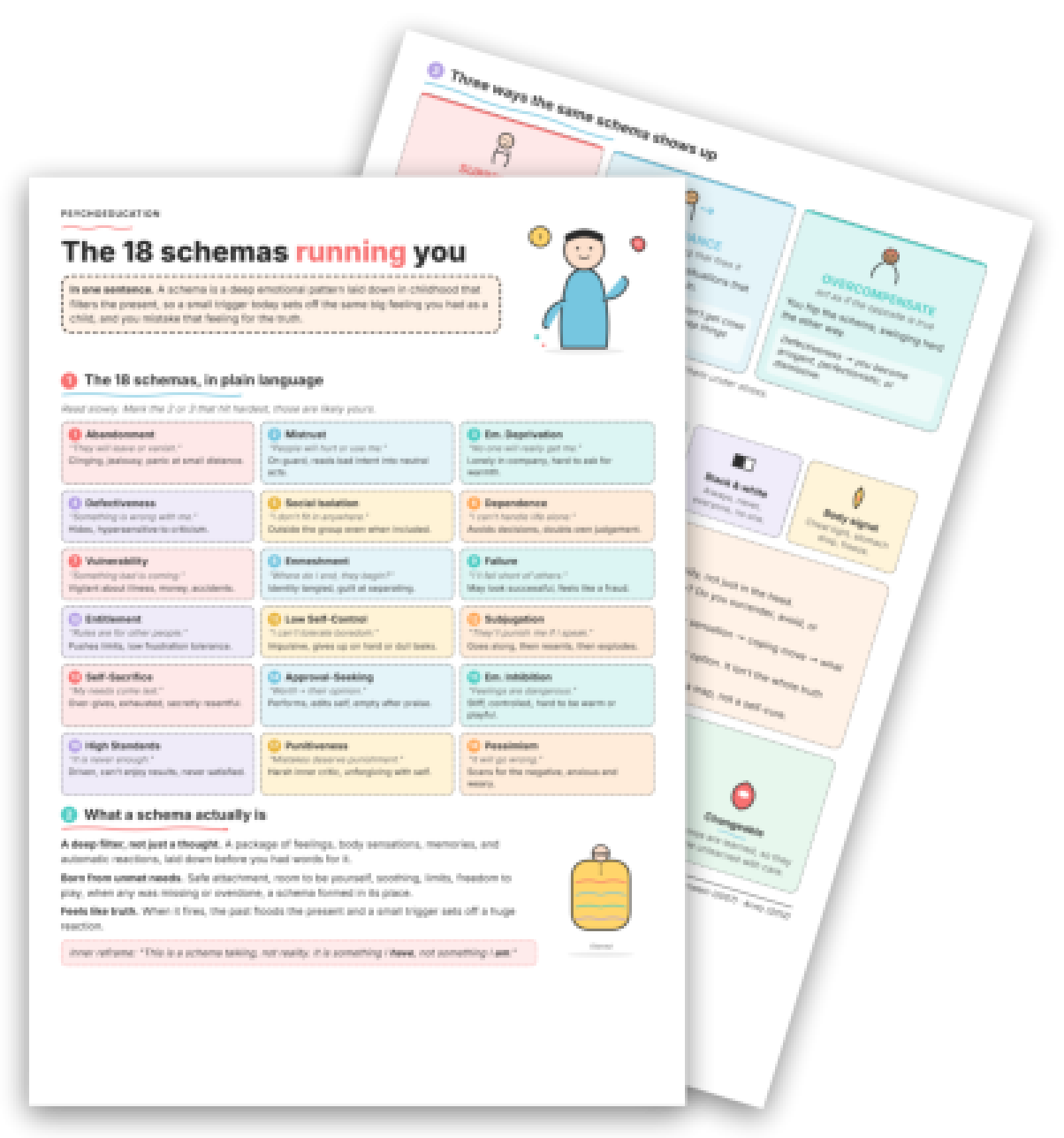
What the Fiche Contains: A Five-Panel Visual Map
The fiche is organised into five panels that you can walk through with the patient directly on screen or as a printed handout.
- Panel 1 ("The 18 schemas, in plain language") lists all 18 schemas with a one-line description and two behavioural clues each, from Abandonment ("They will leave or vanish") through to Pessimism. You can invite the patient to mark the two or three that "hit hardest" as you read together, rather than completing the exercise alone.
- Panel 2 ("What a schema actually is") frames the schema as a package of feelings, body sensations, memories, and automatic reactions, not just a thought, born from unmet needs. The key reframe printed on the page reads: "This is a schema talking, not reality. It is something I have, not something I am." That sentence alone tends to shift the patient's relationship to the concept faster than a spoken explanation.
- Panel 3 ("Three ways the same schema shows up") gives a clean visual breakdown of surrender, avoidance, and overcompensation, with a concrete example for each. This panel is especially useful for coping styles work in schema therapy and for patients who present with an approval-seeking pattern or a defectiveness schema that alternates between submission and overachievement.
- Panel 4 ("Clues that a schema just fired") lists five somatic and cognitive signals: reaction outsized for the situation, the "familiar wave" of having been here before, black-and-white thinking, a sudden impulse to cling or flee, and a body signal such as chest tightness. This panel trains the patient's self-monitoring before they begin a schema diary.
- Panel 5 ("Starting to work with your schemas") offers five structured steps, from circling the top two or three schemas to keeping a one-week diary and building a "healthy answer to the schema voice."
> Key point: the fiche is a visual support that facilitates your explanation of the schema model in session. It is not a self-administered questionnaire. The patient does not fill it in alone; you use it together as a psychoeducation anchor, then leave them the printout as a concrete reference between appointments.
750+ clinical tools
A library built with and for clinicians, ready to use in session and extend between appointments.
Access all the toolsWhen and How to Introduce It
This fiche fits naturally in the case formulation phase, typically sessions two to four once the initial anamnesis is complete and a working alliance is established. It works across a wide range of presentations: patients with attachment difficulties, chronic relational conflict, dependence and incompetence patterns, or affect dysregulation that has not responded well to standard cognitive restructuring.
A low-stigma introduction might sound like: "I'd like to look at something with you that could help us understand why certain situations keep triggering such a strong reaction, even when part of you knows the reaction is out of proportion." You then open Panel 1 together and invite the patient to identify themselves in the descriptions, rather than receiving a label.
After the session, use the schema diary structure in Panel 5 as a between-session exercise, and pair it with tools like the downward arrow technique or the origins-of-beliefs exercise to trace each schema back to its developmental context. For patients where schemas are tied to trauma, note explicitly, as the fiche itself does, that this is "a map, not a self-cure," and calibrate the depth of in-session exploration accordingly. The ACT schemas and modes fiche and the core belief clarification exercise integrate naturally as follow-up resources once the patient has named their two or three dominant schemas.
The fiche does not replace schema-focused formulation or experiential work; it makes the conceptual entry point clear, quick, and memorable for the patient.
Use it with your patients
Share this tool in the mobile app and follow the work between sessions.
Sources
- Young, J. E., Klosko, J. S., Weishaar, M. E. (2003). Schema Therapy: A Practitioner's Guide. Guilford Press.
- Young, J. E. (1990). Cognitive Therapy for Personality Disorders: A Schema-Focused Approach. Professional Resource Press.
- Rijkeboer, M. M., van Vreeswijk, M. F., Spinhoven, P., van der Heijden, P. T., Broersen, J. (2022). The higher-order structure of early maladaptive schemas: A meta-analytical approach. Frontiers in Psychiatry.
Your session continues in your patients' pocket
Use with a patientYour resources, available everywhere
The handouts, exercises, programs and audios above: you choose which ones to make available to your patients, in the mobile app dedicated to them.
And far more than a library
The app goes well beyond resources, to support your patients every day:
Related categories
Explore other clinical resources by category.

Trauma
Clinical hub on trauma and PTSD: assessment, differential diagnosis, treatment phases, and printable resources for practitioners. 155 chars.

Mood
Evidence-based worksheets and clinical tools for mood disorders: CBT, ACT, and positive psychology resources for psychologists and therapists.

Identity
Clinical resources for self-identity work in therapy: CBT, ACT, schema tools for clinicians addressing self-concept, core beliefs, and identity disruption.

Cognition
Printable cognitive therapy worksheets and clinical tools for therapists: CBT, ACT, schema work, defusion, distortions, and belief restructuring.

Understand
Clinical hub for the therapeutic aim 'Understand': worksheets and tools to build patient insight across CBT, ACT, schema therapy and more.

Build awareness
Clinical worksheets and tools to build awareness in therapy: cognitive distortions, schemas, emotions, ACT and CBT resources for practitioners.