
Clinical picture. M., a woman in her late thirties, presented with persistent low mood and a longstanding pattern of consulting her partner, her mother, and a close friend before making almost any decision, including routine administrative tasks she described as "too risky to get wrong." The clinician introduced the psychoeducational sheet on the Dependence/Incompetence Schema during a mid-therapy session, framing it as a map of a learned conviction rather than a character flaw. M. paused at the phrase "relief, then a quiet sting of again" and said it named something she had never found words for. Over the following two weeks she tracked three instances of sought reassurance, noting the emotional sequence each time, which gave the work a more concrete focus than had been possible before.
Dependence/Incompetence Schema: PDF Worksheet, Tools and Exercises
A printable PDF fiche, clinical tools, and exercises to explain the dependence/incompetence schema and begin loosening its grip in session.
Clinical vignettes
Outsourced Decisions, Quiet Shame
Schema Recognition in a Young Adult
Clinical picture. T., a man aged twenty-six, was seen for generalised anxiety and reported that solo evenings reliably produced a sense of threat he could not explain, leading him to call family members for extended periods until he felt "settled." When the clinician shared the informational sheet, T. recognised the childhood phrases section immediately, recalling a parent who had routinely intervened before tasks were attempted. The sheet gave a shared vocabulary for what had previously been discussed only in vague terms of "needing people." T. did not shift his behaviour immediately, though he began to distinguish between choosing contact and urgently needing it, which he identified as a small but unfamiliar distinction.
The dependence/incompetence schema tends to survive the first few sessions of psychoeducation almost intact. Patients hear the explanation, recognize themselves in it, and nod, then spend the following week outsourcing three decisions they could have made alone. Naming the schema aloud is rarely enough. This fiche PDF provides a visual support that makes the pattern explicit during the session itself, gives the patient a shared vocabulary to return to, and leaves a concrete reference between appointments.
Use this resource with your patients
Handout, exercises and materials ready to use, right inside SessionFuel.
Why the Dependence/Incompetence Schema Resists Explanation in Session
In schema therapy terms, this early maladaptive schema (Young et al., 2003) operates through both overcompensatory and surrender coping modes: the patient either avoids solo action entirely or, more subtly, systematically seeks reassurance while appearing to function. That subtlety is what makes the oral explanation fall flat. When you describe the schema in abstract terms, many patients hear a character flaw rather than a learned lens, and the alliance takes a hit before any real work has begun.
The schema also sustains itself through evidence erasure: every successful solo action gets quickly discounted ("I got lucky"), while every moment of struggle becomes proof of incapacity. Without a visual structure, patients have no external memory of their own competence. The pattern actively rewrites history, which is exactly why the Emotional Dependency guided exercise and the Reassurance-Seeking Behavior exercise often work better after a first psychoeducation step. This fiche is that step.
It also connects directly to attachment dynamics and to the approval-seeking behavioral cluster: many patients presenting with the dependence/incompetence schema show overlapping core beliefs about self that are worth mapping in parallel.
What the Fiche Contains: A Visual Support for an Invisible Schema
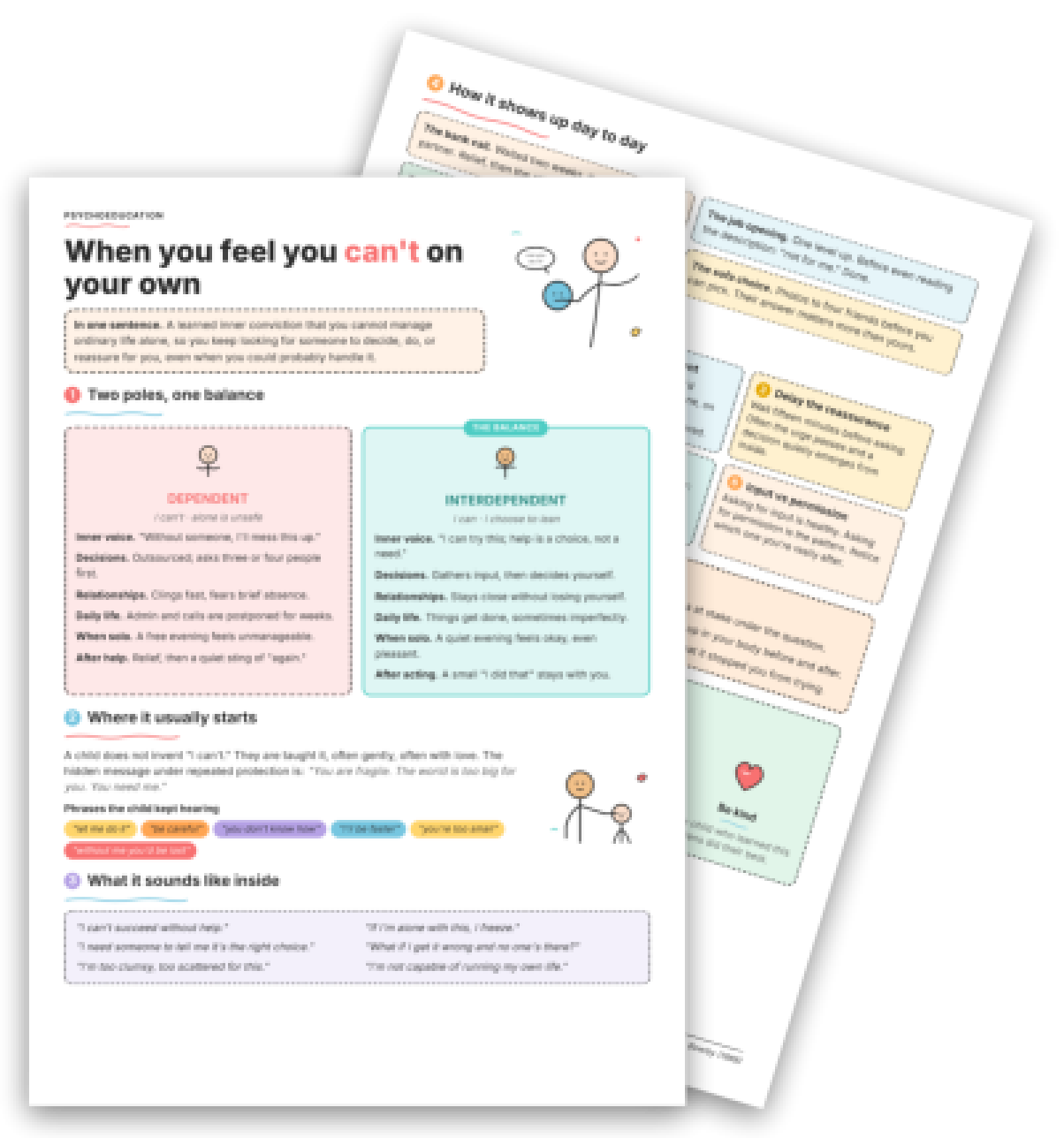
The fiche is structured around five distinct panels, all grounded in the patient's lived experience rather than diagnostic language.
The first panel, "Two poles, one balance," is the clinical centrepiece. It places DEPENDENT and INTERDEPENDENT profiles side by side across six dimensions: inner voice, decision-making, relationships, daily functioning, time alone, and the emotional aftermath of receiving help. Verbatim from the fiche: "Inner voice: 'Without someone, I'll mess this up'" / "Inner voice: 'I can try this; help is a choice, not a need.'" Seeing both columns simultaneously does something the oral comparison cannot: it shows the patient that interdependence already exists as a possibility, not as an aspirational ideal invented by the therapist.
The second panel traces the developmental origins of the schema: the childhood phrases ("let me do it," "you don't know how," "without me you'd be lost") that implicitly communicated fragility. This is directly useful for linking the current pattern to the origins of early beliefs without requiring the patient to reconstruct the narrative from scratch.
The third panel lists six specific behavioral experiments under "First moves to loosen the grip": renaming the automatic voice, running one solo task per week as deliberate practice, delaying reassurance by fifteen minutes, keeping a written proof list, preparing a ready-made phrase when others offer to take over, and distinguishing input from permission. That last distinction, "Asking for input is healthy. Asking for permission is the pattern," reliably generates productive discussion in session.
A closing section, "To raise in your next session," provides three structured prompts the patient can reflect on before returning, directly bridging the fiche to the debrief.
> Key point: The fiche functions as a visual support that facilitates the explanation in session, not a self-guided questionnaire. The clinician uses it to build a shared map, then sends it home as a reference, not a homework form.
750+ clinical tools
A library built with and for clinicians, ready to use in session and extend between appointments.
Access all the toolsWhen and How to Introduce the Fiche
This fiche fits naturally at the psychoeducation phase, once the initial formulation of the case has identified the schema as a central maintenance factor. It works particularly well in the second or third session, after the first anamnesis has surfaced themes of reassurance-seeking, difficulty deciding alone, or pervasive self-doubt, patterns that also appear in the abandonment schema, the approval-seeking cluster, and the coping styles described in schema therapy.
A useful introduction, without labelling the patient diagnostically: "I'd like to show you something. It's a map of a pattern that often develops in childhood, have a look and tell me what you recognize." Patients typically respond to the developmental panel before the behavioral one; the childhood phrases land fast.
Contraindication worth noting: with patients whose fragile child mode is dominant and self-criticism is already high, the dependent/interdependent comparison can initially reinforce shame. In that context, move slowly through the developmental panel first, and pair the fiche with the ACT schemas and modes framework or the core belief clarification exercise to keep the lens on the learned pattern rather than on defect.
Debrief at the next session around the three session-prompts printed on the fiche: which childhood phrase resonated, what happened in the body before and after a solo attempt, and whether the patient caught themselves seeking permission rather than input. The proof list the fiche asks them to keep is worth reviewing aloud, it is the most direct counter to the schema's evidence-erasure mechanism.
The fiche does not replace assertiveness work or the deeper behavioral experiments the Emotional Dependency exercise supports. It sets the conceptual foundation those tools need to land.
Use it with your patients
Share this tool in the mobile app and follow the work between sessions.
Sources
- Young, J. E., Klosko, J. S., & Weishaar, M. E. (2003). Schema Therapy: A Practitioner's Guide. Guilford Press.
- Young, J. E., & Klosko, J. S. (1994). Reinventing Your Life: The Breakthrough Program to End Negative Behavior and Feel Great Again. Plume/Penguin.
- Arntz, A., Rijkeboer, M., Chan, E., Fassbinder, E., Karaosmanoglu, A., Lee, C. W., & Panzeri, M. (2021). Towards a Reformulated Theory Underlying Schema Therapy: Position Paper of an International Workgroup. Cognitive Therapy and Research.
Your session continues in your patients' pocket
Use with a patientYour resources, available everywhere
The handouts, exercises, programs and audios above: you choose which ones to make available to your patients, in the mobile app dedicated to them.
And far more than a library
The app goes well beyond resources, to support your patients every day:
Related categories
Explore other clinical resources by category.

Identity
Clinical resources for self-identity work in therapy: CBT, ACT, schema tools for clinicians addressing self-concept, core beliefs, and identity disruption.

Understand
Clinical hub for the therapeutic aim 'Understand': worksheets and tools to build patient insight across CBT, ACT, schema therapy and more.

Build awareness
Clinical worksheets and tools to build awareness in therapy: cognitive distortions, schemas, emotions, ACT and CBT resources for practitioners.

Schema therapy
Schema therapy clinical resources for practitioners: worksheets, exercises, and programs targeting early maladaptive schemas, core beliefs, and schema modes.

Anxiety
Clinical hub for anxiety disorders: CBT and ACT worksheets, psychoeducation sheets, and exercises for assessment and treatment across the anxiety spectrum.

Trauma
Clinical hub on trauma and PTSD: assessment, differential diagnosis, treatment phases, and printable resources for practitioners. 155 chars.