
Clinical picture. M., a man in his early forties, presented after repeated conflicts with colleagues who described him as dismissive and impossible to collaborate with. He reported feeling chronically underestimated and saw no reason to follow departmental procedures he considered beneath his level of expertise. In session, the clinician introduced the entitlement schema framework and the concept of the "grandiose flavour," naming the core belief that ordinary rules do not apply. M. recognised the pattern with some discomfort, noting that his father had consistently told him he was destined for exceptional things while shielding him from most consequences at home. Over subsequent sessions he began to distinguish between genuine competence and the schema-driven assumption of priority, which slightly reduced his reactive dismissiveness with peers.
Entitlement / Grandiosity Schema: PDF Worksheet, Tools and Exercises
A visual PDF worksheet to explain the entitlement schema in session, its three presentations, hidden collapse layer, and concrete exercises for lasting schema work.
Clinical vignettes
Grandiose Flavour in a High-Achiever
Dependent Flavour and Resentment of Autonomy
Clinical picture. K., a woman in her late thirties, sought therapy following a series of relationships she described as disappointing, saying that partners never "stepped up" when she needed them. She became visibly irritated whenever she was expected to handle practical difficulties alone, experiencing this as evidence that she was uncared for. The clinician presented the dependent flavour of the entitlement schema, framing it as a quiet but firm expectation that others should accommodate and rescue. K. was initially resistant to seeing her stance as a schema rather than a reasonable need, yet she acknowledged that the underlying fear of being unsupported had been present since childhood, when parental unavailability was offset by occasional overindulgence. Naming the pattern opened a small but workable space to explore what self-reliance might feel like without it signalling abandonment.
The entitlement / grandiosity schema is one of the hardest early maladaptive schemas to work with precisely because patients carrying it rarely experience it as a problem, they experience other people as the problem. This fiche PDF gives you a concrete visual anchor to begin that conversation without triggering the very schema you're trying to address.
Use this resource with your patients
Handout, exercises and materials ready to use, right inside SessionFuel.
Why the Entitlement Schema Resists Explanation in Session
The schema literature (Young, 2003; Kernberg, 1975) is clear on the clinical picture, but naming "entitlement" to a patient in plain language almost always lands as a judgment. The word itself activates schema-driven defensiveness: the patient hears a verdict, not a formulation. And yet leaving the pattern unnamed leaves you without a shared vocabulary for the work.
A second difficulty is clinical heterogeneity. Not all presentations look like the loud, grandiose profile most clinicians think of first. The same schema can run as quiet expectation of being rescued, or as low frustration tolerance with no obvious inflation. Without a framework that shows this range, patients with the softer variants simply don't recognise themselves in your description. The same problem arises when you're mapping the collapse side: the sudden shame crash after a minor slight is easy to miss as schema-linked unless you have named the connection explicitly. The fiche makes that connection visible, which is where oral explanation alone falls short.
What the Fiche Contains, and Why the Visual Layout Matters
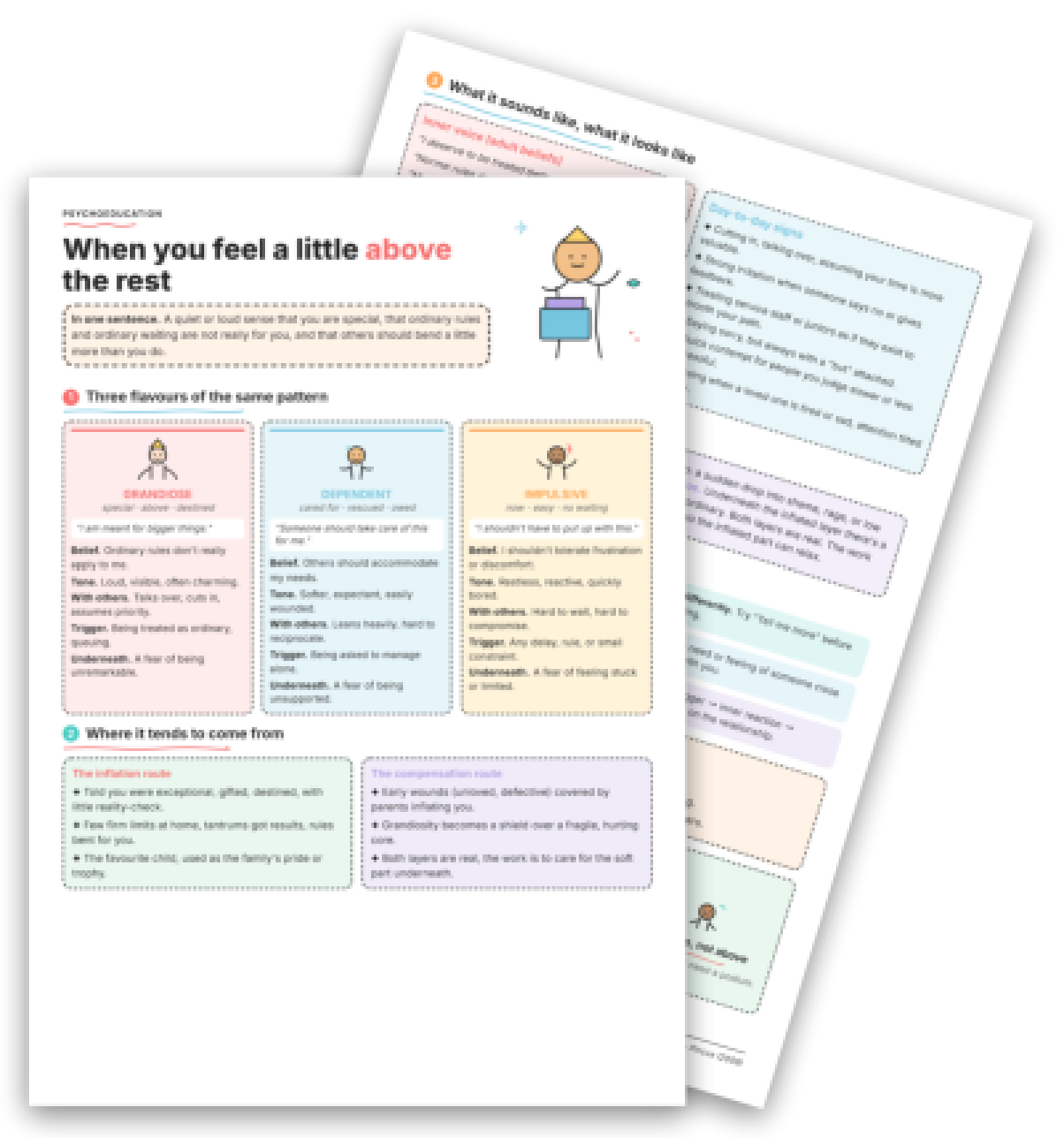
The support visuel is organised into five clinical panels.
Panel 1 distinguishes three presentations under the same schema heading: Grandiose (loud, special, destined), Dependent (cared-for, owed, expectant), and Impulsive (now, no waiting, no constraint). Each carries its own underlying trigger and, crucially, what sits underneath it. The side-by-side layout lets you point to a column and ask the patient "Which flavour is closest to yours?" in a way that oral description rarely achieves. That single question often moves the session forward faster than ten minutes of psychoeducation.
Panel 2 maps two developmental pathways: the inflation route (few limits, rules bent, favoured-child dynamics) and the compensation route (grandiosity as a shield over early wounds). Making both visible on the same page is clinically useful when the patient assumes entitlement schemas only arise from spoiling, and when your formulation points toward a defectiveness / shame schema underneath.
Panel 3 presents six inner-voice belief statements, "Normal rules don't really apply to me", "My opinion matters more", "I'm meant for big things, ordinary life is below me", with the instruction to "rate each line 0 to 100 honestly." This is a brief self-anchoring task you can do together in session using the fiche as the visual reference, rather than administering a separate questionnaire. It pairs naturally with a core beliefs self-monitoring exercise for between-session work.
Panel 4 addresses what the fiche calls "the collapse side": the disproportionate shame, rage, or low mood after a refusal or minor failure. The text names it plainly, "That collapse is a clue", and links it back to the fragile core beneath the inflated layer. This panel alone can shift the alliance substantially when a patient who came in describing relational conflict begins to recognise their own vulnerability. The anger iceberg worksheet is a natural companion here for patients who primarily present the anger face of that collapse.
Panel 5 offers five concrete between-session practices (including a one-week trigger-reaction-consequence log) plus three "To discuss in session" prompts. This closes the fiche as a proper psychoeducation arc: understanding, recognition, and structured action. The practices dovetail with demandingness work from an REBT frame and with ego and pride exercises for patients with more relational presentations.
> To retain: the fiche functions as a visual support that facilitates the explanation of the entitlement schema in session, not a self-administered questionnaire. The schematic layout lets you introduce a complex, multi-layered schema without the patient hearing a moral verdict, and leaves them with a concrete, named reference between sessions.
750+ clinical tools
A library built with and for clinicians, ready to use in session and extend between appointments.
Access all the toolsWhen and How to Introduce the Fiche
Optimal timing is once a preliminary case formulation has identified the entitlement schema as active and the alliance is solid enough to tolerate some schema confrontation, typically mid-treatment, not the first or second session. Introducing it too early risks alliance rupture; too late and it may feel academic rather than live.
Patient profiles where the fiche tends to be most useful: patients referred for relationship difficulties or anger management who are initially externalising; patients in schema therapy who are in the surrender or overcompensation coping mode for this schema; and patients whose presentations overlap with approval and admiration seeking, where the two schemas often co-occur.
A low-confrontation introduction: "I'd like to show you a map of a pattern I'm seeing, not a label, just a way to look at it together. Can you tell me which column fits best?" Pointing to the three-flavour panel immediately moves the conversation from verdict to collaborative exploration.
Debriefing the fiche the following session, ask about the 0-100 ratings and whether the "collapse side" section landed as recognisable. If the patient rejected the whole fiche, that rejection itself is schema-relevant data. You can then connect their reaction to the beliefs that damage their relationships and to any devaluing-others patterns you've been tracking.
The fiche does not replace the formulation conversation or the relational work; it makes the schema legible enough that the deeper work can actually begin.
Use it with your patients
Share this tool in the mobile app and follow the work between sessions.
Sources
- Young, J. E., Klosko, J. S., Weishaar, M. E. (2003). Schema Therapy: A Practitioner's Guide. Guilford Press.
- Young, J. E. (1999). Cognitive Therapy for Personality Disorders: A Schema-Focused Approach (3rd ed.). Professional Resource Press.
- van Vreeswijk, M., Broersen, J., Nadort, M. (2012). The Wiley-Blackwell Handbook of Schema Therapy: Theory, Research, and Practice. John Wiley and Sons.
Your session continues in your patients' pocket
Use with a patientYour resources, available everywhere
The handouts, exercises, programs and audios above: you choose which ones to make available to your patients, in the mobile app dedicated to them.
And far more than a library
The app goes well beyond resources, to support your patients every day:
Related categories
Explore other clinical resources by category.

Identity
Clinical resources for self-identity work in therapy: CBT, ACT, schema tools for clinicians addressing self-concept, core beliefs, and identity disruption.

Relationships
Clinical worksheets and tools on relational functioning: attachment, schemas, assertiveness, and communication skills for therapists. Printable PDF resources.

Understand
Clinical hub for the therapeutic aim 'Understand': worksheets and tools to build patient insight across CBT, ACT, schema therapy and more.

Build awareness
Clinical worksheets and tools to build awareness in therapy: cognitive distortions, schemas, emotions, ACT and CBT resources for practitioners.
CBT
CBT worksheets, cognitive restructuring exercises & behavioral tools for clinicians. Evidence-based resources for every phase of cognitive behavioral therapy.

Integrative
Integrative therapy clinical resources: worksheets, psychoeducation programs, and exercises for eclectic, multimodal practice across orientations.