
Clinical picture. M., a man in his late thirties, presents with a pattern of abruptly ending friendships at the point of deepening closeness, which he frames as the other person inevitably losing interest. During a session reviewing the exclusion schema worksheet, the clinician traces a recent episode: a colleague's two-hour response delay had triggered an automatic verdict of rejection, leading M. to send a cold, distancing message before any actual rupture had occurred. When the colleague eventually replied warmly and with a plausible explanation, M. found the relief short-lived and the conviction largely unchanged. Over subsequent sessions, naming the loop as a protective system installed long before this colleague existed gave M. enough distance to pause before the protective gesture, though the urge to withdraw remained present.
The Social Exclusion Schema: PDF Worksheet, Tools and Exercises
A visual PDF worksheet, clinical tools and structured exercises to explain the social exclusion schema and its self-confirming loop directly in session.
Clinical vignettes
Withdrawal Before the Wound Arrives
Reassurance That Strains the Bond
Clinical picture. T., a woman in her mid-twenties, describes a close friendship that has become strained by her repeated need to confirm that she is not being excluded or criticised. Using the two-faces diagram from the informational sheet, the clinician and T. identify that her scanning behaviour, checking social media for signs she was left out of plans, and her reassurance-seeking, asking her friend several times after each meeting whether she had said something wrong, belong to the hypersensitive face of the same schema. The friend has begun to withdraw, which T. reads as proof of impending rejection rather than as a response to the pressure. Identifying the loop did not immediately reduce the urge to check, but T. began to distinguish between the radar's verdict and the actual evidence available to her.
When a patient insists that people always eventually drift away, the therapeutic response is rarely the problem. The problem is that an oral explanation of the social exclusion schema tends to bounce off the very conviction it aims to unpack. This fiche PDF gives you a visual scaffold to make the schema's mechanics graspable in a single session, without the patient walking out holding only a label.
Use this resource with your patients
Handout, exercises and materials ready to use, right inside SessionFuel.
Why the social exclusion schema resists verbal explanation
The schema's self-confirming architecture is what makes it clinically stubborn. Unlike the defectiveness/shame schema, where the wound centers on an internal flaw, the exclusion schema organizes around a relational verdict: the circle is not for me. Patients frequently confuse it with shyness, social anxiety, or introversion, and they present it as a streak of bad luck with people rather than a schema-driven perceptual filter.
The deeper difficulty is that the schema is bidirectional. The same wound can produce hyper-attachment and clinging in one patient and preemptive withdrawal in another. Patients showing the protective pole often arrive presenting something closer to loneliness or emotional flatness than interpersonal distress. A verbal account of "you scan for rejection and then inadvertently create it" frequently triggers defensiveness, or produces abstract agreement with zero somatic resonance. Without a map of the full cycle, the schema stays a concept rather than a mechanism the patient can recognize in real time.
What the fiche contains, and why the visual layout matters
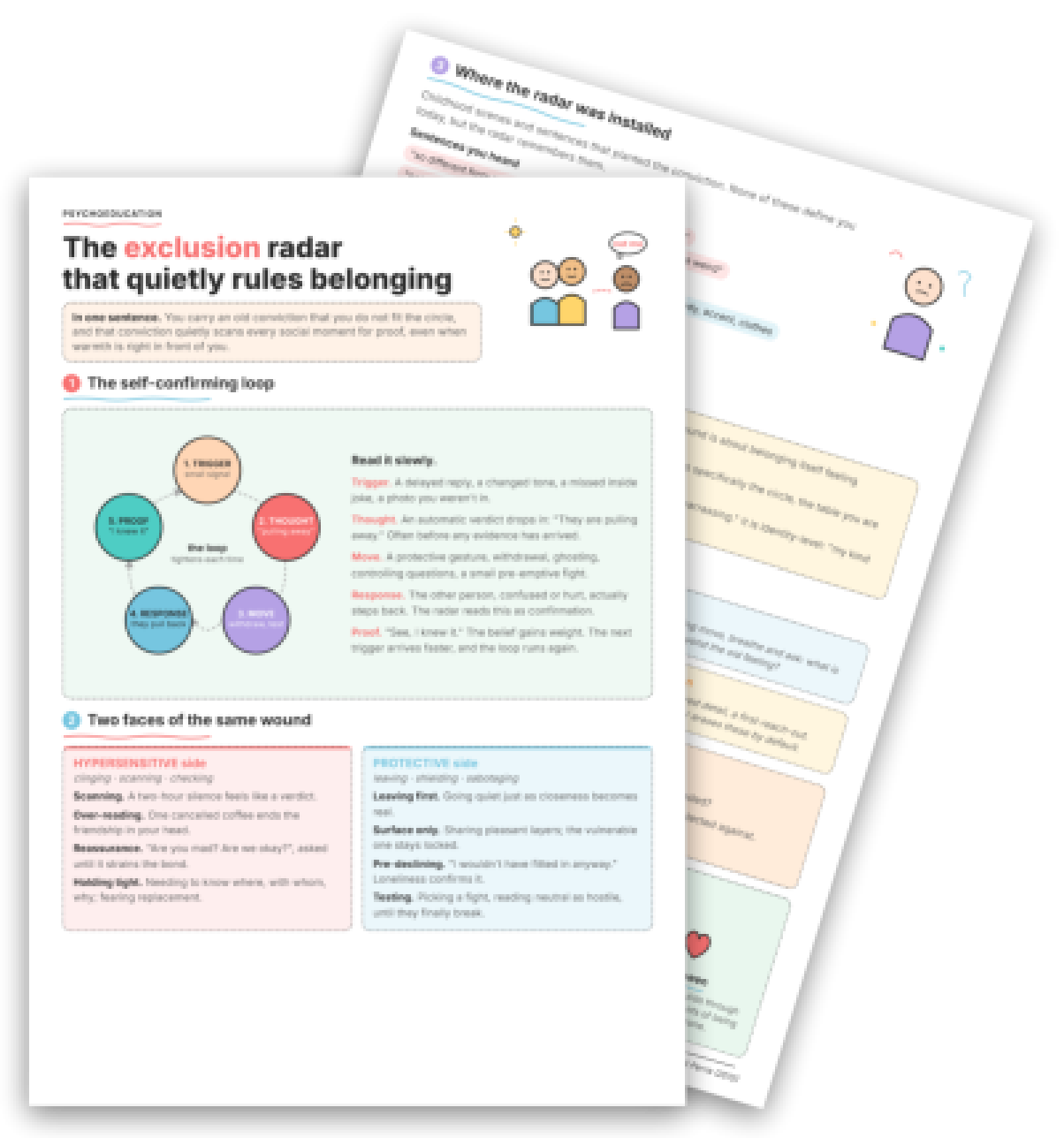
The fiche is built around five named sections that you use sequentially as a psychoeducation support during the session. It is not a questionnaire patients complete at home.
The centerpiece is the self-confirming loop: a five-step cycle (Trigger, Thought, Move, Response, Proof) that makes the schema's perpetuation concrete and visible. Seeing the loop drawn out, with the annotation "the loop tightens each time," shifts the patient from "I am just bad at belonging" toward "I have a feedback system that generates its own evidence." That perceptual move is harder to produce with words alone, and it is exactly where the visual support earns its place in the session.
A second section maps the two faces of the same wound: the hypersensitive pole (scanning, reassurance-seeking, holding tight) against the protective pole (leaving first, surface-only sharing, pre-declining). Displaying both on one page helps patients recognize the structure of their own pattern, including those whose schema expression shifts depending on relational closeness. It also gives you shared clinical language for both poles, which matters when tracking schema maintenance cycles across sessions.
The fiche then traces the childhood origins of what it calls the "exclusion radar," listing recurring scenes ("last picked, eating alone, the only one of something in the room") and sentences patients may recognize verbatim. A useful distinctions section separates the exclusion schema from the abandonment schema, from the defectiveness/shame schema, and from performance-based social anxiety. This differential matters clinically: patients frequently carry early maladaptive schemas that overlap, and articulating the distinctions verbally in session takes time that the diagram resolves at a glance. The same distinctions apply when ruling out mistrust and abuse schemas, where the expectation of harm is more deliberate.
The closing section, "what loosens the grip," offers four concrete levers (naming the radar, slowing the interpretive gap, running small belonging experiments, logging micro-inclusion events) and three session discussion prompts you can use directly to debrief or assign as between-session reflection.
> Key point: This fiche is a visual support that facilitates the explanation of the social exclusion schema in session. The loop diagram, the two-face panel, and the distinctions section hold the entire schema architecture visible at once, and they leave the patient with a concrete reference rather than a verbal impression that fades.
750+ clinical tools
A library built with and for clinicians, ready to use in session and extend between appointments.
Access all the toolsWhen and how to introduce the fiche
The fiche fits naturally after the initial case formulation phase, once the schema has been named but before active behavioral work begins. It is particularly useful with intellectualizing patients (they need the structure) and with those who oscillate between anxious clinging and sudden disengagement (they need to see both poles mapped simultaneously). It also opens productive work with patients whose attachment style has never been framed in schema terms.
Introduce it simply: "I'd like to show you something that maps what we've been describing, not to label you, but to give us a shared vocabulary for the pattern." Walk through the loop together mid-session, pausing at whichever step lands most strongly. The three prompts at the bottom ("When you notice the radar firing this week, what was the trigger, what verdict landed?") serve as a natural between-session bridge without requiring a separate homework sheet.
One limit worth anticipating: when the therapeutic alliance is still fragile, or when the patient is already flooded with shame about their relational history, the childhood origins section can amplify rather than settle affect. In those cases, begin with the loop and the two faces, and return to origins once the schema feels less charged. Pair the fiche with schema bias work and, where relevant, with coping styles in schema therapy to build a coherent account of how the exclusion schema perpetuates itself from session to session. The fiche does not replace that formulation work; it gives both of you a shared visual anchor to return to when the radar fires in the room.
Use it with your patients
Share this tool in the mobile app and follow the work between sessions.
Sources
- Young, J. E., Klosko, J. S., Weishaar, M. E. (2003). Schema Therapy: A Practitioner's Guide. Guilford Press.
- Rafaeli, E., Bernstein, D. P., Young, J. (2011). Schema Therapy: Distinctive Features. Routledge.
- Brockman, R. N., Simpson, S., Hayes, C., van den Wijngaart, R., Smout, M. (2023). Cambridge Guide to Schema Therapy. Cambridge University Press.
Your session continues in your patients' pocket
Use with a patientYour resources, available everywhere
The handouts, exercises, programs and audios above: you choose which ones to make available to your patients, in the mobile app dedicated to them.
And far more than a library
The app goes well beyond resources, to support your patients every day:
Related categories
Explore other clinical resources by category.

Identity
Clinical resources for self-identity work in therapy: CBT, ACT, schema tools for clinicians addressing self-concept, core beliefs, and identity disruption.

Relationships
Clinical worksheets and tools on relational functioning: attachment, schemas, assertiveness, and communication skills for therapists. Printable PDF resources.

Cognition
Printable cognitive therapy worksheets and clinical tools for therapists: CBT, ACT, schema work, defusion, distortions, and belief restructuring.

Understand
Clinical hub for the therapeutic aim 'Understand': worksheets and tools to build patient insight across CBT, ACT, schema therapy and more.

Build awareness
Clinical worksheets and tools to build awareness in therapy: cognitive distortions, schemas, emotions, ACT and CBT resources for practitioners.

CBT
CBT worksheets, cognitive restructuring exercises & behavioral tools for clinicians. Evidence-based resources for every phase of cognitive behavioral therapy.