
Clinical picture. J., a woman in her early thirties, presented with persistent low mood and social isolation following a series of short-lived relationships. She described herself as someone who simply preferred solitude, framing repeated cancellations of plans as "listening to her body." In session, the clinician introduced the three coping styles and invited J. to map her week onto the framework. J. recognized, with some discomfort, that her withdrawals reliably followed moments when closeness felt imminent, keeping her core belief that she was fundamentally unlovable insulated from any disconfirming experience. She left the session with a monitoring sheet to log the triggering belief alongside each avoidance response, a first step toward distinguishing protective habit from genuine preference.
Coping Styles in Schema Therapy: PDF Worksheet, Tools and Exercises
A printable PDF worksheet, tools, and exercises to help clinicians explain surrender, avoidance, and overcompensation clearly and efficiently in session.
Clinical vignettes
Avoidance Mistaken for Self-Care
Overcompensation Concealing a Worthlessness Schema
Clinical picture. T., a man in his mid-forties, was referred after a disciplinary incident at work linked to harsh criticism of junior colleagues. He presented as composed and somewhat dismissive of the referral, noting that high standards were simply necessary in his field. The clinician used the coping styles framework to examine the pattern without pathologizing ambition, and T. gradually connected his driven, controlling stance to an early-formed belief that he was not good enough. He acknowledged that any perceived error in subordinates triggered a sharp internal alarm he then managed by asserting dominance. Naming overcompensation as a coping response, rather than a character flaw, created enough distance for T. to engage with the underlying schema in subsequent sessions.
Schema therapy's three coping styles make perfect clinical sense the moment you read Young's model. Getting a patient to genuinely grasp them is a different matter. Explaining surrender, avoidance, and overcompensation verbally tends to produce polite nodding, then a blank look when the patient tries to apply the framework to last week's conflict. This fiche PDF is a visual support designed to do the explaining for you, inside the session, so the concept actually sticks.
Use this resource with your patients
Handout, exercises and materials ready to use, right inside SessionFuel.
Why Coping Styles Resist Oral Explanation
The core difficulty is that patients arrive with an implicit theory of their own behaviour. Someone who overcompensates reads their perfectionism as discipline, not defence. Someone who surrenders experiences deference as just being realistic. When you name the coping style aloud, you are challenging that implicit theory, and the patient has no anchor to hold the reframe in place.
A second layer of difficulty: the three styles are not mutually exclusive. The same early maladaptive schema (say, defectiveness) can produce avoidance with family, overcompensation at work, and surrender in romantic relationships. Communicating that complexity without a diagram tends to produce confusion rather than clarity. Patients working with the abandonment schema or approval-seeking patterns face exactly this layered picture.
Finally, there is the reinforcement paradox: each coping style provides short-term relief while quietly consolidating the schema beneath it. That loop is difficult to convey in a sentence. It needs to be seen.
750+ clinical tools
A library built with and for clinicians, ready to use in session and extend between appointments.
Access all the toolsWhat the Fiche Contains: A Visual Architecture for the Concept
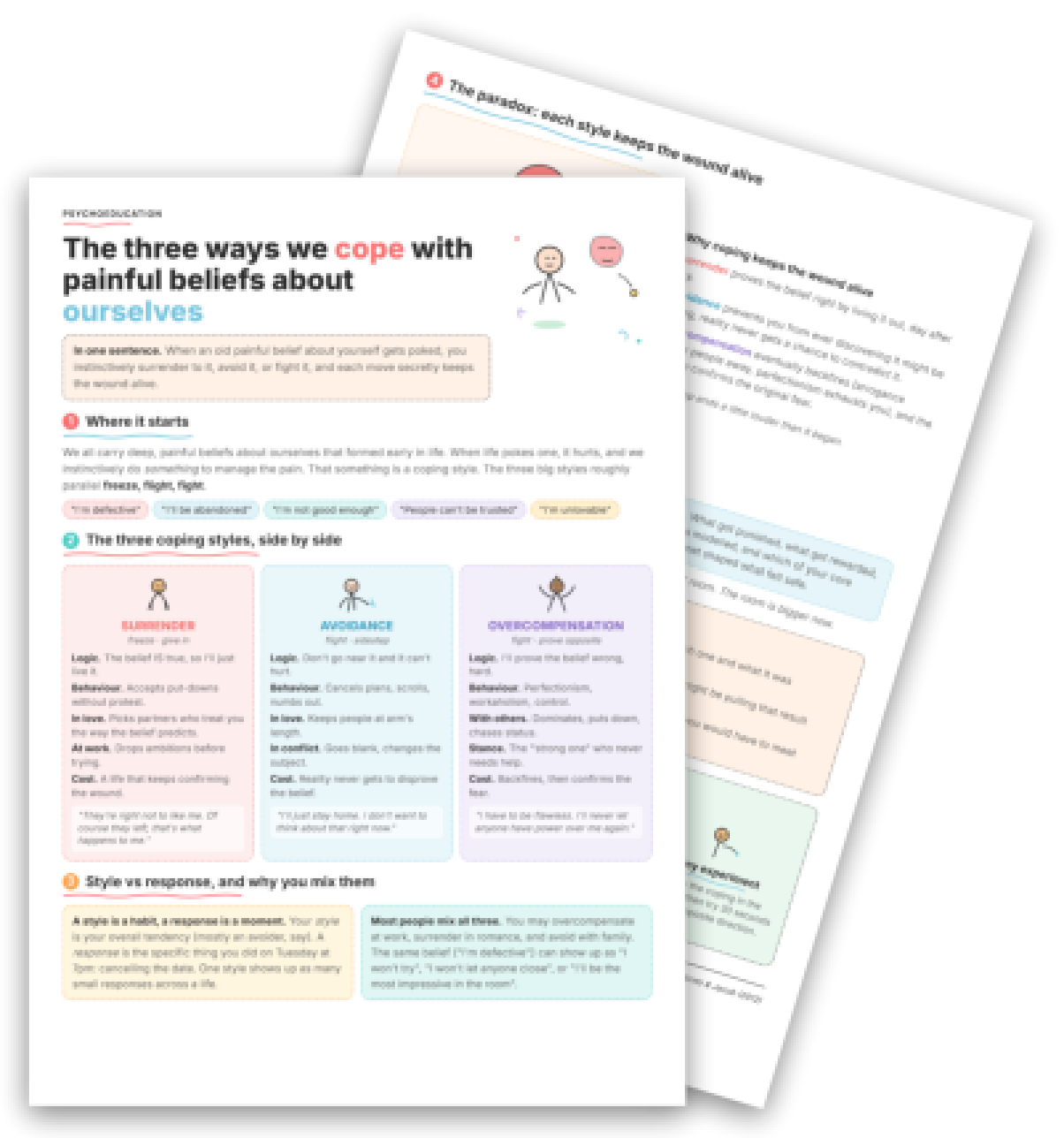
The fiche organises the content across five numbered panels, moving from origin to mechanism to clinical reflection. The opening panel grounds the concept in early painful beliefs ("I'm defective", "I'll be abandoned", "I'm unlovable") so the patient understands what is being protected before you name how.
The centrepiece is a side-by-side three-column table comparing surrender, avoidance, and overcompensation across five domains: the internal logic, visible behaviour, relational presentation, occupational presentation, and long-term cost. Having the three styles on the same page, in parallel columns, is what an oral explanation cannot replicate. A patient can point to the column that fits last Tuesday. You can watch where their finger hesitates.
The fiche then draws an explicit distinction between style and response: "A style is a habit, a response is a moment." That sentence alone resolves a confusion that routinely derails early schema work. A dedicated panel maps the reinforcement loop visually (trigger → belief activated → coping → short relief → belief reinforced), making the paradox legible rather than theoretical. The developmental panel on temperament and environment contextualises the patient's style without pathologising it: "Your coping was the best move available to a small person in that exact room."
Three structured session discussion prompts close the fiche, including one that is particularly useful for experiential work: "When you imagine dropping your usual coping for one minute, notice what feeling you would have to meet underneath." You can use that prompt as a live exercise immediately after reviewing the sheet together.
This is the logic of the fiche as a visual support: it does not replace your formulation, it makes your formulation concrete enough to be held by the patient between sessions. Clinicians working on adaptive versus maladaptive coping or avoidance reduction will recognise the same scaffolding logic.
> Key point: The fiche is a visual support that facilitates in-session explanation of coping styles; it is not a self-administered questionnaire. The clinician uses it to anchor a complex concept, then leaves the patient with a concrete reference they can return to between appointments.
Use it with your patients
Share this tool in the mobile app and follow the work between sessions.
When and How to Introduce the Fiche
The optimal window is after case formulation is established but before schema-focused experiential work begins, typically sessions four to seven. The patient needs enough alliance and enough self-knowledge to recognise themselves in one of the columns, but not so much that the psychoeducation arrives too late to orient the work.
For patients with perfectionism or cognitive distortions that clearly serve a defensive function, you can introduce the fiche earlier. For patients still in anamnèse, it is better paired with tracing the origins of a core belief once the schema landscape is clearer.
A low-inference opening: "I want to show you something that maps out the three main ways people manage painful beliefs about themselves. Let's go through it together and see which one, or which combination, fits for you." That framing invites curiosity rather than triggering defensiveness.
Debrief by column: which style does the patient recognise most readily? Where do they see the cost clearly, and where do they resist it? The ACT schemas and modes framework pairs well here if you are working with defusion alongside schema work. For deeper belief-level consolidation, follow up with clarifying the core belief or restructuring a negative core belief in subsequent sessions.
The fiche does not replace the therapeutic relationship or the schema mode work that follows. It establishes a shared vocabulary quickly, so the clinical work can go deeper sooner.
Your session continues in your patients' pocket
Use with a patientYour resources, available everywhere
The handouts, exercises, programs and audios above: you choose which ones to make available to your patients, in the mobile app dedicated to them.
And far more than a library
The app goes well beyond resources, to support your patients every day:
Related categories
Explore other clinical resources by category.

Trauma
Clinical hub on trauma and PTSD: assessment, differential diagnosis, treatment phases, and printable resources for practitioners. 155 chars.

Mood
Evidence-based worksheets and clinical tools for mood disorders: CBT, ACT, and positive psychology resources for psychologists and therapists.

Identity
Clinical resources for self-identity work in therapy: CBT, ACT, schema tools for clinicians addressing self-concept, core beliefs, and identity disruption.
Relationships
Clinical worksheets and tools on relational functioning: attachment, schemas, assertiveness, and communication skills for therapists. Printable PDF resources.

Understand
Clinical hub for the therapeutic aim 'Understand': worksheets and tools to build patient insight across CBT, ACT, schema therapy and more.

Build awareness
Clinical worksheets and tools to build awareness in therapy: cognitive distortions, schemas, emotions, ACT and CBT resources for practitioners.