
Clinical picture. M., a 34-year-old secondary school teacher, presented with chronic low mood and a pervasive sense of inadequacy that she described as "just the way I am." She had no prior psychoeducation about early maladaptive schemas. During a session introducing the informational sheet on negative parenting styles, the clinician walked through the nine patterns; M. paused at belittling and identified her father's habitual comparisons with an older sibling as a repeated, not isolated, experience. She began to reframe her harsh inner critic not as a character flaw but as a learned conclusion drawn under chronic conditions, which reduced her self-blame and opened space for schema-focused work.
HandoutPersonalityRelationshipsMood & depressionTrauma & PTSDUnderstandBuild awarenessRestructureSchema therapy
Negative Parenting Styles: PDF Worksheet, Tools and Exercises
A visual psychoeducation tool to help patients connect childhood relational patterns to their early maladaptive schemas, unmet needs, and adult behaviors in schema therapy.
Clinical vignettes
Belittling History, Persistent Self-Criticism
Controlling Style, Subjugation Schema
Clinical picture. R., a man in his late forties referred following occupational burnout, struggled to articulate his own preferences and routinely deferred to colleagues even when he disagreed. The clinician introduced the parenting styles sheet as a psychoeducational bridge before beginning mode work. R. recognised the controlling pattern in both parents and connected it, cautiously, to his adult difficulty asserting limits. He did not reach immediate insight, but the normalising framing of unmet autonomy needs reduced his shame enough that he agreed to keep a brief log of moments when his own wishes went unexpressed, providing concrete material for the following session.
Explaining the developmental origins of early maladaptive schemas at the whiteboard rarely lands cleanly. Patients either over-identify ("yes, my parents were monsters") or deflect entirely ("it was fine, really"). This fiche PDF gives you a structured visual frame that holds the complexity, names what happened without assigning blame, and leaves the patient with something concrete to take home.
Use this resource with your patients
Handout, exercises and materials ready to use, right inside SessionFuel.
Why Negative Parenting Styles Are Hard to Explore in Session
The core clinical obstacle is not resistance in the dynamic sense; it is conceptual thinness. Patients have rarely thought systematically about their upbringing as a pattern of unmet needs. When you raise the link between childhood relational experience and, say, approval-seeking behaviors or the emotional deprivation schema, you are asking them to hold multiple levels simultaneously: what the parent did, what need went unmet, what belief crystallised, and where that belief still operates today. Oral explanation runs these levels together.
Three specific blocks surface repeatedly. Subtle neglect is the hardest to name because nothing dramatic happened; the patient has no "story" to point to. The guilt dynamic ("I don't want to blame them") short-circuits curiosity before it starts. And comparison minimisation ("others had it worse") shuts down the patient's own emotional data. A printed visual externalises the schema origin model so you can think about it together rather than talk past each other.
Clinical library
750+ clinical tools
A library built with and for clinicians, ready to use in session and extend between appointments.
Access all the toolsSeveral resource types
Psychoeducation handouts
Understand at a glance
Interactive exercises
To do and fill in
Interactive programs
A structured path
Audios
Meditation and relaxation
Psychometric tests
Automatic scoring
Inside the Negative Parenting Styles Worksheet
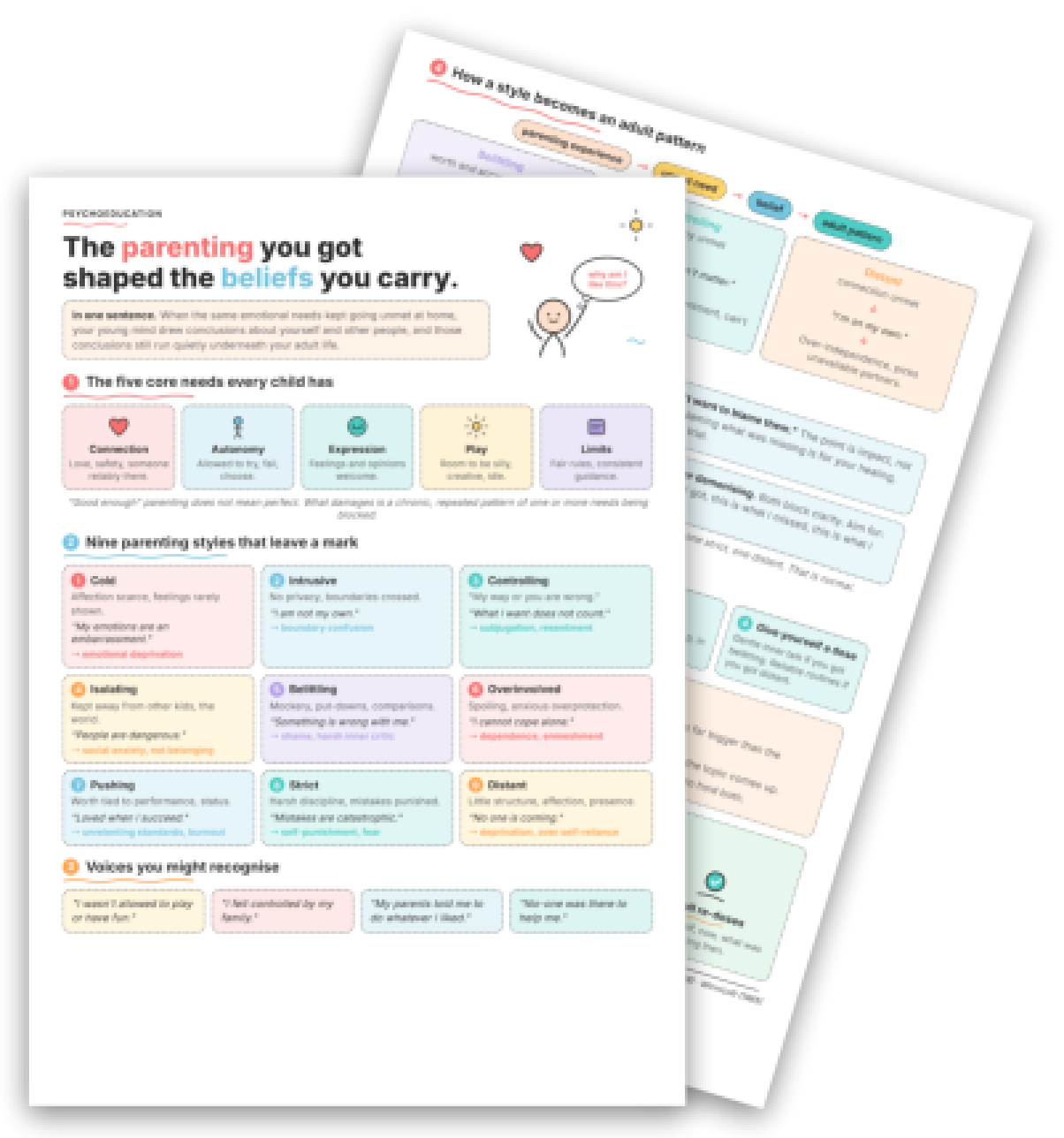
The fiche opens by anchoring the work in a single orienting sentence: "The parenting you got shaped the beliefs you carry." From there, it unfolds across six structured panels.
Panel 1 names the five core needs every child carries: connection, autonomy, expression, play, and limits. This taxonomy, drawn from Young's schema model (Young, 2003), gives patients a precise vocabulary to replace the vague sense that "something was off." Panel 2 maps nine parenting styles that chronically block one or more of these needs, from Cold (affection scarce, feelings rarely shown) and Belittling (mockery, comparisons, shame) through Overinvolved and Distant, each paired with the schema it typically generates. The visual layout of nine distinct profiles, each with a characteristic belief and a downstream schema label, does work that a verbal list cannot.
Panel 4 is the clinical centrepiece: a three-column chain showing parenting experience → unmet need → belief → adult pattern, illustrated with three worked examples including the mistrust and abuse schema trajectory and the controlling-parenting path toward subjugation and an inability to say no. Patients can see their own case reflected without having it narrated to them. Panel 5 addresses resistance points directly, naming the idealising-or-demonising split and the fact that multiple styles often coexist in one family, which matters when patients encounter apparent contradictions in their attachment style. Panel 6 closes with four guided reflection steps and three session discussion prompts, flagging moments when the fiche deserves a deeper clinical conversation: disproportionate emotional reactions, minimisation as soon as the childhood topic arises, or two contradictory styles in the same narrative.
> Key takeaway: this fiche is a visual support that facilitates the in-session explanation of parenting-to-schema pathways; it is not a standalone questionnaire to complete at home, but a shared reference the clinician uses to make a complex developmental model immediately legible.
Use it with your patients
Share this tool in the mobile app and follow the work between sessions.
When and How to Introduce the Worksheet in Session
The fiche fits naturally from the second or third session onward, once the anamnèse has touched on family of origin and you have at least a working hypothesis about which early maladaptive schemas are active. It is well-suited to patients presenting with enmeshment, chronic shame, or the failure schema, where the developmental thread is clinically central but affectively charged.
A low-pressure introduction: "I'd like to show you a framework that might help us understand where some of those beliefs about yourself got started. We'll go through it together." Handing the fiche over without that framing risks the patient reading it defensively as a checklist of parental failures.
Useful debrief questions: which of the nine styles resonates most, and which feels the least accurate? Where does the patient notice resistance? The fiche's built-in panel on coping responses and the downstream schema vocabulary also set the stage for later work on core beliefs, abandonment fear, and how past patterns affect present behavior.
One practical limit: for patients with severe trauma histories or an active dissociative presentation, the developmental mapping work embedded in this fiche warrants more preparation and a slower pace. In those cases, consider pairing it with the Four Parenting Styles fiche as a gentler entry point before moving to the fuller schema-linked model here.
The fiche does not replace the formulation; it makes the formulation visible, and leaves the patient with a shared map they can return to between sessions.
Patient mobile app
Your session continues in your patients' pocket
Use with a patientYour resources, available everywhere
The handouts, exercises, programs and audios above: you choose which ones to make available to your patients, in the mobile app dedicated to them.
Psychoeducation handoutsInteractive exercisesInteractive programsAudiosPsychometric tests
And far more than a library
The app goes well beyond resources, to support your patients every day:
Standardized tests
Therapy journal
Gamification
Wellbeing challenges
Introspection prompts
Therapist homework
Related categories
Explore other clinical resources by category.

Trauma
Clinical hub on trauma and PTSD: assessment, differential diagnosis, treatment phases, and printable resources for practitioners. 155 chars.
Mood
Evidence-based worksheets and clinical tools for mood disorders: CBT, ACT, and positive psychology resources for psychologists and therapists.

Relationships
Clinical worksheets and tools on relational functioning: attachment, schemas, assertiveness, and communication skills for therapists. Printable PDF resources.

Understand
Clinical hub for the therapeutic aim 'Understand': worksheets and tools to build patient insight across CBT, ACT, schema therapy and more.

Build awareness
Clinical worksheets and tools to build awareness in therapy: cognitive distortions, schemas, emotions, ACT and CBT resources for practitioners.

Schema therapy
Schema therapy clinical resources for practitioners: worksheets, exercises, and programs targeting early maladaptive schemas, core beliefs, and schema modes.