
Clinical picture. M., a woman in her late thirties referred for generalised anxiety, describes a pattern of scanning colleagues' facial expressions and replaying meetings for hidden criticism. She grew up in a household where caregivers were unpredictable and routinely dismissive. In session, the clinician introduced the informational sheet on the mistrust schema and invited M. to read section three aloud, pausing at the inner-voice statements. She identified the phrase "What do they really want?" as one she rehearses almost daily before team interactions. By the end of the session she had named the pattern as a learned posture rather than an accurate reading of her colleagues, a small but workable shift in stance.
Mistrust/Abuse Schema: PDF Worksheet, Tools and Exercises
A visual psychoeducation tool to help clinicians explain the mistrust/abuse schema, map its three defensive postures, and open a conversation about earned trust in session.
Clinical vignettes
Hypervigilance Blocking a Work Relationship
Pre-emptive Withdrawal in a New Friendship
Clinical picture. T., a man in his mid-forties with a history of relational trauma in childhood, reported terminating a promising friendship the moment the other person began showing warmth, citing a vague sense of danger he could not articulate. The clinician offered the psychoeducational sheet and asked T. to locate his habitual response among the three postures listed in section one. He placed himself firmly in the overcompensation column, recognising the "striking first" quality of his withdrawals. Naming this as armour, rather than good judgment, allowed him to approach the next session with a specific recent example and begin distinguishing threat from closeness at a behavioural level.
Patients carrying the mistrust/abuse schema often nod along when you describe it verbally, then leave the session with the same rigid vigilance intact. The concept makes intuitive sense to them intellectually, yet the implicit conviction ("people will harm me if I let them close") never quite lands as a schema rather than as reality. This fiche PDF gives you a structured visual scaffold to make that distinction concrete during the session itself.
Use this resource with your patients
Handout, exercises and materials ready to use, right inside SessionFuel.
Why the Mistrust/Abuse Schema Is Hard to Explain at the Oral Level
The core clinical difficulty is that the schema masquerades as accurate perception. Unlike a depressogenic core belief ("I am worthless"), a mistrust schema feels evidential: the patient experienced real harm, the body still scans for threat, and the coping behaviours have been reinforced repeatedly over time. Naming it as a maladaptive early schema rather than a fact about the world asks the patient to hold two things simultaneously: "yes, some people did hurt me" and "this pattern now distorts how I read everyone." That is cognitively demanding without a visual anchor.
A second difficulty is the overlap with adjacent schemas. Clinicians often need to spend time in session differentiating mistrust from the abandonment schema (deliberate harm vs. unreliability and loss), from the defectiveness/shame schema ("they are dangerous" vs. "I am unlovable"), or from generalised hypervigilance in PTSD. Doing this verbally, from memory, on both sides of the alliance, is inefficient and error-prone.
What the Fiche Contains: a Visual Scaffold for Session
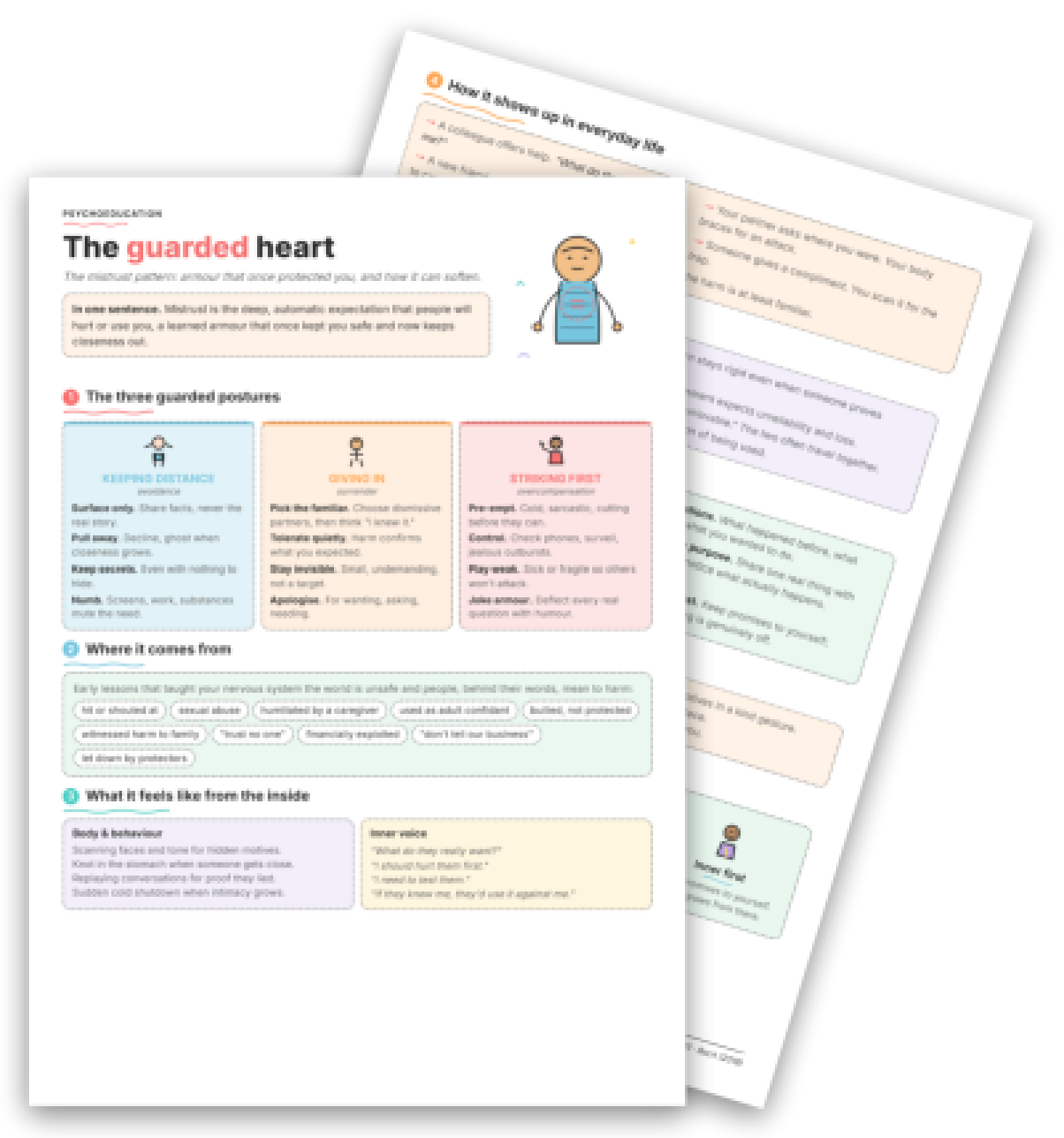
The fiche, titled "The guarded heart," organises the schema across seven numbered panels that you work through collaboratively. The clinical value of the layout is that it makes abstract coping responses visible and side by side.
Panel 1 maps the three guarded postures the schema generates: keeping distance (avoidance: sharing only facts, pulling away as closeness grows), giving in (surrender: choosing dismissive partners, staying invisible, apologising for having needs), and striking first (overcompensation: pre-empting with sarcasm, controlling behaviour, jealous outbursts). Seeing these three columns simultaneously lets patients locate themselves without needing to accept a label first. You can ask "which of these does your nervous system go to fastest?" and the conversation becomes observational rather than diagnostic. This maps neatly onto the coping styles framework in schema therapy.
Panel 2 lists the early learning experiences that calibrated the nervous system toward threat: being hit or shouted at, sexual abuse, being used as an adult confidant, witnessing harm to a family member, growing up with rules like "trust no one" or "don't tell our business." Seeing this list lets the patient recognise the function the schema once served, not just its current cost. The fiche names this explicitly: "You learned this for a reason. It kept you safe."
Panels 3 and 4 shift to phenomenology: body sensations ("knot in the stomach when someone gets close"), inner voice quotes ("What do they really want?", "I need to test them"), and everyday micro-examples ("A new friend gets warm. You suddenly find reasons to cancel."). These ground abstract schema theory in recognisable lived experience.
Panel 5 handles the differential directly, distinguishing the schema from paranoia, abandonment fear, shame, and social anxiety. Printed on the fiche, this distinction does not feel like a correction; it reads as nuance, which preserves the alliance.
Panel 6 offers six concrete directions for softening the schema, from naming the activation to taking small risks toward vulnerability, and Panel 7 provides three reflective prompts explicitly framed for the next session.
> Key point: the fiche is a visual psychoeducation support that facilitates the explanation of the mistrust/abuse schema during the session; it is not a self-administered questionnaire, but a shared reference that clinicians use to structure a nuanced conversation and leave the patient with a concrete take-home anchor.
Clinical library
750+ clinical tools
A library built with and for clinicians, ready to use in session and extend between appointments.
Access all the toolsSeveral resource types
Psychoeducation handouts
Understand at a glance
Interactive exercises
To do and fill in
Interactive programs
A structured path
Audios
Meditation and relaxation
Psychometric tests
Automatic scoring
When and How to Introduce the Fiche
The right moment is typically once a provisional formulation is in place, after the first anamnesis has surfaced relational avoidance, testing behaviour, or a history of harm by caregivers. Introducing it too early, before sufficient alliance, risks the patient reading the schema label through the very lens you are trying to name.
A low-threat introduction: "I have a diagram that describes a pattern a lot of people develop after early relationships that felt unsafe. I'd like to look at it with you and tell me what fits, what doesn't." This frames the fiche as exploratory, not diagnostic, and positions the patient as the expert on their own experience.
Useful profiles:
- Patients with attachment disruption, complex trauma, or a history of relational harm who intellectualise their guardedness without linking it to schema maintenance
- Patients oscillating between avoidance and aggressive pre-emption who benefit from seeing both as the same underlying schema, not contradictory traits
- Patients working on trust-building in a current relationship who need a shared language for the moments their nervous system overrides the evidence
After reviewing the fiche together, the most productive debrief question is usually Panel 7's first prompt: "When have you noticed yourself testing someone close to you this week?" That keeps the schema alive in between-session experience rather than confined to the consultation room. The fiche does not replace the formulation work; it makes it portable.
Use it with your patients
Share this tool in the mobile app and follow the work between sessions.
Sources
- Young, J. E., Klosko, J. S., & Weishaar, M. E. (2003). Schema Therapy: A Practitioner's Guide. Guilford Press.
- Young, J. E., & Klosko, J. S. (1993). Reinventing Your Life: The Breakthrough Program to End Negative Behavior and Feel Great Again. Plume.
- Rafaeli, E., Bernstein, D. P., & Young, J. E. (2011). Schema Therapy: Distinctive Features. Routledge.
- Petrenko, V. (2025). Schema therapy in addressing betrayal trauma: Overcoming the long-term consequences of trust violations.
Patient mobile app
Your session continues in your patients' pocket
Use with a patientYour resources, available everywhere
The handouts, exercises, programs and audios above: you choose which ones to make available to your patients, in the mobile app dedicated to them.
Psychoeducation handoutsInteractive exercisesInteractive programsAudiosPsychometric tests
And far more than a library
The app goes well beyond resources, to support your patients every day:
Standardized tests
Therapy journal
Gamification
Wellbeing challenges
Introspection prompts
Therapist homework
Related categories
Explore other clinical resources by category.

Trauma
Clinical hub on trauma and PTSD: assessment, differential diagnosis, treatment phases, and printable resources for practitioners. 155 chars.
Relationships
Clinical worksheets and tools on relational functioning: attachment, schemas, assertiveness, and communication skills for therapists. Printable PDF resources.

Understand
Clinical hub for the therapeutic aim 'Understand': worksheets and tools to build patient insight across CBT, ACT, schema therapy and more.

Build awareness
Clinical worksheets and tools to build awareness in therapy: cognitive distortions, schemas, emotions, ACT and CBT resources for practitioners.

Schema therapy
Schema therapy clinical resources for practitioners: worksheets, exercises, and programs targeting early maladaptive schemas, core beliefs, and schema modes.
Anxiety
Clinical hub for anxiety disorders: CBT and ACT worksheets, psychoeducation sheets, and exercises for assessment and treatment across the anxiety spectrum.