
Clinical picture. M., a woman in her early forties, presented with a longstanding pattern of emotional suppression following recurrent professional setbacks; she described keeping busy as her main coping strategy. During the intake session, her clinician introduced the resilience psychoeducation program and oriented her to Lesson 1, asking her to work through its steps before their next appointment. When she returned, M. had completed the guided prompt on recent sadness and selected 'I tried to think of something else' as her typical response to difficult emotions, which opened a productive conversation about the difference between resilience and resistance as framed in the lesson. She acknowledged, with some surprise, that her busyness had functioned as avoidance rather than recovery. No major reorientation of treatment was warranted at that stage, though the shared vocabulary established by the lesson made subsequent emotion-focused work more accessible.
Resilience: A Structured Psychoeducation Program for Clinicians
A 4-lesson between-session program helping patients understand, build, and sustain resilience through guided reflection and concrete skill steps.
Clinical vignettes
Avoidance Reframed Through Psychoeducation
Engagement With Emotion Monitoring in a Reluctant Patient
Clinical picture. T., a man in his mid-thirties with a history of generalised anxiety, initially expressed scepticism about any form of self-reflection, describing it as 'overthinking.' His clinician framed Lesson 1 of the program as a brief, structured reading task rather than an introspective exercise, lowering the entry threshold. T. completed the multiple-choice step on physical sensations of sadness and ticked 'tightness in the stomach' and 'heaviness in the eyes,' noting it was the first time he had connected those sensations to an emotional state. In the following session he was able to reference that experience when discussing a conflict at home, applying the lesson's distinction between acknowledging an emotion and being overwhelmed by it. Progress remained modest and incremental, consistent with his presentation, but his willingness to engage with subsequent lessons increased noticeably.
Use this resource with your patients
Handout, exercises and materials ready to use, right inside SessionFuel.
What Makes Resilience Hard to Transmit Clinically
Resilience is one of those concepts patients have usually heard before they walk into your office, yet rarely understand. They conflate it with stoicism, emotional suppression, or simply "being tough." When you try to correct that verbally, the correction rarely sticks: the word has too much cultural sediment around it. What patients genuinely need is a structured opportunity to examine their own emotional responses, identify where they resist rather than welcome their feelings, and build the internal habits that allow them to bend without breaking.
That gap between knowing and doing is where oral psychoeducation hits its limit. Explaining the difference between resilience and resistance is one thing; helping a patient sit with that distinction, apply it to a recent moment of sadness, notice their body's signals, and then reflect on what meditation could offer them, that requires time, repetition, and personal engagement that a single consultation cannot hold.
This program was built precisely for that gap.

What the Program Contains
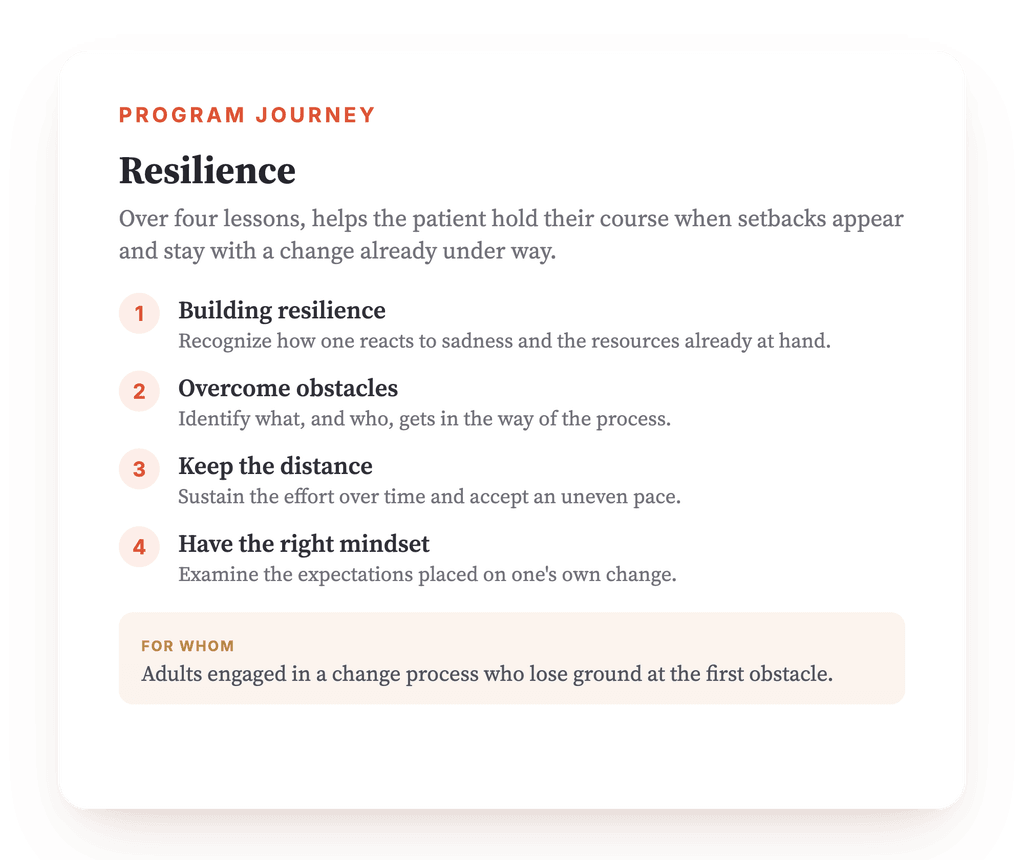
The curriculum unfolds across four lessons, each building on the last. Lesson 1 opens with the core question, what resilience actually is, and immediately reframes it: welcoming emotions, not bypassing them. Patients explore situations where they struggle to bounce back, reflect on a recent experience of sadness and how they responded to it, identify the physical sensations of that emotion, and are introduced to meditation as a tool for creating space between stimulus and response.
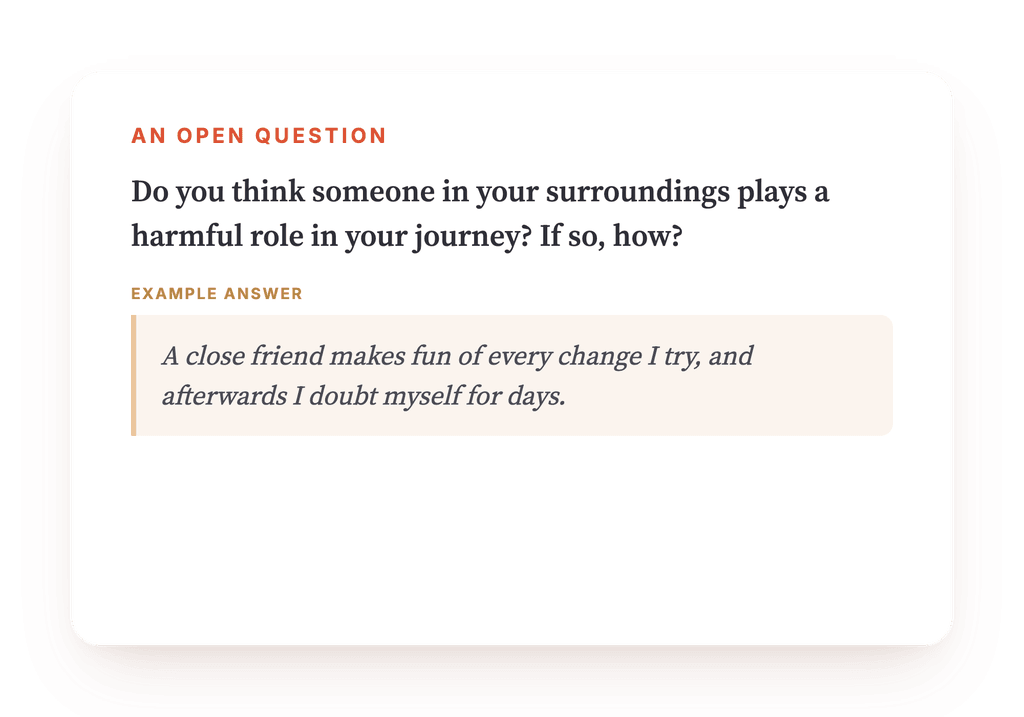
Lesson 2 addresses predictable obstacles: feeling like a special case disconnected from what the content describes, the temptation to seek external validation for the therapeutic journey, the complexity of relationships built around patterns the patient now wants to change, and the fear of relapse when early gains appear. Patients name their personal vision and articulate the message they would need to hear on a hard day.
Lesson 3 focuses on going the distance, the mechanics of sustainable commitment. It dismantles the myth that motivation is a prerequisite for action, introduces the value of small, consistent steps over grand intentions, and teaches patients to track progress across time rather than measuring only against the worst days. The lesson closes with a reflection on appreciating the process itself, not just the destination.
Lesson 4 works on mindset: the difference between wanting to change because you hate where you are versus choosing to grow from a place of genuine self-regard. Patients examine what beliefs they are ready to question, reflect on what it means to take reasonable risks, practice self-compassion in moments of stagnation, and reconnect with a forward-looking perspective when circumstances feel defeating.
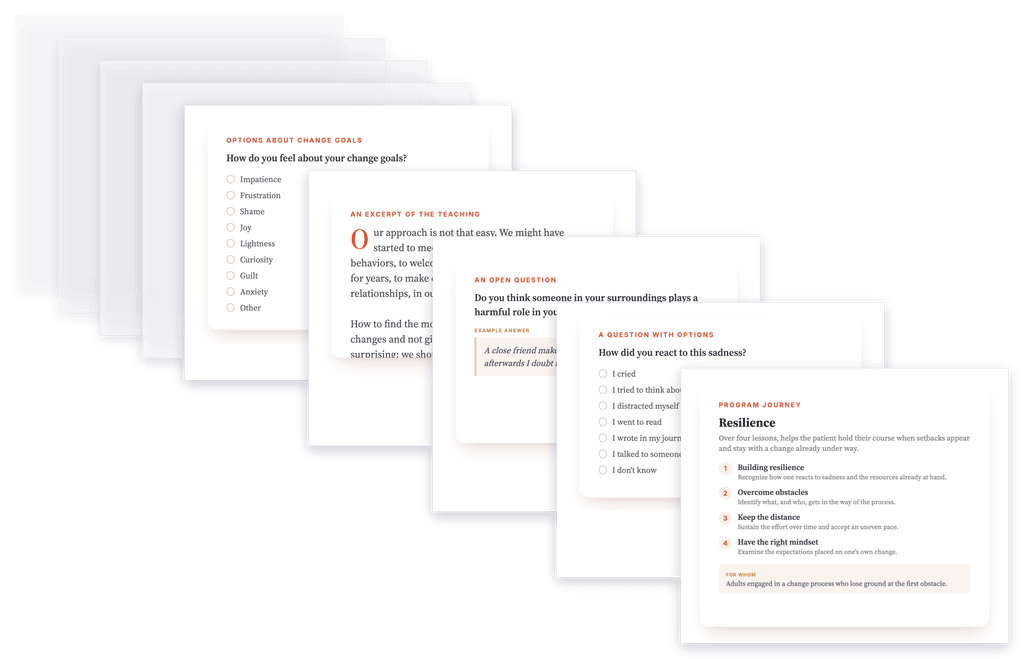
Throughout, the program weaves structured multiple-choice questions, personal reflection prompts, and short psychoeducation texts into a coherent arc that patients can follow at their own pace. These preview images, the overview map and the sample cards embedded here, show only a fraction of the program; the complete curriculum contains far more lessons, steps, exercises, and guided prompts than these aperçus reveal.
This program is available to patients through the mobile application that is the dedicated patient-side interface of SessionFuel: once you assign it in your SessionFuel account, your patient receives it directly on their phone and works through each lesson independently, between your appointments.
750+ clinical tools
A library built with and for clinicians, ready to use in session and extend between appointments.
Access all the toolsIntegrating It as Between-Session Homework
Which patients: This program suits adults who are motivated to understand their own emotional patterns and willing to engage with personal reflection between appointments. It works particularly well alongside work on emotional regulation, with patients who have identified avoidance as a key maintaining pattern (the Cycle of Avoidance fiche makes a strong companion), or wherever low distress tolerance is keeping progress stalled. Patients working on self-image and depression or processing sadness also benefit, since both programs address similar themes around emotional avoidance.
How to introduce it: Frame it simply: between now and the next appointment, there is a structured set of steps to work through, each of which asks a question or offers a short reading. It is not homework in the punitive sense, it is a personal exploration they conduct at their own pace. You might say that the lessons build on what you have started together in the room and give them space to go further on their own. Pairing the first lesson with your oral discussion of the function of emotions or the distinction between resilience and suppression creates a direct bridge.
How to use what they bring back: The program generates concrete material, written reflections, multiple-choice answers about how they responded to a recent sadness, their stated vision, the self-compassion prompts from Lesson 4. These become the opening of your next conversation. Ask which step surprised them, which felt obvious, and which they resisted. If a patient's answers in Lesson 3 reveal persistent staying motivated difficulties, that opens targeted work. If Lesson 2's relational prompts surface a specific person whose presence feels destabilising, you have a precise clinical thread to pull.

Use it with your patients
Share this tool in the mobile app and follow the work between sessions.
Adaptations and Articulations
For patients who find all-or-nothing thinking a barrier to staying the course, pairing Lesson 3 with the Stages of Change fiche and the Progress in Therapy worksheet helps normalise the non-linear nature of the work. Patients prone to harsh self-judgment when they miss a step benefit from introducing Practicing Self-Compassion or Compassion Focused Therapy concepts before they begin Lesson 4, so the mindset shift that lesson calls for has a conceptual scaffold already in place. For patients where cognitive rigidity is prominent, the Developing a Growth Mindset fiche and the Comfort, Stretch and Panic Zones fiche provide vocabulary that maps cleanly onto what Lessons 3 and 4 ask of them.
Key insight: The clinical value of this program lies not only in what it teaches, but in the specific written trace each patient leaves as they move through it, material that makes your next session more precise, more personal, and more productive.
For patients simultaneously working on relational patterns, the Protective Factors fiche offers a domain-by-domain mapping of resilience resources that complements the program's introspective arc with a broader ecological view.
Your session continues in your patients' pocket
Use with a patientYour resources, available everywhere
The handouts, exercises, programs and audios above: you choose which ones to make available to your patients, in the mobile app dedicated to them.
And far more than a library
The app goes well beyond resources, to support your patients every day:
Related categories
Explore other clinical resources by category.

Anxiety
Clinical hub for anxiety disorders: CBT and ACT worksheets, psychoeducation sheets, and exercises for assessment and treatment across the anxiety spectrum.

Trauma
Clinical hub on trauma and PTSD: assessment, differential diagnosis, treatment phases, and printable resources for practitioners. 155 chars.

Mood
Evidence-based worksheets and clinical tools for mood disorders: CBT, ACT, and positive psychology resources for psychologists and therapists.

Identity
Clinical resources for self-identity work in therapy: CBT, ACT, schema tools for clinicians addressing self-concept, core beliefs, and identity disruption.

Emotions
Clinical resources on emotion regulation: worksheets, coping tools, CBT, REBT, and ACT exercises for therapists working across diagnoses and age groups.

Behaviours
Clinical hub for behaviors in therapy: worksheets and tools for coping, eating disorders, CBT formulation, and maladaptive behavioral patterns.