
Clinical picture. M., a woman in her late thirties, presented with a third depressive episode marked by persistent low self-worth and social withdrawal. Her clinician introduced the psychoeducation program A Better Self-Image and asked her to work through Lesson 1 before their next appointment. Completing the multiple-choice step on limiting beliefs, M. selected "I am not good enough" and "Nobody pays attention to me," then added a written reflection on how childhood comparisons with a high-achieving sibling had reinforced both. When the clinician reviewed her responses in session, M. noted mild surprise at recognising the beliefs as longstanding rather than purely mood-driven. This shared starting point allowed the clinician to introduce cognitive restructuring without M. feeling that the framing had been imposed.
Self-Image and Depression: A 4-Lesson Clinical Program
A structured between-session program helping patients understand and rebuild self-image when depression and low self-esteem reinforce each other.
Clinical vignettes
Mapping Limiting Beliefs in Recurrent Depression
Social Comparison Patterns in a Young Adult
Clinical picture. T., a man in his mid-twenties with moderate depression and a history of workplace difficulties, reported spending several hours daily on social media and leaving each session feeling worse about himself. The clinician assigned the guided prompt on social comparison contexts from Lesson 1 of the program, asking T. to complete it between appointments. T. identified that he compared primarily his professional situation and life achievements, and his written response included a specific account of monitoring a former classmate's career updates. Reviewing this in the following session, the clinician used T.'s own words to illustrate the selective upward-comparison pattern described in the lesson text. The structured format gave T. a concrete vocabulary for what had previously felt like a vague, chronic sense of inadequacy.
Use this resource with your patients
Handout, exercises and materials ready to use, right inside SessionFuel.
Why self-image is genuinely hard to shift in the consulting room
Negative self-image is one of the most tenacious features of depression, and one of the trickiest to address verbally. The clinical challenge is not conceptual: most patients have already heard that they are "too hard on themselves." The problem is that their inner experience does not update from explanation alone. Limiting core beliefs ("I am worthless," "I don't deserve to be loved") crystallize through years of social feedback, automatic negative thoughts, and relentless social comparison, all operating below deliberate awareness. Oral psychoeducation rarely dislodges them because the patient's cognitive distortions simply filter out the counter-evidence in real time.
The cycle of depression makes this doubly difficult: depression generates a negative self-image, and a negative self-image deepens depression. Breaking this loop calls for structured, repeated practice across multiple domains, social processes, inner dialogue, assertiveness, self-compassion, far more than a single session can hold.

750+ clinical tools
A library built with and for clinicians, ready to use in session and extend between appointments.
Access all the toolsWhat this four-lesson program contains
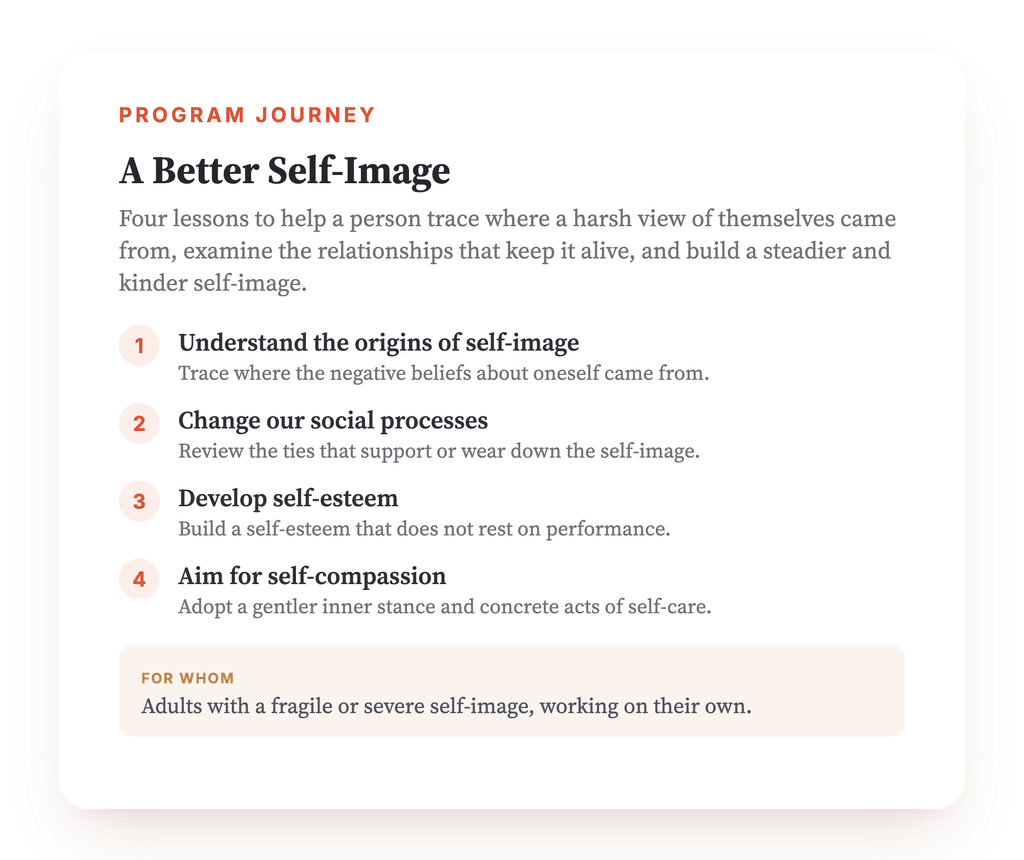
This program guides patients through a coherent arc of four progressive lessons, each tackling a distinct lever of self-image work.
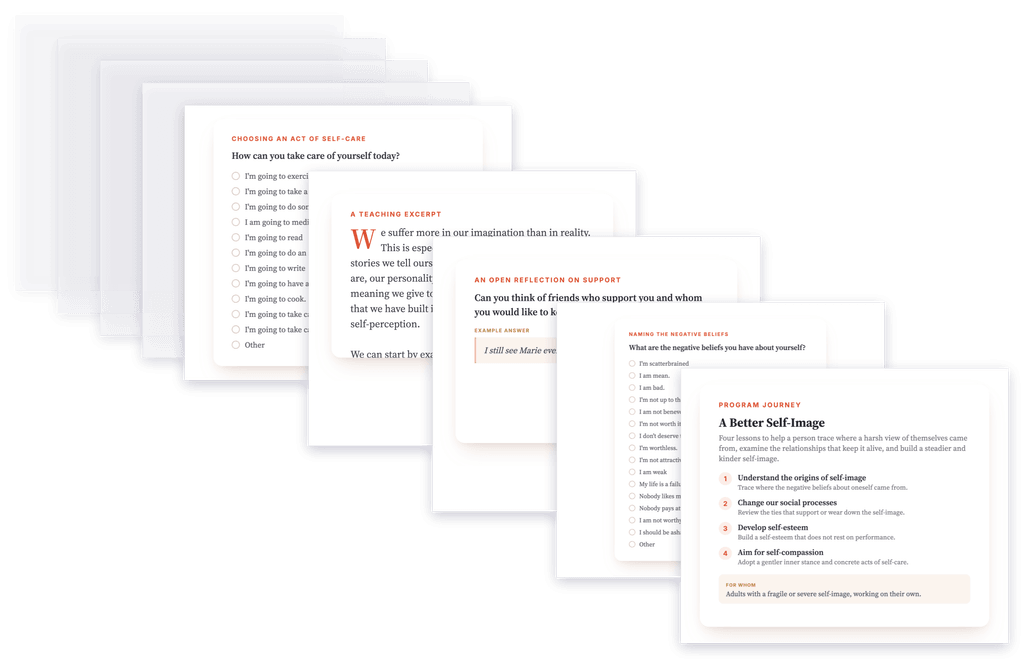
Lesson 1, Understanding the origins of self-image opens the inquiry: how does the social environment shape self-perception? The patient reflects on their specific early maladaptive schemas, identifies which negative automatic thoughts dominate, selects from a structured list the limiting beliefs that fit their experience (from "I am worthless" to "I should be ashamed"), and maps the contexts in which they compare themselves to others, physical appearance, professional situation, social skills, life choices, and more.
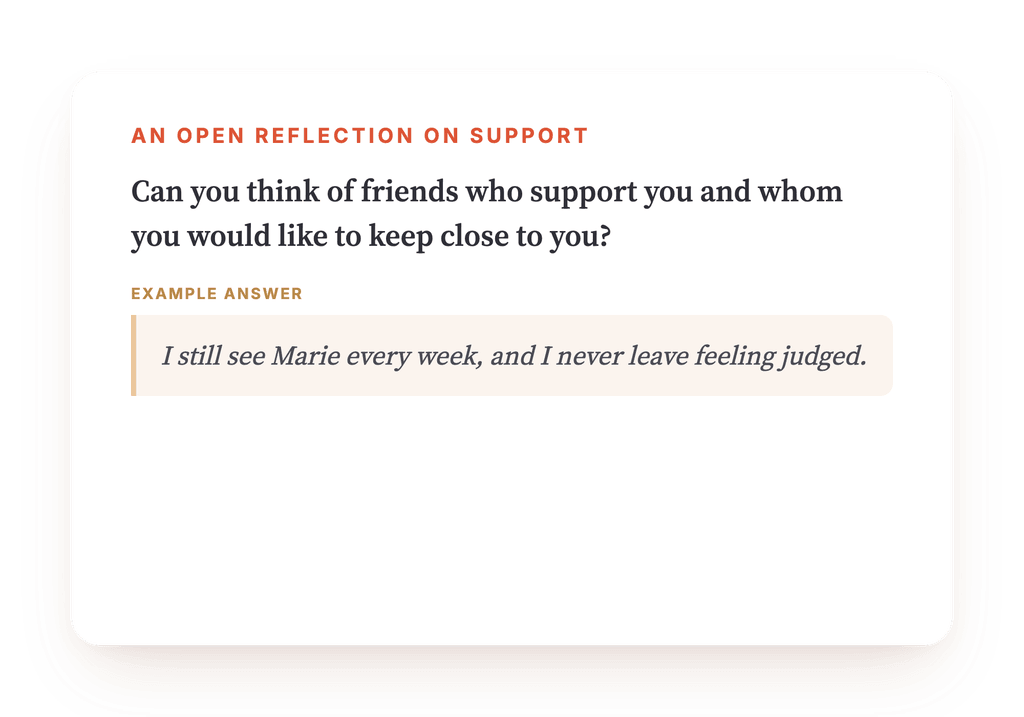
Lesson 2, Changing social processes moves to action: how to reduce damaging social comparisons, identify supportive versus undermining relationships, interrupt self-judgment by replacing negative automatic thoughts with more balanced alternatives, and begin setting boundaries through a guided multiple-choice exercise covering time, energy, emotional, conversational, and opinion limits. This lesson connects naturally to the Assertive Rights framework and boundary styles work.
Lesson 3, Developing self-esteem introduces four concrete practices: rewriting the personal narrative (both the life story and the daily interpretive story), assertive self-expression, shifting inner dialogue from criticism to self-encouragement, and a daily success-tracking prompt ("what three things did you do well today?"). The Fennell CBT model of low self-esteem and the What Keeps Low Self-Esteem Going maintenance cycle sit directly behind this lesson's logic.
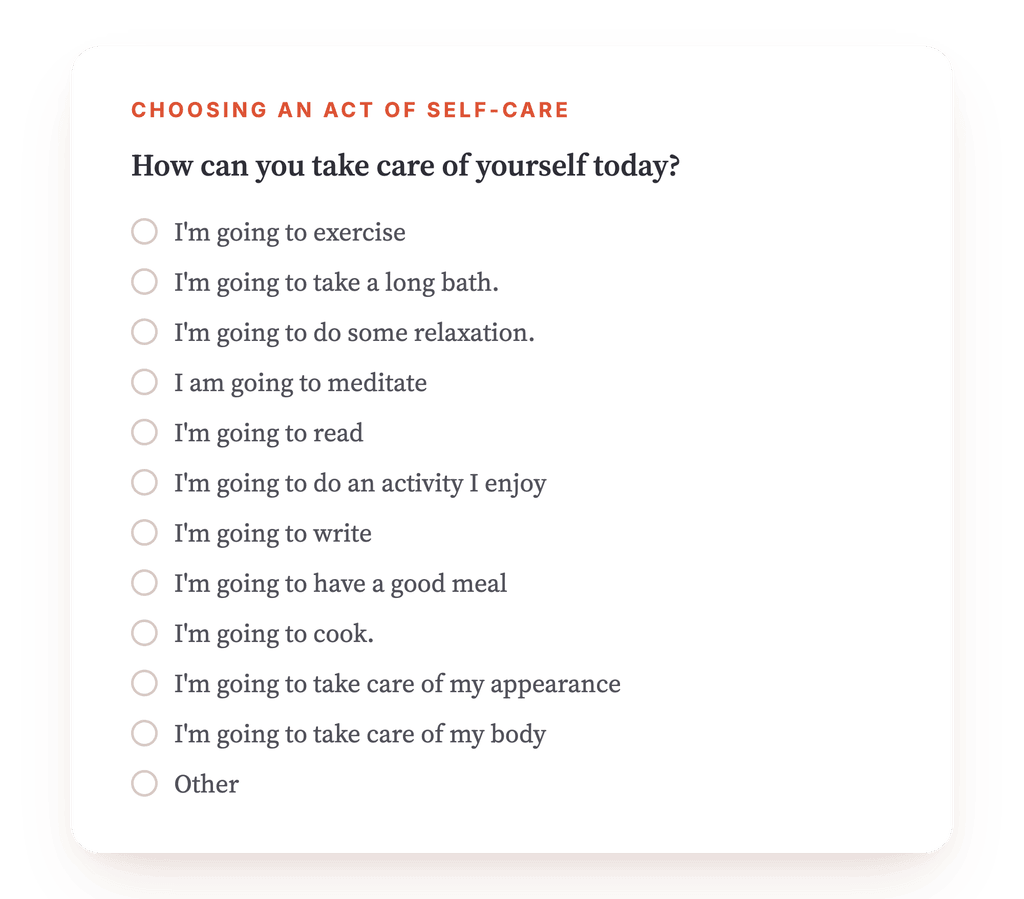
Lesson 4, Aiming for self-compassion closes the arc with self-acceptance: patients reflect on which personal flaws they could begin to hold without rejection, practise defusing from negative thoughts as mental events rather than facts (a core ACT move visible in Psychological Flexibility), choose a concrete self-care action from a guided list, and begin a gratitude journal practice.
This program is available to patients through the mobile application that is the dedicated patient-side interface of SessionFuel: once you assign it, your patient receives the full four-lesson curriculum on their phone and works through each step on their own, at their own pace.
The preview images embedded below, the program overview map and a couple of sample cards, show only a small fraction of the program. The complete curriculum contains many more steps, guided prompts, structured multiple-choice questions, and psychoeducation texts than what is visible here.
Use it with your patients
Share this tool in the mobile app and follow the work between sessions.
Integrating it as between-session homework
Patient profile. This program suits patients presenting with depression where low self-image is a central maintaining factor, those with defectiveness or shame schemas, patients caught in chronic self-criticism (see Transforming Self-Critical Thoughts), and anyone for whom assertiveness and boundary work are clinically relevant. It works alongside Compassion Focused Therapy frameworks and pairs well with the Inner Dialogue Psychoeducation program.
How to introduce it. Assign the first lesson after a session in which you have already named the self-image loop together, for instance, using Thoughts and Depression or the Core Beliefs About Self, Others, and World fiche as a shared map. Frame it simply: "Between now and our next meeting, I'd like you to go through the first lesson at your own pace and answer the questions as honestly as you can. There are no right answers."
How to use what the patient brings back. The program's written outputs, belief checklists, comparison contexts, boundary choices, rewritten narratives, gratitude entries, become direct clinical material. The limiting beliefs selected in Lesson 1 feed naturally into downward arrow or schema-focused restructuring work. The boundary choices from Lesson 2 open an assertive communication conversation. The inner-dialogue prompts from Lesson 3 can be deepened with the Self-Criticism and Negativity Bias exercise or the Self-Compassion After Mistakes exercise. The self-acceptance reflection from Lesson 4 bridges into self-forgiveness work or the Self-Acceptance and Self-Compassion guided exercise.
Key insight: The program's value is not that it replaces the therapeutic relationship, it is that it keeps the work alive between sessions, giving patients repeated structured contact with the concepts, and giving you richer, more concrete material to work with each time they return.
Your session continues in your patients' pocket
Use with a patientYour resources, available everywhere
The handouts, exercises, programs and audios above: you choose which ones to make available to your patients, in the mobile app dedicated to them.
And far more than a library
The app goes well beyond resources, to support your patients every day:
Related categories
Explore other clinical resources by category.

Mood
Evidence-based worksheets and clinical tools for mood disorders: CBT, ACT, and positive psychology resources for psychologists and therapists.

Identity
Clinical resources for self-identity work in therapy: CBT, ACT, schema tools for clinicians addressing self-concept, core beliefs, and identity disruption.

Understand
Clinical hub for the therapeutic aim 'Understand': worksheets and tools to build patient insight across CBT, ACT, schema therapy and more.
Repair & soothe
Clinical resources for the repair and soothe therapeutic aim: worksheets, exercises and tools to build self-compassion, reduce shame and restore emotional safety.
CBT
CBT worksheets, cognitive restructuring exercises & behavioral tools for clinicians. Evidence-based resources for every phase of cognitive behavioral therapy.

Compassion-focused
CFT clinical tools for practioners: exercises, programs and guided audio on shame, self-criticism, guilt and self-compassion. Ready to use in session.