
Clinical picture. M., a 34-year-old professional, presents with generalised anxiety and reports a pervasive sense of dread that she attributes to her workload. During session four, her therapist introduces the three-column S-E-T log and asks her to complete one entry before the next appointment, focusing only on describing the situation factually, naming the emotion with a rating, and writing the automatic thought verbatim. M. returns with an entry reading: situation, "Monday 8 a.m., opened laptop, saw 23 unread emails"; emotion, "anxiety 7/10"; thought, "I will never catch up and everyone will see I can't cope" (belief rating 8/10). She notes, with some surprise, that writing the thought in quotation marks made it feel slightly less absolute, though her anxiety remained largely unchanged. The therapist acknowledges this as the intended first step: observation before any disputation.
Automatic Thoughts (S-E-T): PDF Worksheet, Tools and Exercises
A visual PDF worksheet, clinical tools, and exercises to help patients observe automatic thoughts in session and carry the S-E-T framework into daily life.
Clinical vignettes
S-E-T Worksheet in Generalised Anxiety
Separating Emotion from Thought in Depression
Clinical picture. T., a 47-year-old man seen for a moderate depressive episode, frequently phrases his distress as "I just felt worthless all afternoon," conflating emotion and cognition in a way that makes collaborative work difficult. His therapist uses the S-E-T structure to slow this down, prompting T. to separate the situation ("sitting alone in the kitchen after dinner"), the emotion ("sadness 6/10"), and the actual sentence that had crossed his mind ("nobody would notice if I disappeared", belief rating 5/10). T. initially resists, saying the distinction feels artificial, but he agrees to keep a paper log for one week. At the following session he reports that catching the thought as a sentence, rather than experiencing it as a mood, gave him a brief moment of distance on two occasions, though he does not yet find this consistently useful.
Explaining automatic thoughts orally works well enough for clinicians, but most patients leave the session unable to catch one in real life. They understand the principle, nod along with your examples, and then report the following week: "I just felt bad, I don't know why." This fiche PDF on the S-E-T model (Situation, Emotion, Thought) gives you a concrete visual support to use during the session itself, so the concept lands before the patient walks out the door.
Use this resource with your patients
Handout, exercises and materials ready to use, right inside SessionFuel.
Why Automatic Thoughts Are Hard to Grasp Without a Visual Support
The central difficulty is phenomenological: patients experience their automatic thoughts as facts about reality, not as cognitive events occurring between a situation and a feeling. When you explain this verbally, the corrective feels abstract. And premature psychoeducation about cognitive distortions, without first establishing the observation habit, tends to slide into intellectualisation.
A second obstacle is the thought-emotion conflation that almost every patient brings to the first few sessions. Sentences like "I felt like a failure" or "I felt he was judging me" blur what happened, what was thought, and what was felt into a single undifferentiated mass. Until the patient can separate these three columns reliably, cognitive restructuring exercises and cognitive distortion work lack the raw material they need.
The fiche addresses both obstacles at once by making the three-column structure visible rather than narrated.
What the S-E-T Fiche Contains
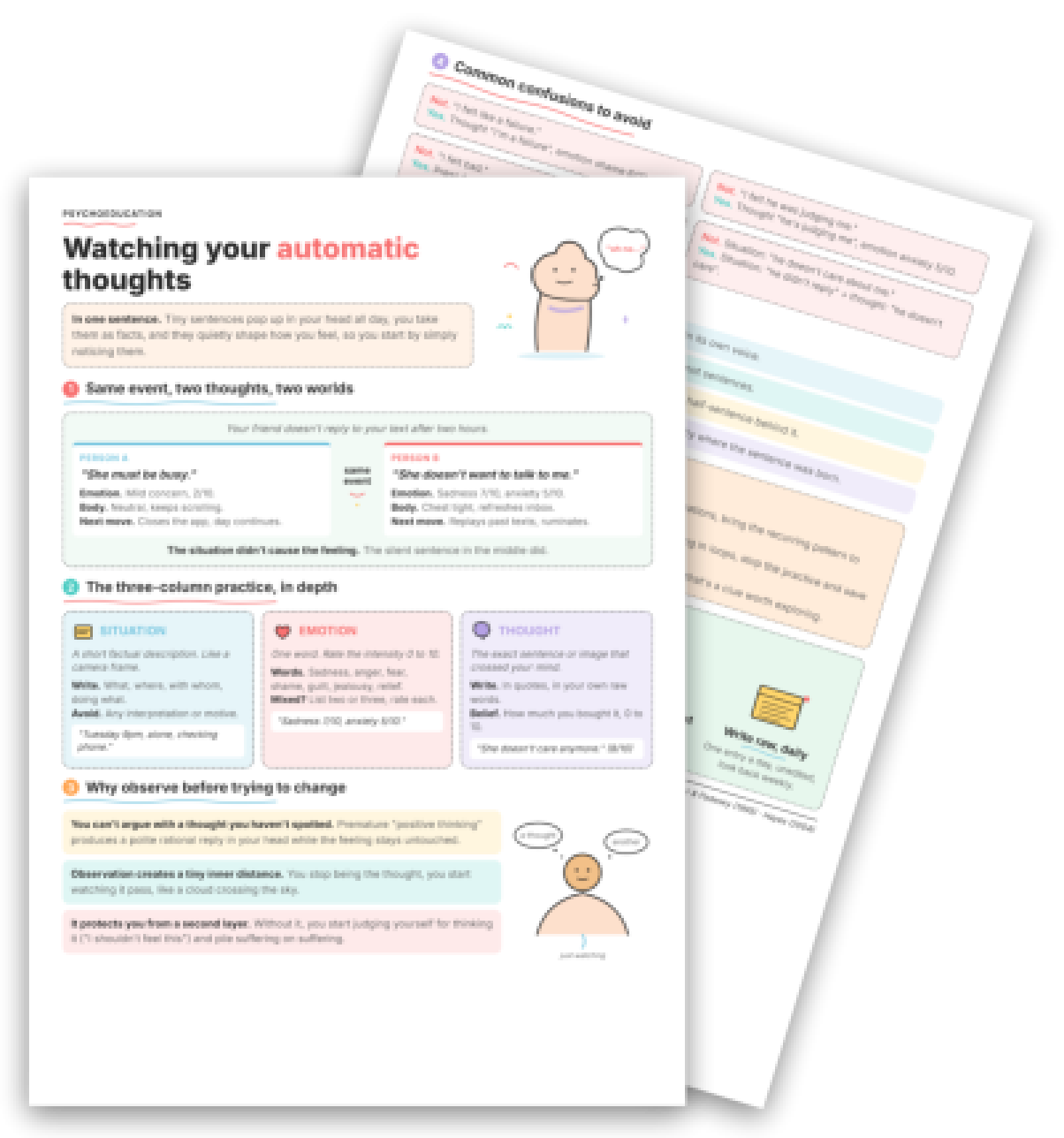
The fiche opens with a comparison panel: the same event (a friend who does not reply to a text after two hours) produces two completely different emotional and behavioral sequences depending on the thought inserted between situation and feeling. Person A thinks "She must be busy" and moves on; Person B thinks "She doesn't want to talk to me" and ruminates. The tagline at the bottom of the panel reads: "The situation didn't cause the feeling. The silent sentence in the middle did." Displaying this panel in session is faster and more precise than any verbal analogy.
The three-column practice then unpacks each element with operational instructions:
- Situation: a camera-frame description, no interpretation, no inferred motive (example given: "Tuesday 9pm, alone, checking phone")
- Emotion: one word, rated 0 to 10; mixed emotions listed separately
- Thought: the exact sentence or image, written in quotes, with a belief-strength rating from 0 to 10
A dedicated panel covers common confusions to avoid, with concrete before/after pairs. The fiche distinguishes "I felt like a failure" (fused) from the correctly separated: Thought "I'm a failure," emotion shame 6/10. This section alone resolves the diagnostic muddle that slows down the first weeks of CBT-based thought record work.
For patients who freeze when asked to identify a thought, the fiche provides five unlocking prompts: "What did that emotion just say to me?", "What image flashed in my mind?", and so on. These map directly onto what you would do verbally in session with a thought-catching exercise, but the written version gives the patient a portable scaffold for between-session practice.
A "To discuss in session" block closes the fiche with three flagged situations: recurring sentences across different contexts, thoughts too intense to write alone, and the habit of editing thoughts to sound reasonable. This last flag is clinically precise and worth debriefing explicitly.
> Key takeaway: The S-E-T fiche is a visual support that facilitates the explanation of automatic thoughts in session. You use it to walk the patient through the model; they leave with a reference they can consult between appointments, not a form to fill out alone.
750+ clinical tools
A library built with and for clinicians, ready to use in session and extend between appointments.
Access all the toolsHow and When to Introduce the Fiche
The fiche fits naturally at the psychoeducation phase, typically sessions two to four, after you have enough anamnesis to anchor examples in the patient's own material. It is particularly useful with patients who present intellectualised accounts of their distress, with social anxiety profiles who conflate others' intentions with their own interpretations, and with any patient where the cognitive triangle has been introduced but not yet grounded in daily observation.
You can introduce it with something like: "I'd like to show you a map of what happens between an event and how you feel. Let's look at it together and use something that came up for you this week." Walk through the two-person panel first, then co-construct one S-E-T entry using the patient's own material from the session. The ABC model covers similar terrain if you are working in an REBT framework; the S-E-T fiche is closer to Beck's original formulation and integrates naturally with defusion work when you move toward third-wave techniques.
One limit worth naming: patients with acute dissociation or who are still in crisis stabilisation may find the introspective demand of the thought column activating. In those cases, defer to grounding exercises first. For patients who are ready, the debrief question that yields the most clinical information is: "Which column felt hardest to fill in?" The answer often points directly to the next formulation target.
The fiche does not replace the therapeutic frame; it makes the explanation cleaner and leaves the patient with a concrete reference between sessions.
Use it with your patients
Share this tool in the mobile app and follow the work between sessions.
Sources
- Beck, A. T., Rush, A. J., Shaw, B. F., & Emery, G. (1979). Cognitive Therapy of Depression. Guilford Press.
- Beck, A. T. (1979). Cognitive Therapy and the Emotional Disorders. Meridian / New American Library.
- Beck, J. S. (2021). Cognitive Behavior Therapy: Basics and Beyond (3rd ed.). Guilford Press.
- Burns, D. D. (1980). Feeling Good: The New Mood Therapy. William Morrow.
- Hollon, S. D., & Kendall, P. C. (1980). Cognitive self-statements in depression: Development of an automatic thoughts questionnaire. Cognitive Therapy and Research, 4(4), 383-395.
Your session continues in your patients' pocket
Use with a patientYour resources, available everywhere
The handouts, exercises, programs and audios above: you choose which ones to make available to your patients, in the mobile app dedicated to them.
And far more than a library
The app goes well beyond resources, to support your patients every day:
Related categories
Explore other clinical resources by category.
Anxiety
Clinical hub for anxiety disorders: CBT and ACT worksheets, psychoeducation sheets, and exercises for assessment and treatment across the anxiety spectrum.

Mood
Evidence-based worksheets and clinical tools for mood disorders: CBT, ACT, and positive psychology resources for psychologists and therapists.

Identity
Clinical resources for self-identity work in therapy: CBT, ACT, schema tools for clinicians addressing self-concept, core beliefs, and identity disruption.

Cognition
Printable cognitive therapy worksheets and clinical tools for therapists: CBT, ACT, schema work, defusion, distortions, and belief restructuring.

Build awareness
Clinical worksheets and tools to build awareness in therapy: cognitive distortions, schemas, emotions, ACT and CBT resources for practitioners.

CBT
CBT worksheets, cognitive restructuring exercises & behavioral tools for clinicians. Evidence-based resources for every phase of cognitive behavioral therapy.