
M., a man in his late thirties presenting with persistent low mood, repeatedly described his emotional state using phrases such as "I feel like no one would notice if I disappeared." The clinician introduced the informational sheet mid-session, drawing attention to the linguistic giveaway section and asking M. to locate his statement on the page. M. identified, with some surprise, that his phrase followed the "I feel like" pattern and therefore contained a claim rather than an emotion. When asked what he actually felt in his chest when that thought arose, he paused and said "hollow, I think, and scared." Separating the two gave the clinician a clearer entry point: the thought could be examined, and the feeling could be acknowledged without either being dismissed.
Thoughts or Feelings: PDF Worksheet, Tools and Exercises for CBT Practice
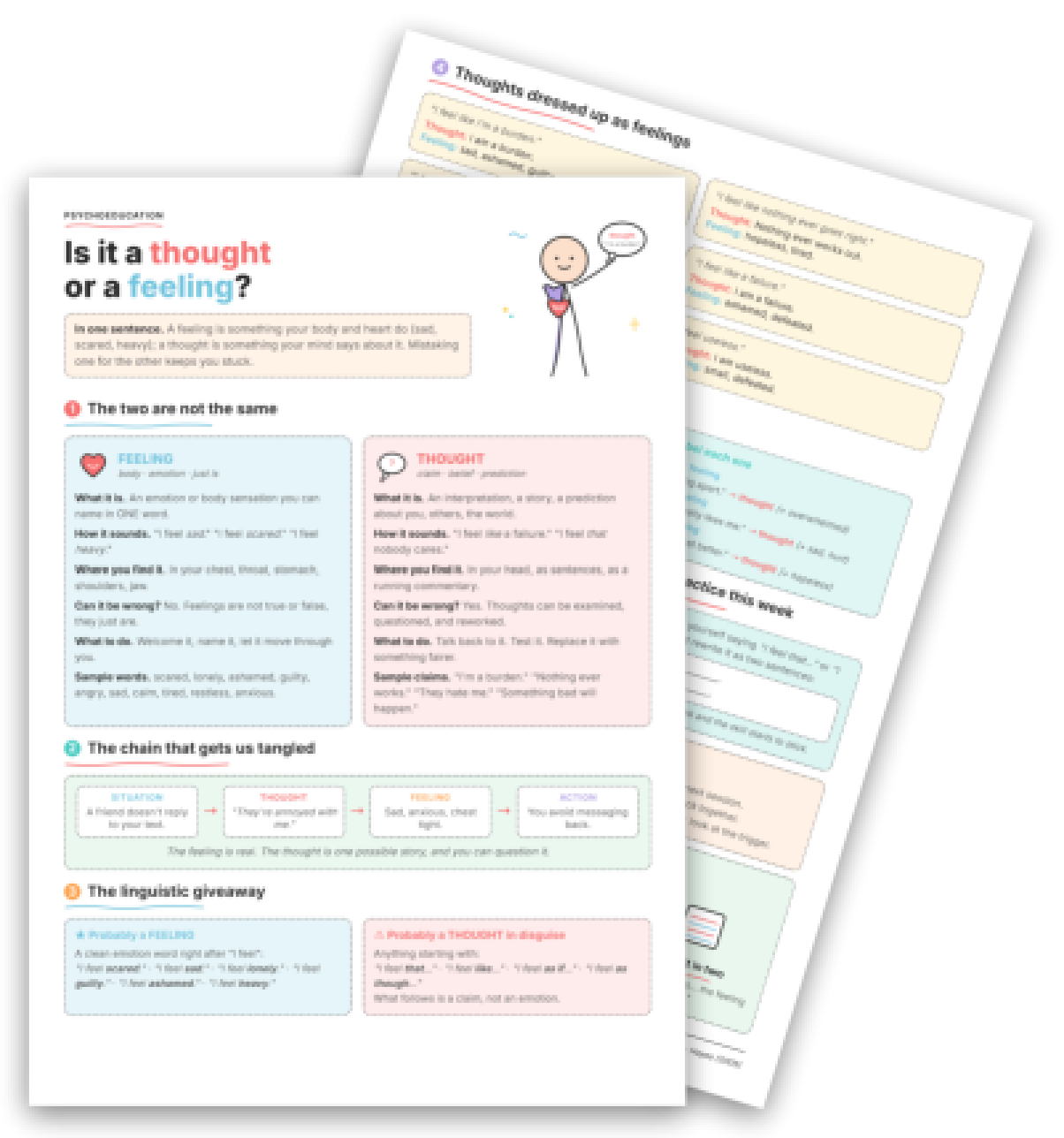
A visual psychoeducation fiche helping clinicians teach the thought/feeling distinction in session, with a side-by-side framework, real examples, and a take-home practice.
Clinical vignettes
Naming the Difference in Session
Psychoeducation Before Thought Records
K., a woman in her mid-twenties with a presentation of health anxiety, struggled to complete thought records between sessions because she consistently wrote emotions in the "thought" column and vice versa. The clinician shared the worksheet at the start of the following appointment, working through the chain example together using a recent situation K. had brought in. K. noted that what she had been calling "feeling certain something is wrong" was, according to the sheet, a prediction, not a sensation. With that distinction in place, she was able to identify a concurrent body sensation she had not previously labeled: tightness across her sternum that she named, tentatively, as dread. Subsequent thought records showed greater precision, which made cognitive restructuring more tractable.
The phrase "I feel like I'm a burden" turns up in almost every presenting problem, and patients rarely notice it contains a claim rather than an emotion. That conflation keeps the thought invisible, untested, and clinically inert. This fiche PDF gives you a visual support to break the fusion the moment it appears in session, without a lengthy detour into theory.
Use this resource with your patients
Handout, exercises and materials ready to use, right inside SessionFuel.
Why the Thought/Feeling Distinction Keeps Slipping Away
Verbal explanation alone rarely shifts this. Patients have used "I feel like..." as a feeling word their entire lives, and the linguistic habit is deeply grooved. Worse, the more painful the thought, the more it feels emotionally true, which is precisely what emotional reasoning relies on. When you say "that's actually a thought," many patients nod and immediately revert, because nothing has concretely shown them the structural difference.
The confusion also has a functional payoff: a statement that sounds like a feeling cannot be examined, which makes it a natural vehicle for cognitive distortions. Fusing cognition with emotion protects the belief from scrutiny. This is why the distinction needs a persistent, shareable anchor, not just a verbal clarification that evaporates after the session ends.
750+ clinical tools
A library built with and for clinicians, ready to use in session and extend between appointments.
Access all the toolsWhat the Fiche Contains: A Side-by-Side Visual Framework
The fiche PDF is built around seven numbered panels designed to be worked through with the patient, not handed over as reading material.
- Panel 1 contrasts FEELING (body, emotion, one word, cannot be wrong) with THOUGHT (interpretation, prediction, sentence, can be examined). The column layout makes the structural difference visible at a glance.
- Panel 2 shows the situation → thought → feeling → action chain with a concrete example: a friend who doesn't reply becomes "They're annoyed with me", which produces sadness and avoidance. Seeing this sequence drawn out helps patients recognize where automatic thoughts enter.
- Panel 3 is the linguistic giveaway: "I feel scared" stays a feeling; "I feel that / like / as if / as though..." signals a thought in disguise. This single rule, made visual, is often the most clinically productive panel.
- Panel 4 unpacks six common examples ("I feel like I'm a burden", "I feel like a failure", "I feel as if life won't get better"), splitting each into its embedded thought and the genuine underlying emotion. You can use these to train the patient's ear for their own speech.
- Panel 5 offers a two-question self-test and a short labelled mini-quiz, useful for debrief within the session or as a check-in the following week.
- Panel 6 addresses the "but it really feels true" objection directly: "The more painful the thought, the more convincing it usually sounds, and the more important it is to name it as a thought." Having this in print defuses a common impasse without you having to re-argue it.
- Panel 7 gives a structured between-session practice: each time "I feel that / like" appears, the patient rewrites it as two sentences: "The thought is... The feeling is..." A closing "To discuss in session" block flags the prompts you will want to follow up on.
> Key point: this fiche is a visual support that facilitates the explanation in session. It is not a self-administered questionnaire. The side-by-side layout, the chain diagram, and the worked examples communicate what a spoken explanation cannot: that the distinction has a visible, repeatable structure.
Used alongside the Cognitive Triangle and a map of automatic thought patterns, the fiche slots naturally into the early CBT psychoeducation sequence.
Use it with your patients
Share this tool in the mobile app and follow the work between sessions.
When and How to Propose It
The optimal moment is early in the formulation phase, typically session two or three, once the patient has produced at least one "I feel like..." statement you can point to. You do not need to wait for the full case formulation.
A low-threshold introduction: "I'd like to show you something that might explain why this thought keeps feeling so real to you." Open the fiche to Panel 1 and walk through it together, using the patient's own wording in Panel 3 or 4 wherever you can.
The fiche works particularly well with patients presenting emotional reasoning as a dominant distortion, with rumination profiles, and with anyone who struggles to challenge negative thoughts because the thought never gets named as a thought in the first place. It also prepares the ground for cognitive defusion work and for exercises that ask patients to evaluate whether a thought is actually useful.
One limit worth noting: patients in acute dissociative states or with marked alexithymia may find the categorical split premature. In those cases, beginning with basic emotion identification and a fact-vs-interpretation framework first tends to build more traction before introducing the full fiche.
Leave the printed fiche with the patient at the end of the session. The "The thought is... the feeling is..." rewrite practice gives them a concrete micro-skill to practise three times a day, and the "To discuss in session" prompts ensure the work carries forward rather than stalling between appointments.
Your session continues in your patients' pocket
Use with a patientYour resources, available everywhere
The handouts, exercises, programs and audios above: you choose which ones to make available to your patients, in the mobile app dedicated to them.
And far more than a library
The app goes well beyond resources, to support your patients every day:
Related categories
Explore other clinical resources by category.
Anxiety
Clinical hub for anxiety disorders: CBT and ACT worksheets, psychoeducation sheets, and exercises for assessment and treatment across the anxiety spectrum.

Mood
Evidence-based worksheets and clinical tools for mood disorders: CBT, ACT, and positive psychology resources for psychologists and therapists.

Emotions
Clinical resources on emotion regulation: worksheets, coping tools, CBT, REBT, and ACT exercises for therapists working across diagnoses and age groups.

Cognition
Printable cognitive therapy worksheets and clinical tools for therapists: CBT, ACT, schema work, defusion, distortions, and belief restructuring.

Build awareness
Clinical worksheets and tools to build awareness in therapy: cognitive distortions, schemas, emotions, ACT and CBT resources for practitioners.

CBT
CBT worksheets, cognitive restructuring exercises & behavioral tools for clinicians. Evidence-based resources for every phase of cognitive behavioral therapy.