
Clinical picture. A. is a 34-year-old presenting with persistent low mood and difficulty sustaining close relationships. He describes himself as "always busy" and reports spending several hours each evening scrolling or watching series, yet feels chronically drained and vaguely empty. During the session, the clinician introduced the informational sheet on avoidance and invited A. to map his own patterns using the four categories. A. identified his constant busyness and evening screen use as distraction, and, with some hesitation, began to link both behaviours to an underlying feeling of loneliness he had not previously named. The clinician did not press for further disclosure; simply naming the function of the behaviour appeared to shift A.'s stance from puzzlement about his fatigue to a tentative curiosity about what he had been keeping at bay.
Confronting Avoidance: PDF Worksheet, Tools and Exercises for ACT Practice
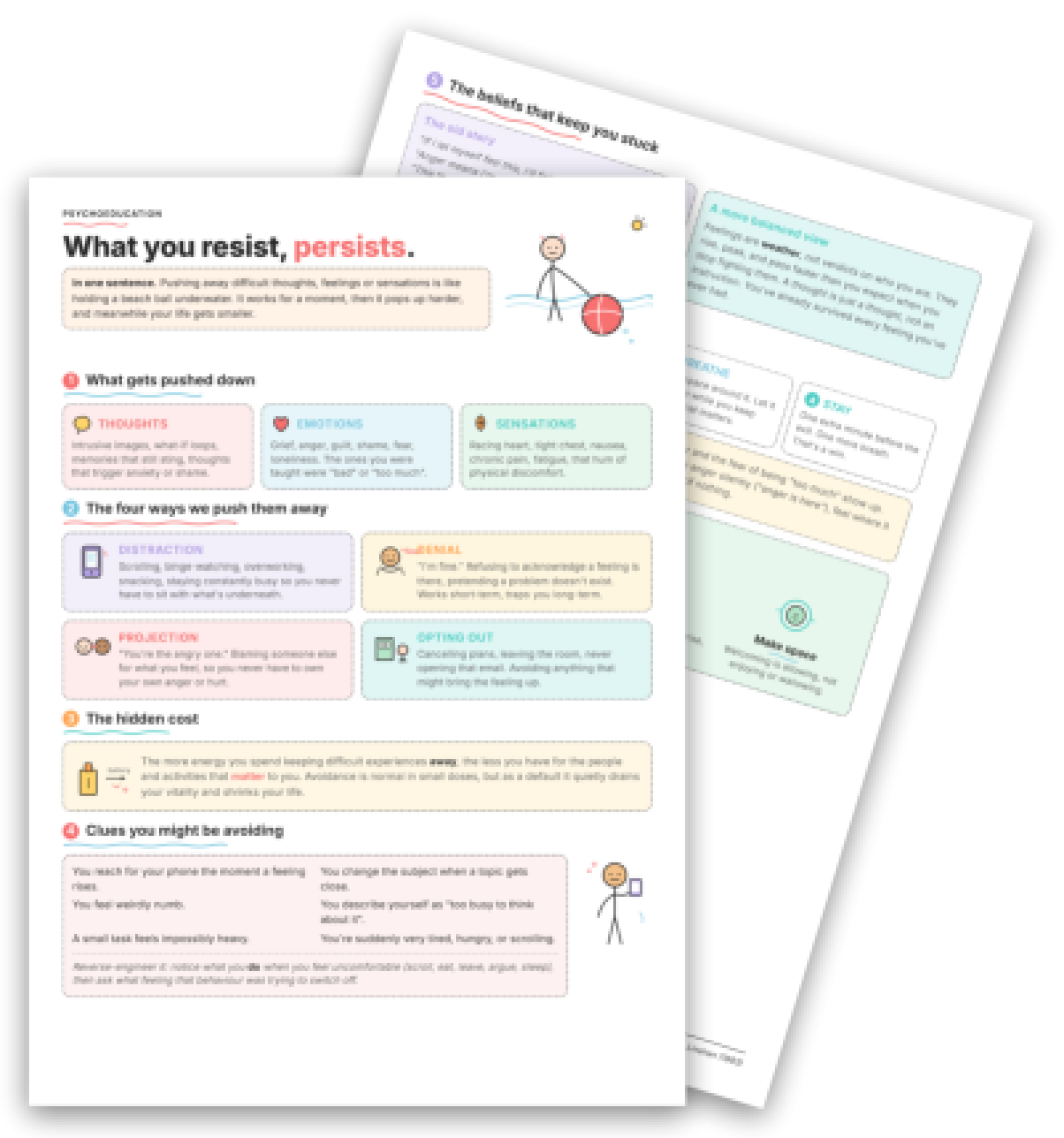
A visual psychoeducation tool to explain experiential avoidance in session, map its hidden costs, and introduce acceptance-based steps with ACT-grounded patients.
Clinical vignettes
Recognising Distraction as Avoidance
Opting Out Maintaining Social Anxiety
Clinical picture. M. is a 27-year-old referred for social anxiety who has progressively cancelled social engagements over eighteen months, now rarely leaving home for non-essential tasks. The clinician used the sheet to introduce the concept of avoidance cost, framing the energy spent on anticipatory dread and escape planning as a finite resource. M. recognised herself clearly in the "opting out" description and, less expectedly, in the "clues" list: she noted she felt inexplicably tired every Sunday afternoon, just before the week began. This recognition provided a concrete, low-charge entry point for subsequent work on graduated exposure, without requiring M. to immediately challenge any core belief about social threat.
Explaining experiential avoidance to a patient in plain language rarely lands on the first attempt. The concept is counterintuitive, and the typical verbal explanation ("the more you avoid, the worse it gets") tends to provoke polite nodding rather than genuine recognition. This PDF worksheet gives you a structured visual anchor to make the mechanism visible in session, not just audible.
Use this resource with your patients
Handout, exercises and materials ready to use, right inside SessionFuel.
Why Confronting Avoidance Resists Verbal Explanation
The clinical difficulty is not conceptual density; it is that avoidance feels adaptive from the inside. Patients who cancel plans, scroll compulsively, or shut down in difficult conversations are not consciously aware they are managing aversive internal states. When you describe the évitement expérientiel mechanism at the oral level, they often locate it in someone else's behavior, or they acknowledge it abstractly without connecting it to their own safety behaviors.
The situation is compounded when the patient presents with mixed avoidance strategies: distraction in professional contexts, denial in family systems, and opting out in intimate relationships. Without a shared typology, each behavioral pattern looks like a separate problem rather than a single function. The worksheet provides exactly that typology, in a format patients can read, point to, and take home.
This is also where psychological flexibility work stalls earliest: before a patient can move toward values-based committed action, they need to clearly see what they have been moving away from, and why.
What the Worksheet Contains: Six Panels That Show What the Oral Explanation Cannot
The fiche PDF is organized into six numbered sections, each addressing one piece of the avoidance architecture.
- Panel 1 maps the three categories of internal experience that get suppressed: thoughts (intrusive images, what-if loops, shame-triggering memories), emotions (grief, anger, guilt, loneliness), and sensations (tight chest, fatigue, chronic physical discomfort). Showing this triad visually prevents the common clinical narrowing where patients report only cognitive content.
- Panel 2 names four avoidance modes: distraction, denial, projection, and opting out, each with a brief behavioral description. The projection example ("You're the angry one") is particularly useful for patients whose avoidance is relational and who have never considered that blaming outward serves an emotion-regulation function.
- Panel 3 introduces the hidden cost: the energy spent suppressing difficult experience is energy unavailable for valued activity. This reframes avoidance as a resource problem, not a character flaw.
- Panel 4 offers six behavioral cues the patient can self-identify ("You reach for your phone the moment a feeling rises," "You describe yourself as 'too busy to think about it'"), followed by a reverse-engineer prompt: notice the escape behavior first, then ask what feeling it was trying to switch off. This sequencing is clinically precise and maps directly onto what the Changing Avoidance worksheet formalizes for behavioral experiments.
- Panel 5 contrasts the old story (core beliefs sustaining avoidance: "If I let myself feel this, I'll fall apart") with a more workable view ("Feelings are weather, not verdicts on who you are"). The weather metaphor is consistent with ACT defusion work and gives you a shared vocabulary for the rest of the session.
- Panel 6 introduces a four-step acceptance sequence (Name, Locate, Breathe, Stay) with a worked example grounded in an interpersonal scenario. A difficult conversation triggers anger and shame; the old move is to shut down; the new move is to name the feeling silently, locate it somatically, and stay for one honest sentence. This bridges directly into graded exposure planning and the somatic tracking used in Automatic Behaviors work.
> Key point: the fiche is a visual support that facilitates the in-session explanation of experiential avoidance; it is not a self-report questionnaire. You use it to point, to illustrate, to slow down, and to build a shared language before the patient leaves with a tangible reference.
750+ clinical tools
A library built with and for clinicians, ready to use in session and extend between appointments.
Access all the toolsWhen and How to Propose It
The worksheet fits naturally in early-to-mid formulation, once you have an anamnèse and a clear sense of avoidance patterns in the patient's behavioral repertoire. It works across presentations: anxiety (including generalized anxiety and social anxiety), depression where behavioral withdrawal is a maintaining process, and personality presentations with prominent opting-out or affective suppression.
A clean introduction: "I'd like to show you something that maps what often happens when we try to push difficult feelings away. There's no right or wrong answer here; just tell me what resonates." This positions the fiche as exploratory, not diagnostic, which protects the therapeutic alliance at a moment when patients may feel observed.
Debriefing is where the clinical work begins. Ask the patient to point to the panel that fits their pattern most precisely, then ask about the feeling they imagine the behavior is managing. The Adaptive vs Maladaptive Coping worksheet and the Comfort, Stretch and Panic Zones fiche pair well as next-step resources once the avoidance map is established. For patients in an ACT framework, the worksheet integrates directly with the ACT Hexaflex and 12 ACT Schemas and Modes materials, giving the full contact-with-the-present-moment work a concrete behavioral entry point.
One note of caution: for patients with acute trauma or severely limited distress tolerance, the Stay step in Panel 6 may need explicit scaffolding before it is clinically appropriate. Pair it with regulated exposure work rather than presenting it as a simple behavioral instruction.
The fiche does not replace the clinical formulation; it makes one part of it visible, portable, and easier to return to between sessions.
Use it with your patients
Share this tool in the mobile app and follow the work between sessions.
Sources
- Hayes, S. C., Strosahl, K. D., Wilson, K. G. (1999). Acceptance and Commitment Therapy: An Experiential Approach to Behavior Change. Guilford Press.
- Hayes, S. C., Strosahl, K. D., Wilson, K. G. (2012). Acceptance and Commitment Therapy: The Process and Practice of Mindful Change (2nd ed.). Guilford Press.
Your session continues in your patients' pocket
Use with a patientYour resources, available everywhere
The handouts, exercises, programs and audios above: you choose which ones to make available to your patients, in the mobile app dedicated to them.
And far more than a library
The app goes well beyond resources, to support your patients every day:
Related categories
Explore other clinical resources by category.
Anxiety
Clinical hub for anxiety disorders: CBT and ACT worksheets, psychoeducation sheets, and exercises for assessment and treatment across the anxiety spectrum.

Mood
Evidence-based worksheets and clinical tools for mood disorders: CBT, ACT, and positive psychology resources for psychologists and therapists.

Emotions
Clinical resources on emotion regulation: worksheets, coping tools, CBT, REBT, and ACT exercises for therapists working across diagnoses and age groups.

Behaviours
Clinical hub for behaviors in therapy: worksheets and tools for coping, eating disorders, CBT formulation, and maladaptive behavioral patterns.

Cognition
Printable cognitive therapy worksheets and clinical tools for therapists: CBT, ACT, schema work, defusion, distortions, and belief restructuring.

Build awareness
Clinical worksheets and tools to build awareness in therapy: cognitive distortions, schemas, emotions, ACT and CBT resources for practitioners.