
Clinical picture. M., a man in his late twenties, completed 16 sessions of CBT for social anxiety centred on work presentations and informal team interactions. In the final two sessions, the clinician introduced the therapy blueprint as a consolidation exercise: M. was invited to write a one-page letter to himself, in his own words, naming the maintenance cycle that had kept his anxiety alive and listing the three behavioural experiments that had shifted his predictions most reliably. Four months after discharge, M. emailed to say he had re-read the letter before a company away-day; he reported that seeing his own account of the spotlight effect, written at a point when he felt competent, made it easier to redirect attention outward during the event. No booster session was needed at that point.
Social Anxiety Blueprint: PDF Worksheet, Tools and Exercises for Clinical Practice
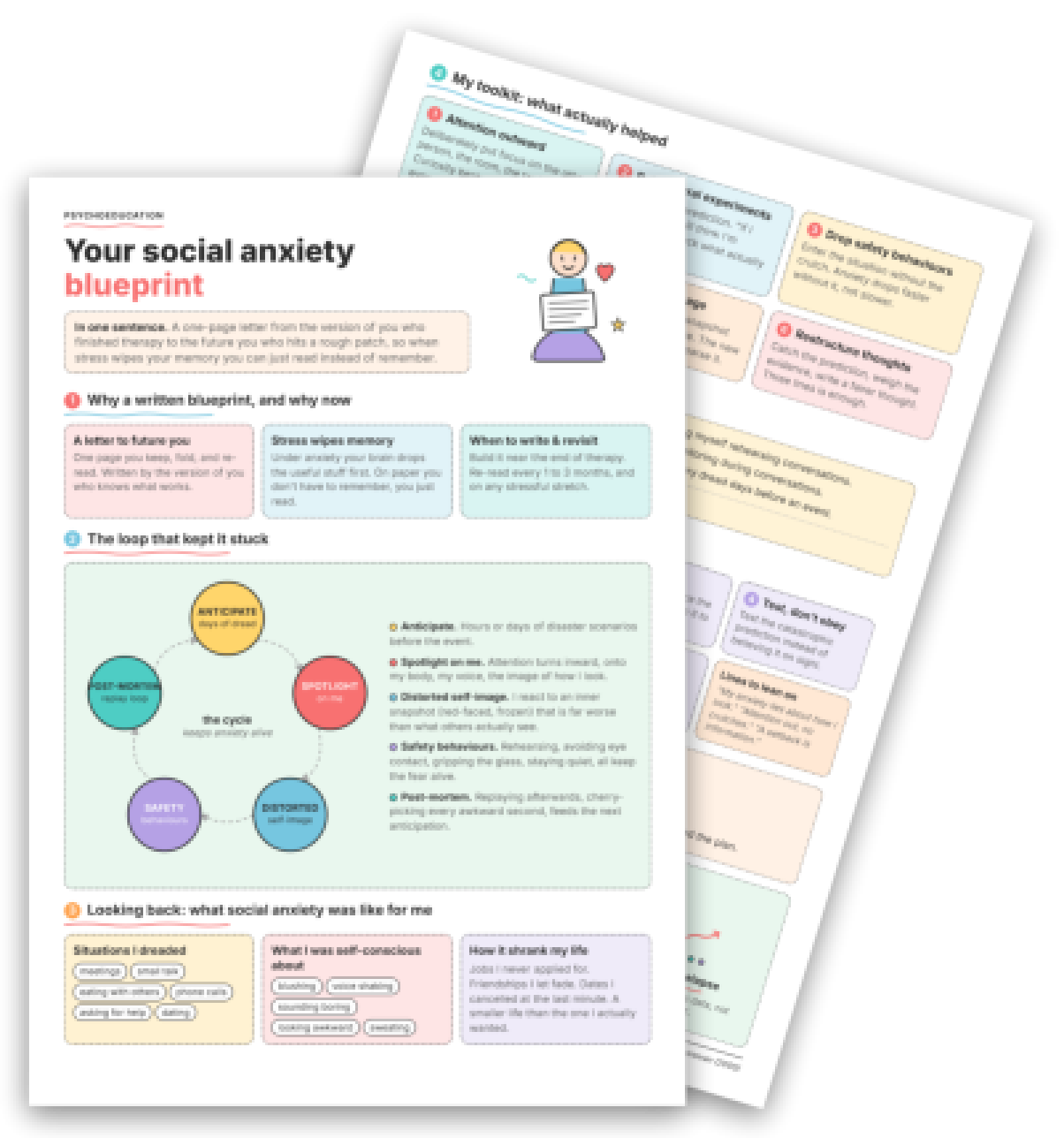
A one-page visual fiche that helps patients hold onto what therapy taught them, the maintenance cycle, the toolkit, the warning signs, and a concrete setback plan.
Clinical vignettes
Blueprint Written, Relapse Contained
Revisiting the Blueprint After Setback
Clinical picture. A., a woman in her early forties, had made solid gains in group-based CBT for social anxiety, including reduced avoidance of social meals and phone calls. She returned for a single follow-up appointment eight months later, describing a period of work stress during which she had slipped back into preparatory rehearsal and post-event rumination. The clinician asked her to retrieve the blueprint she had drafted at the end of the group; reading it aloud in session, A. identified that she had stopped the outward-attention practice she herself had flagged as most useful. The appointment focused on re-engaging that specific strategy rather than revisiting the full formulation, which kept the work brief and targeted.
Patients with social anxiety often make genuine gains in therapy, then hit a stressful stretch and find they can't reconstruct what worked. Not because the work wasn't done, but because stress degrades retrieval, and a verbal explanation, however clear, leaves nothing to hold in the moment. This fiche PDF is designed precisely for that gap: a one-page visual support that consolidates the key clinical content of treatment and gives the patient something concrete to re-read rather than remember.
Use this resource with your patients
Handout, exercises and materials ready to use, right inside SessionFuel.
Why the Clark & Wells Cycle Doesn't Stay Put
The maintenance loop of social anxiety is well-established. As the Clark & Wells Model of Social Anxiety shows, anticipation, inward attentional focus, distorted self-image, safety behaviours, and post-event processing form a self-sustaining cycle that anxiety alone doesn't interrupt. Patients can understand this conceptually in session and still lose access to it entirely when the next high-stakes situation arrives.
The problem isn't comprehension, it's state-dependent memory under load. When anticipatory dread kicks in days before a meeting or a social event, the prefrontal processes that support flexible thinking narrow. The patient is left with the old habits: rehearsing, avoiding eye contact, replaying the evening afterwards. What they need at that moment is not another session; they need the clinical map already in their hand.
An oral explanation, however well-structured, doesn't survive that load. A visual support can.
What the Fiche Contains
The fiche is built around six numbered sections, each serving a distinct clinical function. Section 1 frames the purpose clearly: "Stress wipes memory. On paper you don't have to remember, you just read." That framing alone is clinically useful to show patients, because it repositions the document as an active coping tool rather than a passive reminder.
Section 2 presents the maintenance cycle as a closed visual loop, Anticipate, Spotlight, Distorted self-image, Safety behaviours, Post-mortem, making explicit what keeps anxiety alive long after the triggering event. This diagram does work that verbal explanation often cannot: it shows the loop as a system, not a list of symptoms.
Sections 3 and 4 are personalisation spaces. Section 3 invites the patient to name the situations they dreaded, what they were self-conscious about (blushing, voice shaking, sounding boring), and how social anxiety shrank their life. Section 4 maps the six-item toolkit, attention outward, behavioural experiments, dropping safety crutches, video feedback, updating the self-image, and thought restructuring, grounded in the same evidence base as graded exposure work and the attentional retraining strategies from Hofmann (2007) and Heimberg et al. (2014).
Sections 5 and 6 handle relapse prevention directly. The early warning signs checklist, "A slip rarely looks like panic. It looks like quiet avoidance", is designed to catch drift before it escalates, consistent with Marlatt and Donovan's relapse framework. The seven-step setback plan closes the loop: re-read, one step in, refocus outward, test rather than obey, cap replays, two trusted people, booster session if needed.
> Key takeaway: The fiche is a visual support that facilitates explanation in session; it is not a self-help questionnaire. The clinician uses it to walk through the cycle, name the tools, and personalise the warning signs together, then leaves it with the patient as a concrete post-therapy reference.
750+ clinical tools
A library built with and for clinicians, ready to use in session and extend between appointments.
Access all the toolsWhen and How to Introduce It
The fiche works best late in the treatment arc, once the patient has real experiential knowledge of the cycle and has tested at least several toolkit elements through behavioural experiments. Introducing it too early, before the patient has lived the tools, turns the blueprint into theory rather than self-knowledge.
A natural opening: "We've covered a lot of ground. I'd like to go through this one-page summary together so you have something to come back to, especially on the rough stretches when the useful stuff is hard to access." From there, walk section by section, asking the patient to fill in the personalisation prompts (Section 3) in their own words. This co-construction is what gives the document its retention value.
For patients with recognisable social anxiety disorder presentations, including those who have already worked through the stages of social anxiety, the fiche also pairs naturally with the Social Anxiety in Relationships program for extended maintenance work. The companion fiches on therapy blueprints for OCD and panic follow the same structural logic for comorbid presentations.
Debrief in the session following handover: ask which section the patient has already re-read, and whether any warning signs are already present. That debrief turns a printed page into a living clinical tool.
Use it with your patients
Share this tool in the mobile app and follow the work between sessions.
Sources
- Clark, D. M., & Wells, A. (1995). A Cognitive Model of Social Phobia. Guilford Press.
- Rapee, R. M., & Heimberg, R. G. (1997). A Cognitive-Behavioral Model of Anxiety in Social Phobia. Behaviour Research and Therapy, 35, 741-756.
- Heimberg, R. G., & Becker, R. E. (2002). Cognitive-Behavioral Group Therapy for Social Phobia: Basic Mechanisms and Clinical Strategies. Guilford Press.
- Heimberg, R. G., Brozovich, F. A., & Rapee, R. M. (2010). A Cognitive Behavioral Model of Social Anxiety Disorder: Update and Extension. In S. G. Hofmann & P. M. DiBartolo (Eds.), Social Anxiety: Clinical, Developmental, and Social Perspectives (2nd ed., pp. 395-422). Elsevier.
Your session continues in your patients' pocket
Use with a patientYour resources, available everywhere
The handouts, exercises, programs and audios above: you choose which ones to make available to your patients, in the mobile app dedicated to them.
And far more than a library
The app goes well beyond resources, to support your patients every day:
Related categories
Explore other clinical resources by category.

Anxiety
Clinical hub for anxiety disorders: CBT and ACT worksheets, psychoeducation sheets, and exercises for assessment and treatment across the anxiety spectrum.

Build awareness
Clinical worksheets and tools to build awareness in therapy: cognitive distortions, schemas, emotions, ACT and CBT resources for practitioners.

Prevent relapse
Prevention as a therapeutic aim: clinical framing, risk stratification, and printable resources for relapse prevention and early intervention in mental health.

CBT
CBT worksheets, cognitive restructuring exercises & behavioral tools for clinicians. Evidence-based resources for every phase of cognitive behavioral therapy.

Trauma
Clinical hub on trauma and PTSD: assessment, differential diagnosis, treatment phases, and printable resources for practitioners. 155 chars.

Mood
Evidence-based worksheets and clinical tools for mood disorders: CBT, ACT, and positive psychology resources for psychologists and therapists.