
Clinical picture. P., a man in his mid-thirties, presented following a return to heavy alcohol use after eight months of abstinence. He described the relapse as sudden and unpredictable. In session, the clinician introduced the informational sheet and guided P. through listing specific external cues rather than broad categories; P. identified late Friday evenings after a long shift and a particular petrol station on his route home as the two most reliable precursors. Together, they drafted one concrete, observable plan for each cue, including an alternate walking route and a pre-set transfer of his payday wages on the morning they arrived. P. reported at the following session that he had used the alternate route twice without difficulty, though he noted the pre-written reply to a friend's text felt awkward and would need revision.
Triggers and Coping Skills: PDF Worksheet, Tools and Exercises for Clinical Practice
A printable PDF worksheet with visual tools and exercises helping clinicians make trigger-plan mapping concrete and memorable in addiction and recovery work.
Clinical vignettes
Mapping Triggers After Relapse
Rehearsed Plan for Social Pressure
Clinical picture. M., a woman in her late twenties with a three-year history of cannabis use disorder, was consolidating early recovery and found social situations the most destabilising context. The clinician used the worksheet's trigger-plan pairing structure to help her move from the vague formulation "being around certain friends" to a specific and workable one: receiving a group message from two named contacts after nine in the evening. M. drafted a short pre-written reply declining the invitation and identified one support contact to call immediately afterward. When the scenario arose ten days later, she sent the reply but did not follow through with the phone call; she brought this to the next session as useful information about which part of the plan still needed rehearsal.
In relapse prevention work, patients can name their triggers in session for weeks without ever producing a workable plan. Trigger mapping is a concept clinicians grasp immediately; patients, hearing it described verbally, tend to produce broad categories rather than actionable specifics. This fiche PDF is a visual support designed for use during the session, giving both clinician and patient a shared structure that moves the conversation from abstract acknowledgment to concrete, pre-committed planning.
Use this resource with your patients
Handout, exercises and materials ready to use, right inside SessionFuel.
Why Trigger Mapping Stays Vague Without a Visual Anchor
The core clinical difficulty is specificity. Patients engaged in addiction recovery and coping skills work know, in the abstract, that certain situations pull for the old behaviour. Asked to name their triggers, most produce categories: "stress," "my friends," "weekends." These are cognitive shortcuts, not behavioural plans. The cue-reactivity mechanism described by Marlatt & Donovan (2005) operates at the level of specific paired stimuli, not life domains, so vague triggers produce vague plans.
Stated once verbally, the distinction between "friends" and "Mark and Jay after 10pm" lands briefly, then fades. Laid out on paper in a structured taxonomy, it tends to stick. The second difficulty is prospective planning under low arousal. Patients develop their best thinking in session; the moment the urge activates, reflective capacity drops. Permissive thinking patterns, the internal justifications that precede a slip, need to be identified and countered before they arrive, not argued with in the moment. A written plan, built when the head is clear, does what an oral agreement cannot.
750+ clinical tools
A library built with and for clinicians, ready to use in session and extend between appointments.
Access all the toolsWhat the Fiche Contains: Five Panels That Make Specificity Visible
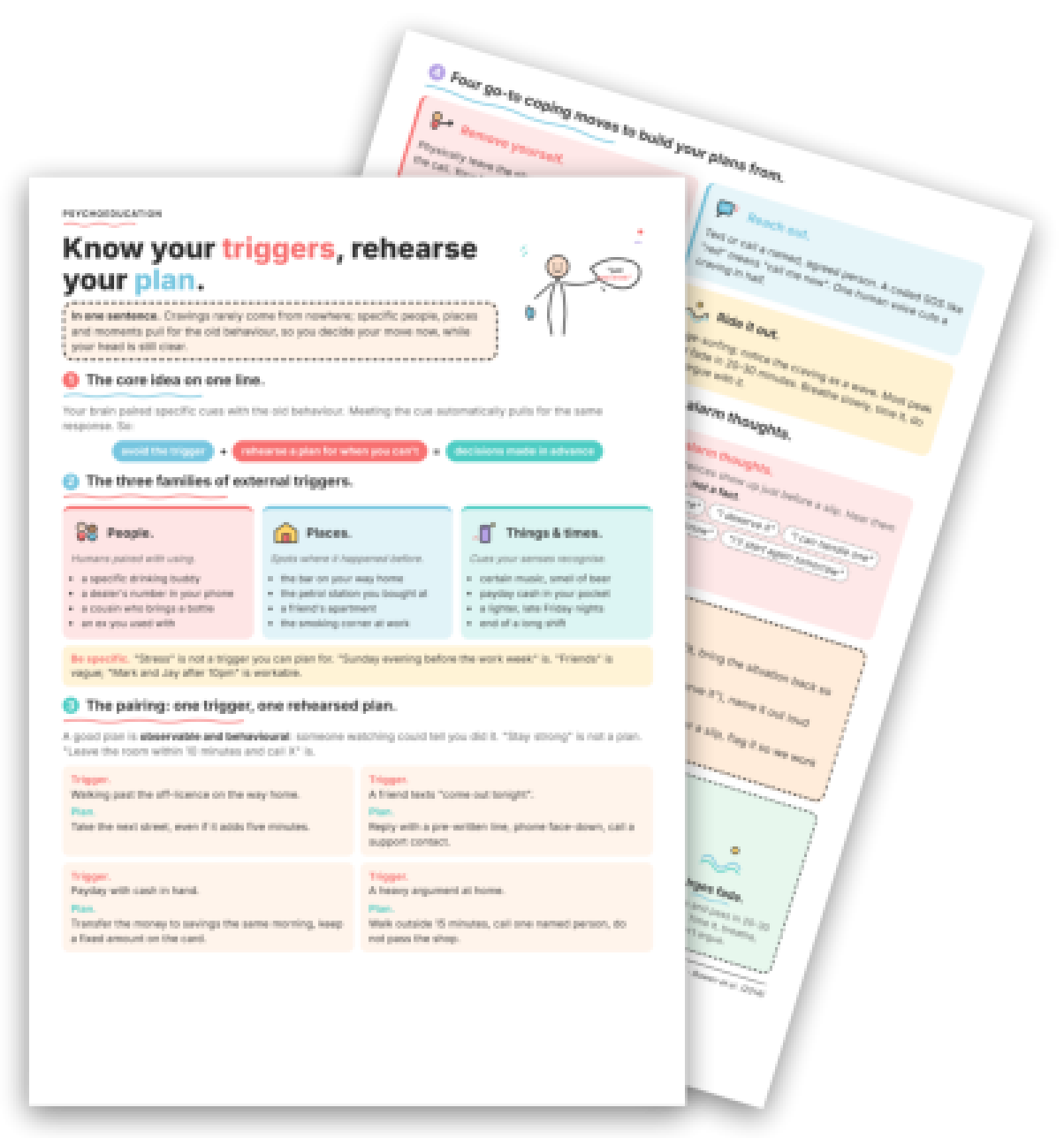
The printable is structured across five numbered sections.
- Panel 1 anchors the psychoeducation in a single operational line: "avoid the trigger + rehearse a plan for when you can't = decisions made in advance." This frames the whole exercise as decision-making under good conditions, which connects naturally to choice-point work in ACT.
- Panel 2 taxonomises external triggers into three families: People, Places, and Things & times, each illustrated with four concrete examples. The three-column visual layout shows at a glance why "stress" is unplannable and "end of a long shift" is not.
- Panel 3 pairs four sample triggers with four observable plans, modelling the behavioural specificity standard: "a good plan is observable and behavioural: someone watching could tell you did it." This is the panel most useful for in-session co-construction.
- Panel 4 names four go-to coping moves: Remove yourself, Reach out, Replace the behaviour, Ride it out. The last draws explicitly on urge-surfing principles; you can extend that work with the Surfing the Wave distress tolerance resource.
- Panel 5 adds two clinical refinements: a stress-test protocol ("what could get in the way of actually doing this?") and a list of smoke-alarm thoughts ("just this once," "I deserve it," "I can handle one"), framed as alarms to recognise, not facts to argue with. The closing "To discuss in session" prompts are directed at the clinical dyad, flagging three likely follow-up moments: a plan that didn't fit, a recurring smoke-alarm thought, and the missing pieces (internal triggers, post-slip planning).
> Key takeaway: This is a visual support that facilitates psychoeducation in session, not a questionnaire the patient completes alone. The clinician uses it to build a shared vocabulary, anchor the specificity principle on paper, and leave the patient with a written plan they have actively co-constructed.
Use it with your patients
Share this tool in the mobile app and follow the work between sessions.
When and How to Introduce It
This resource fits best in the stabilisation phase, once the therapeutic alliance is established and the patient has begun engaging with the stages of change and the rationale for relapse prevention. Introducing it before the patient has connected with the cue-reactivity model risks the fiche becoming a homework form with no clinical frame behind it. For patients in earlier stages, building discrepancy around change motivation may need to come first.
A straightforward introduction: "I'd like to look at something together that maps the specific situations that tend to pull for the old pattern. We'll use it to build a written plan you can keep." This positions the fiche as collaborative work, not an assessment.
Debrief using the three "To discuss in session" items at the next appointment. When a listed plan didn't hold, the written specificity makes revision easy and clinically informative. The fiche pairs naturally with Lapse and Relapse Management, adaptive versus maladaptive coping strategies, identifying and coping with triggers, and a broader coping strategies map as the work deepens. The fiche explicitly names internal triggers and post-slip planning as out of scope, which turns its limits into ready-made agenda items for subsequent sessions.
Your session continues in your patients' pocket
Use with a patientYour resources, available everywhere
The handouts, exercises, programs and audios above: you choose which ones to make available to your patients, in the mobile app dedicated to them.
And far more than a library
The app goes well beyond resources, to support your patients every day:
Related categories
Explore other clinical resources by category.

Behaviours
Clinical hub for behaviors in therapy: worksheets and tools for coping, eating disorders, CBT formulation, and maladaptive behavioral patterns.

Build awareness
Clinical worksheets and tools to build awareness in therapy: cognitive distortions, schemas, emotions, ACT and CBT resources for practitioners.

Build skills
Skill-building resources for clinicians: printable worksheets and exercises for coping, assertiveness, and communication skills training in therapy.

Prevent relapse
Prevention as a therapeutic aim: clinical framing, risk stratification, and printable resources for relapse prevention and early intervention in mental health.

CBT
CBT worksheets, cognitive restructuring exercises & behavioral tools for clinicians. Evidence-based resources for every phase of cognitive behavioral therapy.

Anxiety
Clinical hub for anxiety disorders: CBT and ACT worksheets, psychoeducation sheets, and exercises for assessment and treatment across the anxiety spectrum.