
Clinical picture. M., a man in his late thirties, presents with a pattern of heavy alcohol use concentrated on Sunday evenings following contact with his estranged brother. He reports feeling blindsided each time, describing the drinking as coming "out of nowhere." The clinician introduces the trigger-chain framework from the informational sheet and invites M. to reconstruct his last three episodes in writing, noting place, people present, and the feeling that preceded the first drink. Across all three accounts, the same sequence emerged: a terse phone call, a surge of shame, and then the walk to the kitchen. With that pattern named concretely, M. and the clinician were able to draft a specific avoidance plan for Sunday evenings rather than a vague intention to "try harder."
Identifying and Coping with Triggers: PDF Worksheet, Tools and Exercises
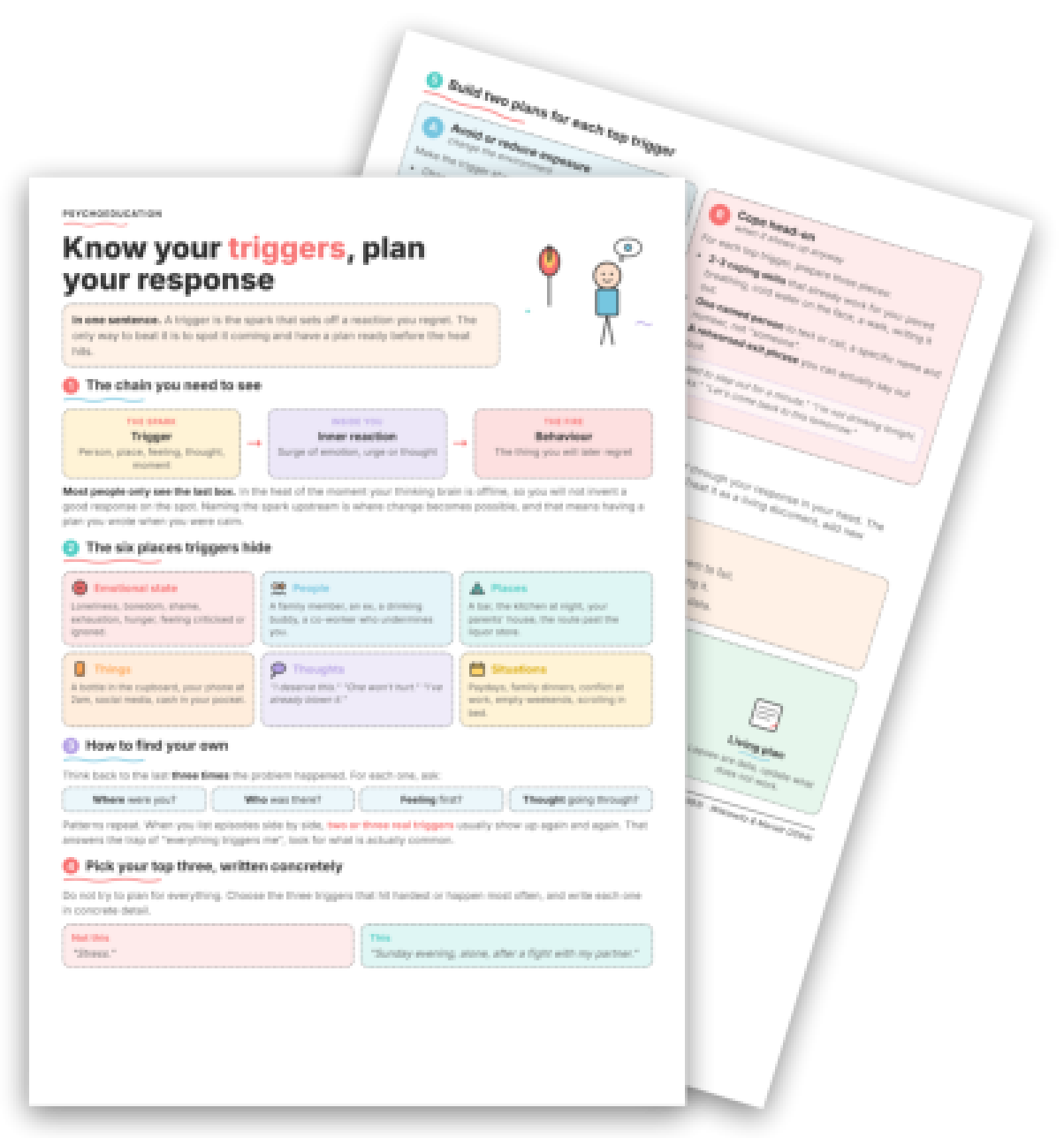
A printable PDF worksheet, concrete tools and exercises to help clinicians teach trigger identification and coping planning as a structured, visual psychoeducation support.
Clinical vignettes
Mapping the Chain Before the Heat
Narrowing 'Everything' to Three Real Triggers
Clinical picture. P., a woman in her mid-forties with a long history of binge eating, initially stated that her eating felt completely unpredictable and that any emotion could set it off. The clinician used the six-category trigger list from the worksheet as a shared reference point, asking P. to place each recent episode into a category rather than leaving it as a global impression. Within one session, a clearer picture appeared: late-night phone scrolling, the physical sensation of fatigue after work, and cash in her wallet on paydays accounted for the majority of episodes. Narrowing to these three concrete triggers allowed P. to engage with planning as a practical task rather than an overwhelming one, and she left the session with a written coping intention for each.
Most patients who present with impulsive behaviour, relapse, or escalating anger already know, in the abstract, that "something sets them off." The clinical bottleneck is precision: naming the antecedent concretely enough to plan around it. This PDF worksheet on identifying and coping with triggers gives you a ready-made visual support to move that conversation from vague self-insight to actionable formulation, in a single session.
Use this resource with your patients
Handout, exercises and materials ready to use, right inside SessionFuel.
Why Trigger Identification Resists Verbal Explanation
When you explain the antecedent-behaviour chain verbally, patients typically nod and report the behaviour, rarely the cue. That is partly because emotional arousal at the time of the trigger compromises prefrontal access, as Marlatt's relapse prevention model makes clear: the thinking brain is, in his words, "offline" once the fire has started. The clinical task is to catch the spark upstream, and that requires a shared vocabulary and a concrete map built while the patient is calm.
A second friction point is the "everything triggers me" trap. Patients with high anxiety sensitivity, anger dysregulation, or avoidance-driven cycles often feel their reactivity is global and therefore unmanageable. The worksheet's structure pushes back on that helplessness by showing that patterns repeat and that most patients, when they compare three recent episodes side by side, surface two or three recurring triggers rather than an endless list. That reframe alone can consolidate motivation for change mid-session.
What the Worksheet Contains: A Chain, Six Categories, and Two Concrete Plans
The fiche is built around three interlocking parts, each functioning as a visual anchor for the explanation you give orally.
The opening panel presents the three-stage chain: Trigger → Inner reaction → Behaviour. The visual makes explicit what verbal explanation easily blurs: the trigger is "the spark, not the fire." Many patients have never separated the cue from the behaviour; seeing them as distinct boxes on a page creates immediate therapeutic leverage for behaviour-emotion work.
The second section maps six trigger categories (emotional state, people, places, things, thoughts, situations) with concrete examples under each: "Loneliness, boredom, shame, exhaustion, hunger" under emotional state; "Paydays, family dinners, conflict at work, empty weekends" under situations. This taxonomy addresses the clinician's recurring challenge with maladaptive coping: patients cannot modify what they have not named. The grid structure makes it scannable and non-shaming, which matters for patients with high shame sensitivity.
The third section is the action core. Patients identify their top three triggers (the fiche is explicit: "Do not try to plan for everything"), write each one in specific behavioural terms rather than vague labels, and then build two plans per trigger: Plan A (reduce exposure, change the environment) and Plan B (cope when the trigger shows up anyway, including a named coping skill, a specific contact, and a rehearsed exit phrase). The healthy versus unhealthy coping distinction becomes concrete here rather than theoretical.
A closing section frames the plan as a living document to be reviewed weekly. The fiche also flags when escalation back to session is warranted: repeated Plan A and B failure, avoidance that progressively shrinks the patient's life, and lapses read as proof of incapacity rather than data. That last point maps directly onto the distress tolerance skills frame.
> Key takeaway: this fiche is a visual support that facilitates psychoeducation in session; it is not a self-help checklist the patient completes alone. The clinician walks through the chain and the six categories with the patient, and the printed page does the structuring work that an oral explanation cannot.
750+ clinical tools
A library built with and for clinicians, ready to use in session and extend between appointments.
Access all the toolsWhen and How to Introduce the Worksheet
This worksheet fits naturally from the second or third session onward, once the presenting behaviour is identified and rapport is established. It is particularly well-suited to addiction relapse prevention, anger management work, impulsive self-harm, and anxiety-driven avoidance patterns. It translates across TCC, DBT (where it aligns cleanly with chain analysis from Linehan's protocol), and harm-reduction frameworks.
Introduce it without diagnostic labelling: "I want to map, together, what tends to come just before the moment things go wrong for you. This sheet will help us do that visually." Walk through the three-box chain first, then invite the patient to populate the six-category grid from memory. Build the two plans together before the end of the session.
For debrief, the coping strategy evaluation question to return to next session is simple: which plan held, which did not, and what does that tell you about the trigger you underspecified? For patients in active crisis, combine the worksheet with a more immediate distress tolerance protocol rather than treating trigger mapping as the sole intervention.
The worksheet does not replace the formulation; it makes one component of it visible and portable. Patients leave with a concrete plan they helped write, not a concept they half-understood.
Use it with your patients
Share this tool in the mobile app and follow the work between sessions.
Sources
- Marlatt, G. A., Gordon, J. R. (1985). Relapse Prevention: Maintenance Strategies in the Treatment of Addictive Behaviors. Guilford Press.
- Kadden, R., Carroll, K., Donovan, D., Cooney, N., Monti, P., Abrams, D., Litt, M., Hester, R. (1995). Cognitive-Behavioral Coping Skills Therapy Manual: A Clinical Research Guide for Therapists Treating Individuals with Alcohol Abuse and Dependence. National Institute on Alcohol Abuse and Alcoholism (NIAAA).
- National Institute on Alcohol Abuse and Alcoholism (NIAAA). Handling Urges to Drink: Recognize, Avoid, Cope. NIAAA Rethinking Drinking.
Your session continues in your patients' pocket
Use with a patientYour resources, available everywhere
The handouts, exercises, programs and audios above: you choose which ones to make available to your patients, in the mobile app dedicated to them.
And far more than a library
The app goes well beyond resources, to support your patients every day:
Related categories
Explore other clinical resources by category.

Emotions
Clinical resources on emotion regulation: worksheets, coping tools, CBT, REBT, and ACT exercises for therapists working across diagnoses and age groups.

Behaviours
Clinical hub for behaviors in therapy: worksheets and tools for coping, eating disorders, CBT formulation, and maladaptive behavioral patterns.

Build awareness
Clinical worksheets and tools to build awareness in therapy: cognitive distortions, schemas, emotions, ACT and CBT resources for practitioners.

Regulate
Clinical resources for emotion regulation: worksheets, ACT exercises, and psychoeducation tools for affect regulation across diagnoses. For clinicians.

Build skills
Skill-building resources for clinicians: printable worksheets and exercises for coping, assertiveness, and communication skills training in therapy.

CBT
CBT worksheets, cognitive restructuring exercises & behavioral tools for clinicians. Evidence-based resources for every phase of cognitive behavioral therapy.