
Clinical picture. T., a man in his late thirties referred after a workplace incident, reported that his anger "comes out of nowhere" and that he has no time to intervene before conflicts escalate. The clinician introduced the Anger Warning Signs Checklist as a structured psychoeducation exercise, inviting T. to read through the three channels (body, thoughts, behaviour) and circle any signals he recognised as his own. T. readily identified jaw clenching and stomach pain but had never associated them with anger, having labelled them as stress. He was more hesitant with the thought channel until he acknowledged a pattern of replaying conversations on a loop for hours before an outburst. By the end of the session, T. had a personalised list of seven early signals and could see that his anger was, in fact, building across most of a working day before becoming visible to others.
Anger Warning Signs: PDF Worksheet, Tools and Exercises
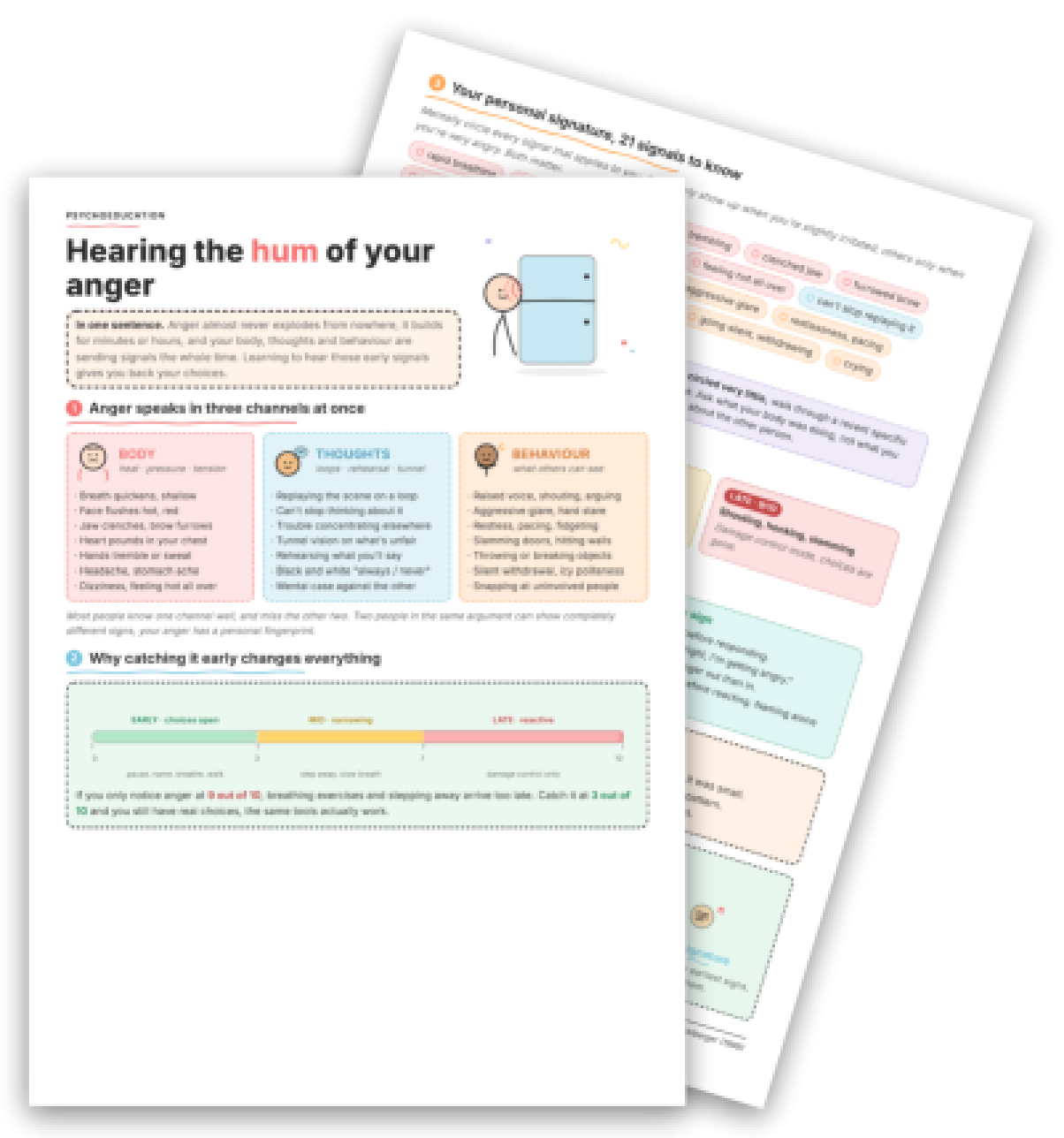
A visual PDF worksheet clinicians can use in session to help patients recognise their personal anger signals across body, thoughts, and behaviour before escalation takes hold.
Clinical vignettes
Mapping a Personal Anger Signature
Calibrating Intervention Timing in Couples Work
Clinical picture. A., a woman in her mid-forties attending individual sessions alongside ongoing couples therapy, described feeling that de-escalation strategies taught previously "never worked" during arguments with her partner. The clinician used the checklist to explore at what intensity level A. had been attempting to apply those strategies, drawing her attention to the 0-to-10 continuum described in the sheet. A. recognised that she typically noticed her anger only when her voice was already raised and she was pacing, placing her consistently at seven or eight out of ten before any attempt at intervention. The two then worked backwards through her body channel to identify flushed cheeks and shallow breathing as reliably earlier signals, occurring closer to three out of ten. Subsequent sessions focused on using those somatic cues as the cue to pause, which A. reported made the breathing techniques feel, for the first time, actually usable.
Most patients who present with anger difficulties can describe their last explosion in detail, but struggle to locate where it started. Asking them to identify early warning signs verbally, without scaffolding, often produces vague answers or a single channel ("I just get tense") while the other two channels remain invisible. This PDF worksheet gives you a concrete, structured visual to run through in session and leave in the patient's hands.
Use this resource with your patients
Handout, exercises and materials ready to use, right inside SessionFuel.
Why Anger Warning Signs Are Hard to Convey Without a Visual
The core clinical problem is channel blindness. Patients tend to monitor one modality well, typically the one that frightens them most, and systematically miss the others. Someone who tracks somatic tension may be entirely unaware of the cognitive rehearsal loop running in parallel. Someone preoccupied with their thoughts may not notice that their jaw has been clenched for the past twenty minutes.
Verbal explanation alone rarely resolves this. You can name the three channels in session, the patient nods, and then arrives the following week having "not noticed anything." Without a shared visual map, the concept stays abstract. The worksheet makes body, thoughts, and behaviour simultaneously visible on the same page, so the patient can locate themselves rather than rely solely on your description.
There is also the problem of the intensity threshold. Patients often report anger only once it is already disruptive, at what the fiche calls the late stage, when choices narrow to damage control. The psychoeducation that earlier detection restores genuine options lands better when the patient can see a concrete scale laid out in front of them, not just hear it.
What the Fiche Contains: Three Channels, 21 Signals, One Scale
The fiche is organised around five sections, each building on the last. Section 1 presents the three-channel model: body (heat, pressure, tension), thoughts (loops, rehearsal, tunnel vision), and behaviour (what others can see). Each channel carries a list of specific signals, so the patient reads "replaying the scene on a loop" or "jaw clenches, brow furrows" rather than processing a generic description of anger.
Section 2 introduces a 0-to-10 intensity scale with three named phases: early (choices open), mid (narrowing), and late (reactive). The visual layout makes the clinical logic immediate: intervention tools that work at 3 out of 10 simply do not work at 9 out of 10. This is the kind of point that takes several minutes to explain orally and takes five seconds to show.
Section 3 is the personal checklist: 21 signals the patient mentally circles. This is where the worksheet shifts from general education to individual profiling. Two guidance notes inside the fiche address common response patterns: if the patient circles almost everything, their baseline arousal may run high and you direct them to "pick the 5 that show up earliest and start there"; if they circle very little, you walk through a recent specific episode together. Both contingencies are named on the page, which saves you from having to anticipate and explain them each time.
Section 4 offers a worked example across the three phases (the traffic scenario), and Section 5 names two traps that frequently derail early detection: confusing the trigger with the anger itself, and equating anger with yelling when for many patients it presents as withdrawal, silence, or icy politeness.
> Key point: The fiche is a visual support that facilitates the explanation of anger warning signs in session. It is not a questionnaire the patient completes alone at home. You use it as a shared reference during the consultation, annotate it together, and hand it over as a concrete reminder the patient can return to between appointments.
This psychoeducation function connects naturally with broader anger work. You can pair it with the Anger Thermometer worksheet for intensity tracking, or with the Anger Stop Signs fiche once early detection is established and the patient is ready to build an interruption plan. For patients who need to trace what fuels their anger at a deeper level, the Anger Iceberg worksheet is a logical next step.
750+ clinical tools
A library built with and for clinicians, ready to use in session and extend between appointments.
Access all the toolsWhen and How to Introduce the Fiche in Session
This worksheet fits best in the early-to-middle phase of anger-focused work, typically after a first anamnesis has confirmed that anger dysregulation is a primary concern. It is appropriate across a wide range of presentations: impulsive anger, relational conflict, suppressed anger expressed as withdrawal, and anger comorbid with perceived injustice schemas or frustration intolerance.
A simple introduction that avoids labelling: "Before we talk about what to do with anger, I'd like us to look at what it looks like for you specifically. There's a one-page overview I find useful, let's go through it together." This frames the fiche as collaborative exploration rather than a corrective exercise.
During the session, work through the 21-signal checklist with the patient rather than asking them to read it independently. Note which signals they hesitate over, which ones produce recognition ("I didn't know that counted"), and which channels are underrepresented in their circled items. The three session discussion prompts printed at the bottom of the fiche (when they noticed an early sign this week, a new signal that surfaced, what circling almost everything or almost nothing might be telling you) give you a structured debrief anchor for the following appointment.
For patients already engaged in the full Anger Psychoeducation Program, this fiche works well as a standalone takeaway from lesson one. For those working on emotion regulation more broadly, it clarifies the anger-specific layer without duplicating the general curriculum. If the patient's anger presentation involves significant aggressive communication patterns with others, pairing early-detection work with assertiveness exercises tends to accelerate transfer to real situations. Between sessions, the Anger Regulation guided audio or the Anger Self-Reflection exercise can deepen what the fiche opens in the room.
The fiche does not replace a functional analysis of anger episodes or a full adaptive coping framework. Its purpose is narrower and specific: it gives the patient a personal map of their own early warning system, and gives you a shared vocabulary to work with from the next session onward.
Use it with your patients
Share this tool in the mobile app and follow the work between sessions.
Sources
- Novaco, R. W. (1975). Anger Control: The Development and Experimental Treatment. Lexington Books.
- Substance Abuse and Mental Health Services Administration (SAMHSA) (2019). Anger Management for Substance Use Disorder and Mental Health Clients: A Cognitive-Behavioral Therapy Manual (Publication No. PEP19-02-01-001). SAMHSA.
- U.S. Department of Veterans Affairs - AIMS Program. Common Anger Warning Signs. U.S. Department of Veterans Affairs.
- DiGiuseppe, R., Tafrate, R. C. (2007). Understanding Anger Disorders. Oxford University Press.
Your session continues in your patients' pocket
Use with a patientYour resources, available everywhere
The handouts, exercises, programs and audios above: you choose which ones to make available to your patients, in the mobile app dedicated to them.
And far more than a library
The app goes well beyond resources, to support your patients every day:
Related categories
Explore other clinical resources by category.

Emotions
Clinical resources on emotion regulation: worksheets, coping tools, CBT, REBT, and ACT exercises for therapists working across diagnoses and age groups.

Understand
Clinical hub for the therapeutic aim 'Understand': worksheets and tools to build patient insight across CBT, ACT, schema therapy and more.

Build awareness
Clinical worksheets and tools to build awareness in therapy: cognitive distortions, schemas, emotions, ACT and CBT resources for practitioners.

CBT
CBT worksheets, cognitive restructuring exercises & behavioral tools for clinicians. Evidence-based resources for every phase of cognitive behavioral therapy.

Anxiety
Clinical hub for anxiety disorders: CBT and ACT worksheets, psychoeducation sheets, and exercises for assessment and treatment across the anxiety spectrum.
Trauma
Clinical hub on trauma and PTSD: assessment, differential diagnosis, treatment phases, and printable resources for practitioners. 155 chars.