
Clinical picture. A mother in her early thirties, referred here as M., presents at a six-week postpartum follow-up reporting that her 14-month-old "cries for no reason" every late afternoon, leaving her feeling incompetent and resentful. The clinician introduces the 14-need checklist as a structured scanning tool, walking through each family of needs aloud with M. during the session. Together they identify a convergence of fatigue, overstimulation from a noisy daycare pickup, and a feed that had shifted later that week. M. returns the following fortnight describing a modest but consistent improvement after adjusting the snack timing and dimming the flat on arrival home. She also notes, without prompting, that the checklist helped her recognise her own mid-afternoon depletion, which had been sharpening her reactions to the crying.
Understanding Infant Crying: PDF Worksheet, Tools and Exercises
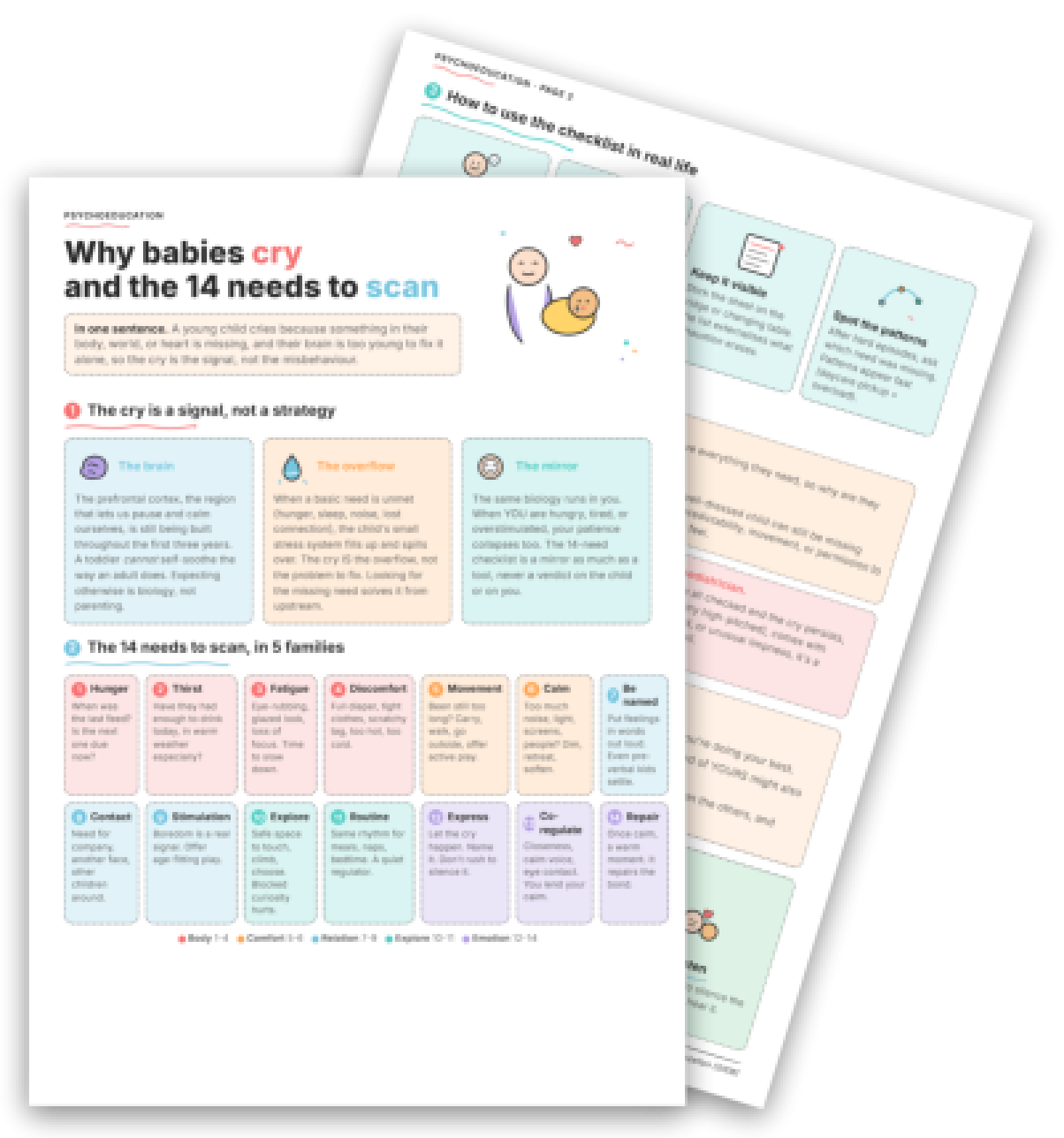
A two-page psychoeducation fiche PDF helping clinicians explain the 14 needs behind infant crying to parents, with a structured 5-family scan and session discussion prompts.
Clinical vignettes
Checklist Reframes Toddler Distress
Naming Needs Reduces Parental Alarm
Clinical picture. F., a first-time father in his late twenties, is seen in a brief consultation after his eight-month-old daughter was assessed medically and found to have no organic cause for frequent evening crying. He describes scanning the internet at 2 a.m. and catastrophising about undiagnosed illness. The clinician provides the informational sheet and guides F. through the distinction between a signal overflow and a pathological symptom, framing the prefrontal immaturity section explicitly. Over two sessions, F. begins using the checklist as a first-pass routine rather than an emergency response, working through the sensory and contact needs in particular. He reports that the structured sequence reduces his own activation enough to attempt co-regulation, and that the crying episodes feel shorter, though he acknowledges the data are subjective.
Parents who come to session exhausted, flooded by guilt, and convinced they are failing their child rarely need more parenting advice. What they need is a coherent neurobiological frame for why their infant is crying, and a concrete scan tool to use at 3 a.m. when their own stress system is equally overwhelmed. This fiche PDF provides exactly that.
Use this resource with your patients
Handout, exercises and materials ready to use, right inside SessionFuel.
Why infant crying resists explanation in session
The core clinical difficulty is not a knowledge gap. Most parents already know their child is hungry, or tired, or overstimulated. What breaks down under sleep deprivation and chronic stress is the rapid, sequential scanning of multiple possible needs at the moment the cry is happening. Oral psychoeducation on infant brain development covers the conceptual ground, but it rarely gives a parent a portable decision tool they can actually use between sessions.
There is also a second, subtler obstacle. Parents who have arrived in your office often carry implicit shame about the crying itself: they experience it as evidence of failed parenting rather than as normal developmental communication. Reframing the cry as a signal (not a manipulation, not misbehaviour) requires a model that is neurodevelopmentally grounded and visually memorable. A spoken explanation evaporates under stress; a structured visual reference survives it.
The fiche pairs well with a broader exploration of children's needs by developmental stage and with the Children's Whining and Complaining psychoeducation program for parents whose child is past infancy but still dysregulating regularly.
What the fiche contains: a visual scan tool for 14 needs
The fiche is structured across four numbered sections. Section 1 grounds the whole framework neurobiologically: the prefrontal cortex is "still being built throughout the first three years", making self-soothing impossible at this developmental stage. The overflow metaphor (an unmet need fills the child's stress system until it spills over as crying) is rendered in plain language that parents retain more reliably than clinical terminology.
Section 2 is the clinical core: a checklist of 14 needs organised into 5 families laid out visually on the page.
- Body (needs 1-4): hunger, thirst, fatigue, discomfort
- Comfort (5-6): movement, calm/sensory reduction
- Relation (7-9): being named, social contact, stimulation
- Explore (10-11): routine, freedom to explore
- Emotion (12-14): permission to express, co-regulation, repair after rupture
The visual grouping matters here. Running through five labelled families takes roughly 20 seconds. A flat list of 14 items does not have that property. The layout externalises the scan sequence so that exhaustion cannot erase it.
Section 3 gives practical usage instructions: run through the five families in order, aim to understand rather than silence the cry, and keep the sheet physically visible (fridge, changing table). Section 4 addresses three common clinical myths directly, including the spoiling myth and the reward-consequence misapplication, with brief neurobiological rebuttals.
The final panel, "To discuss in session", contains three clinician-facing prompts: parents noticing guilt when they are doing their best, parents running out of patience at the same hour each day (an opening toward the Behavior, Emotion, Underlying Need framework), and parents who find needs 12 or 13, co-regulation and expression, harder to offer than the physical ones.
> Key takeaway: the fiche is a visual support that facilitates the explanation of infant crying in session; it gives parents a concrete, portable scan tool to use autonomously, not a questionnaire to fill in alone.
This links naturally to nervous system regulation psychoeducation when you want to extend the co-regulation frame to the parent's own window of tolerance.
750+ clinical tools
A library built with and for clinicians, ready to use in session and extend between appointments.
Access all the toolsWhen and how to introduce the fiche in your practice
This fiche fits cleanly into early-phase parenting support work, typically from the second or third session once the initial anamnesis is complete and alliance is established. It is particularly indicated for parents presenting with postnatal exhaustion, guilt-laden narratives around the crying, or a rigid behaviour-modification frame (sticker charts, time-outs) being applied to an age where that wiring is not yet functional.
To introduce it, you might say: "I have a reference sheet that maps the main reasons infants cry, grouped by category, that some parents find useful to keep somewhere visible. I'd like to walk through it with you now." This positions the fiche as a shared clinical tool, not a verdict on their parenting.
Debrief by asking which of the 14 needs came as a surprise and, using the session prompts in Section 4, which needs feel emotionally harder to meet. That last question often opens productive schema-level work around emotional inhibition or self-sacrifice, traceable with tools like the Parenting Fundamentals program or the Parent-Child Communication program.
For parents of slightly older children, pair it with the Four Parenting Styles fiche and, where attachment history is clinically relevant, with Building Secure Attachment. In perinatal contexts involving high parental anxiety, the Child and Adolescent Anxiety parent program provides structured follow-on psychoeducation. Where you are supporting a strong-willed child's family, the 14-need frame helps parents shift from power-struggle interpretations to a needs-reading stance before other skills are introduced.
The fiche does not replace the therapeutic relationship or a careful formulation of parental history. It makes one specific explanation faster, clearer, and more durable.
Use it with your patients
Share this tool in the mobile app and follow the work between sessions.
Sources
- ZERO TO THREE. Your Calm Is Their Calm: Co-Regulation Strategies for Infants and Toddlers. ZERO TO THREE.
- ZERO TO THREE. It Takes Two: The Role of Co-Regulation in Building Self-Regulation Skills. ZERO TO THREE.
Your session continues in your patients' pocket
Use with a patientYour resources, available everywhere
The handouts, exercises, programs and audios above: you choose which ones to make available to your patients, in the mobile app dedicated to them.
And far more than a library
The app goes well beyond resources, to support your patients every day:
Related categories
Explore other clinical resources by category.

Emotions
Clinical resources on emotion regulation: worksheets, coping tools, CBT, REBT, and ACT exercises for therapists working across diagnoses and age groups.

Relationships
Clinical worksheets and tools on relational functioning: attachment, schemas, assertiveness, and communication skills for therapists. Printable PDF resources.

Understand
Clinical hub for the therapeutic aim 'Understand': worksheets and tools to build patient insight across CBT, ACT, schema therapy and more.

Build awareness
Clinical worksheets and tools to build awareness in therapy: cognitive distortions, schemas, emotions, ACT and CBT resources for practitioners.

CBT
CBT worksheets, cognitive restructuring exercises & behavioral tools for clinicians. Evidence-based resources for every phase of cognitive behavioral therapy.

Humanistic
Printable clinical resources for humanistic therapy: worksheets, exercises, and psychoeducation programs for practitioners using person-centered and experiential approaches.