
Clinical picture. M., a 38-year-old father of two, was referred following a pattern of irritability and self-critical rumination tied to his parenting role. He described chronic low-level guilt but struggled to articulate its source. The clinician introduced the Fundamentals program and asked M. to work through Lesson 1 before the next appointment. The written prompt asking him to describe his vision of a "perfect parent" surfaced a rigid, inherited ideal he had never consciously examined, one that bore little relation to his children's actual temperaments. In session he was able to use this material as a starting point for exploring how that unexamined belief was sustaining his guilt rather than guiding useful behaviour.
Parenting Fundamentals: A 6-Lesson Psychoeducation Program
Help parent-patients examine their beliefs, build curiosity, praise effectively, and regulate emotions with a structured autonomous program.
Clinical vignettes
Uncovering a Hidden Parenting Script
Shifting Focus Toward the Child's Needs
Clinical picture. T., a 44-year-old mother presenting with generalised anxiety centred on her parenting, reported feeling overwhelmed by conflicting advice from books, podcasts, and family members. Her clinician integrated the Fundamentals program alongside weekly appointments, assigning Lesson 1 for independent work at home. The step asking her to list what she believed to be her child's ten most important needs proved unexpectedly difficult; she noted she had spent far more energy auditing her own performance than attending to her daughter's individual characteristics. This observation redirected subsequent sessions toward child-focused attunement rather than self-evaluation, and T. reported a modest but tangible reduction in ambient anxiety over the following fortnight.

Use this resource with your patients
Handout, exercises and materials ready to use, right inside SessionFuel.
The clinical challenge: what makes parenting psychoeducation hard to deliver orally
Parenting work sits at the intersection of deeply held personal beliefs, unexamined intergenerational scripts, and high emotional stakes. Parents rarely arrive with a blank slate; they arrive with an internal image of the "perfect parent," a stack of competing advice, and a low-grade anxiety that they are falling short. Naming this in a consultation is one thing. Helping a patient actually examine their own parenting beliefs and behavioral patterns is another, and that gap is rarely closed through conversation alone.
What resists verbal explanation is precisely what this program targets: the distance between a parent's idealised child and their actual child, the mechanics of effective praise, the case for leading by example rather than issuing instructions, and the emotional regulation demands that parenting places on adults, not only on children. The Four Parenting Styles fiche and the Children's Fundamental Needs by Age worksheet are useful complements at the psychoeducation stage, but parents need more than a single reference; they need a structured arc they can work through on their own.
Clinical library
750+ clinical tools
A library built with and for clinicians, ready to use in session and extend between appointments.
Access all the toolsSeveral resource types
Psychoeducation handouts
Understand at a glance
Interactive exercises
To do and fill in
Interactive programs
A structured path
Audios
Meditation and relaxation
Psychometric tests
Automatic scoring
What the program contains
This six-lesson curriculum moves parent-patients through a carefully sequenced progression:
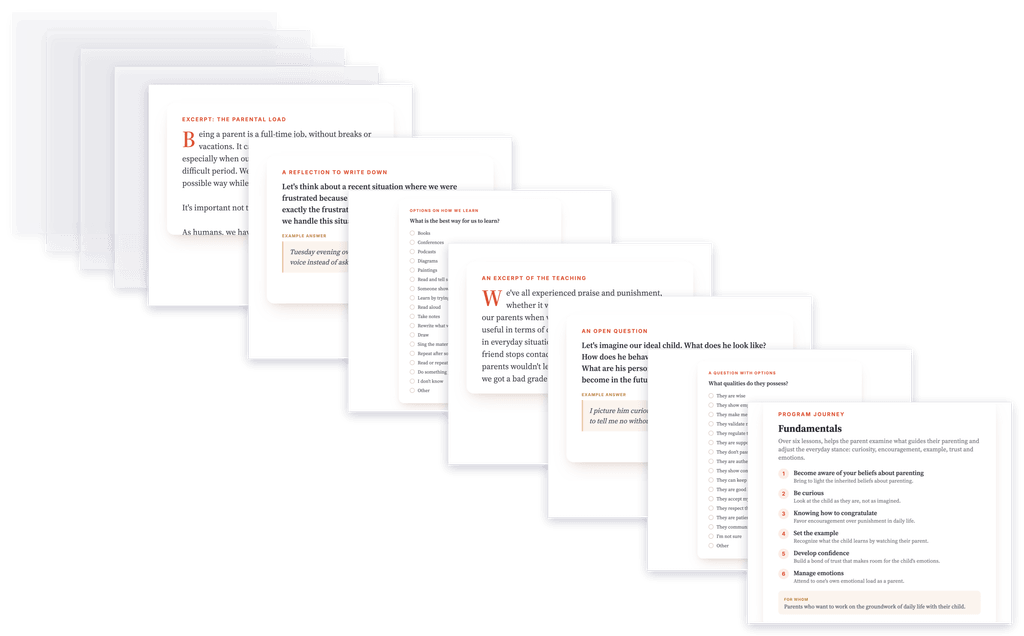
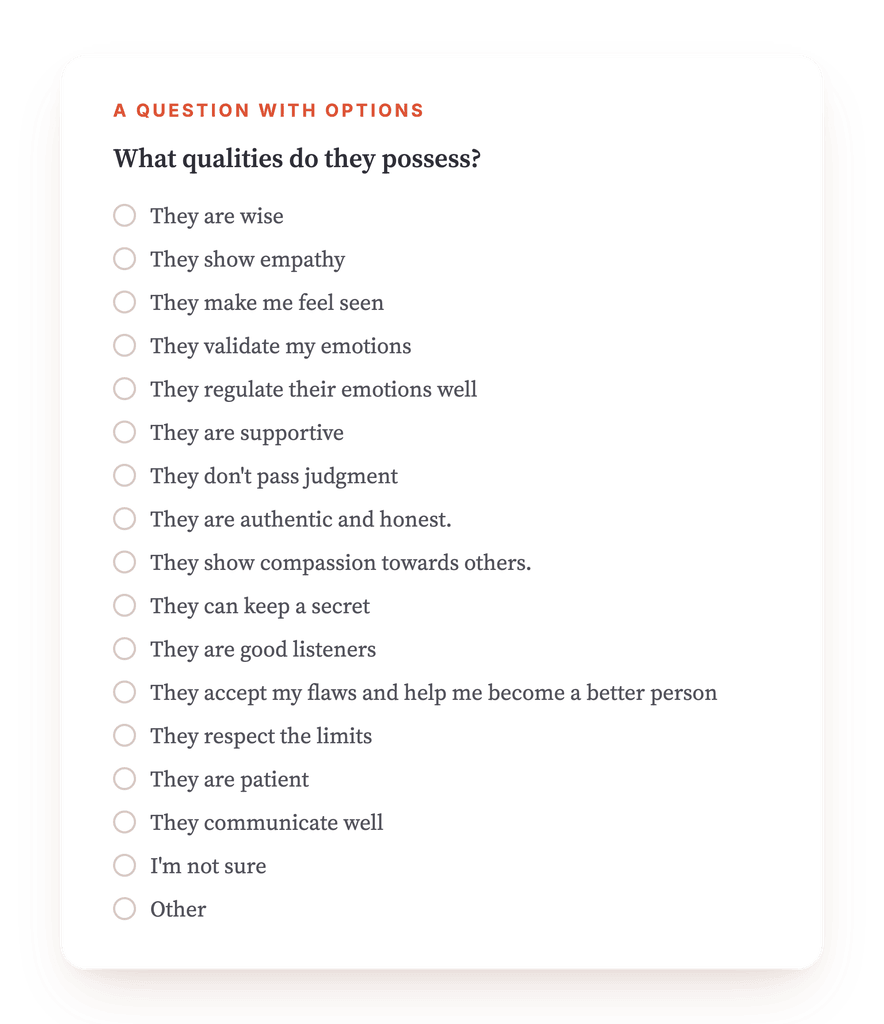
- Lesson 1 surfaces the patient's core parenting beliefs and the gap between the "perfect parent" ideal and the reality of child-specific responsiveness, through guided reflection prompts and a multiple-choice strengths inventory.
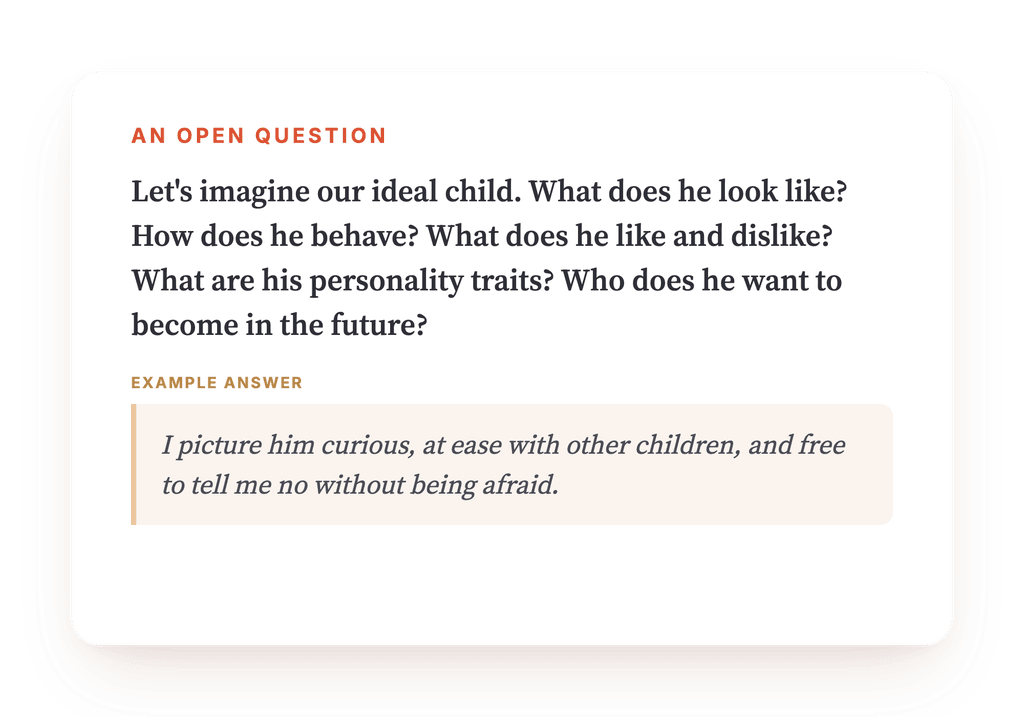
- Lesson 2 shifts focus to curiosity about the child as an individual, contrasting the idealised child with the real one, and inviting parents to notice the comparison traps that quietly erode the relationship.
- Lesson 3 addresses the psychology of praise and positive reinforcement, helping parents understand why specific, genuine compliments shape motivation and relational safety, with immediate practice prompts. This pairs naturally with Using Praise Effectively and Rewards and Consequences.
- Lesson 4 covers modelling as the primary teaching channel, asking parents to reflect on how they themselves learned and what they want to show, not just tell, their children.
- Lesson 5 builds the case for trusting children's emotional experience, including how to address lying and difficult behaviors without global labelling, using concrete behavioral language.
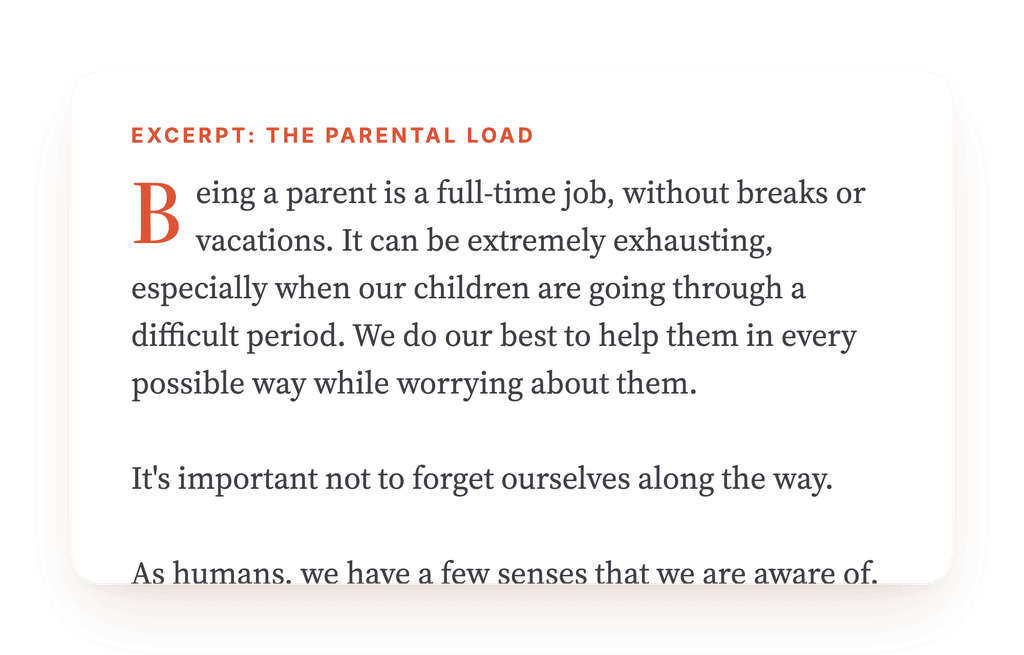
- Lesson 6 turns attention to the parent's own emotional life, mapping difficult emotions in the parenting role and the crucial importance of rest and self-regulation.
The previews embedded here, the program overview map and a couple of sample cards, show only a small fraction of the full curriculum. The complete program contains many more lessons, steps, guided prompts, and multiple-choice reflections than what is visible in these excerpts.
This program is available to patients through the mobile application that is the dedicated patient-side interface of SessionFuel. The clinician assigns the program to their patient, who then works through each lesson directly on their phone, independently, between appointments.
Key insight: Parenting anxiety often feeds on implicit beliefs that have never been articulated or examined. A structured lesson-by-lesson format gives those beliefs somewhere to land, which makes them available for clinical conversation.
Use it with your patients
Share this tool in the mobile app and follow the work between sessions.
How to integrate it as between-session homework
This program works best as assigned autonomous work carried out between consultations, not as in-room material. Assign it when a parent-patient presents with parenting anxiety, perfectionism around their role, conflict with a specific child, or difficulty managing their own emotional reactions during parenting moments. It also fits well alongside Children's Whining and Complaining, Strong-Willed Children, or Sibling Relationships programs, depending on the presenting concern.
Introduce it simply: "Between our appointments, I'd like you to work through this program, one lesson at a time, at your own pace. Each step asks you to reflect and write. Bring what comes up back to our next session." The written prompts, especially the ideal-versus-real-child comparison in Lesson 2 and the behavioral language exercise in Lesson 5, generate rich material. What the patient produces becomes your clinical entry point: you are not starting from scratch; you are deepening what they have already begun to see.
For patients who also need support around their own emotion regulation, the Managing Emotions program and the Behavior, Emotion, Underlying Need worksheet make strong complements. Where communication patterns are central, Nonviolent Communication and Expressing Appreciation to Children extend the work naturally.
Patient mobile app
Your session continues in your patients' pocket
Use with a patientYour resources, available everywhere
The handouts, exercises, programs and audios above: you choose which ones to make available to your patients, in the mobile app dedicated to them.
Psychoeducation handoutsInteractive exercisesInteractive programsAudiosPsychometric tests
And far more than a library
The app goes well beyond resources, to support your patients every day:
Standardized tests
Therapy journal
Gamification
Wellbeing challenges
Introspection prompts
Therapist homework
Related categories
Explore other clinical resources by category.

Emotions
Clinical resources on emotion regulation: worksheets, coping tools, CBT, REBT, and ACT exercises for therapists working across diagnoses and age groups.

Relationships
Clinical worksheets and tools on relational functioning: attachment, schemas, assertiveness, and communication skills for therapists. Printable PDF resources.

Build skills
Skill-building resources for clinicians: printable worksheets and exercises for coping, assertiveness, and communication skills training in therapy.

Humanistic
Printable clinical resources for humanistic therapy: worksheets, exercises, and psychoeducation programs for practitioners using person-centered and experiential approaches.

Positive psychology
Positive psychology clinical resources for therapists: worksheets, exercises & programs on well-being, strengths, gratitude, and resilience-based practice.

Anxiety
Clinical hub for anxiety disorders: CBT and ACT worksheets, psychoeducation sheets, and exercises for assessment and treatment across the anxiety spectrum.