
Clinical picture. A mother in her early thirties presents with exhaustion and growing resentment toward her 22-month-old son, whom she describes as "deliberately defiant" because he screams each evening before bed. The clinician introduces the informational sheet on children's fundamental needs by age, pointing to the overlap between the routine and emotion needs in the 1-to-3 age band. Together they map the evening sequence and identify that the transition from parental return home to bedtime is unpredictable and overstimulating, leaving the child without the "knowing what comes next" that calms his nervous system. The mother shifts her reading of the behaviour from defiance to signal, and agrees to trial a brief, consistent pre-sleep ritual for two weeks. At the following session she reports shorter protests and a modest reduction in her own irritability during that window.
Children's Fundamental Needs by Age: PDF Worksheet, Tools and Exercises
A visual PDF worksheet and practical tools to explain children's core developmental needs in session, with age-specific guidance clinicians can use directly with parents.
Clinical vignettes
Reframing a Toddler's Tantrums
Autonomy Needs in Early Adolescence
Clinical picture. A father attends a consultation concerned that his 14-year-old daughter has become secretive and dismissive, and he worries this signals something more serious. The clinician uses the worksheet to normalise the adolescent need for privacy and growing independence, noting that the need for affection and connection persists even when the adolescent actively pushes the parent away. The father recognises that his responses to her withdrawal, which included increased surveillance and repeated questioning, may have compressed the autonomy she is developmentally seeking. He is invited to consider small, concrete ways to stay present without intruding, such as brief low-stakes contact rather than scheduled talks. Over the following month he reports that his daughter has begun initiating occasional exchanges on her own terms.
Parents arrive with a presenting behaviour, a tantrum, school refusal, an adolescent who shuts down, and rarely with a formulated understanding of what need sits beneath it. Translating developmental theory into something actionable during a 50-minute session, without a shared framework, costs time the consultation doesn't always have. This fiche PDF provides that framework: a concrete visual support for psychoeducating parents on children's fundamental needs, organised by age, that you can work through together in session rather than describe from memory.
Use this resource with your patients
Handout, exercises and materials ready to use, right inside SessionFuel.
Why "needs" resists explanation in session
The concept of developmental needs is deceptively familiar. Most parents have heard of Maslow; fewer can map ten distinct needs onto their six-year-old's behaviour on a Tuesday evening. The gap between conceptual agreement ("yes, children need security") and practical recognition ("my child's meltdown is a signal, not defiance") is exactly where psychoeducation earns its place.
Oral explanations alone tend to collapse that gap only partially. Parents leave with a vague sense of having understood, then return the following week applying the same behavioural interpretation as before. A visual support holds the structure between sessions. It names the needs, shows how they persist from infancy to adolescence, and frames age-specific responses concretely, so the parent has something to return to at 8 p.m. when regulation is hardest.
This is also the terrain where understanding the behaviour-emotion-underlying need triangle becomes clinically tractable, and where work on secure attachment or parent-child communication can be anchored in a shared vocabulary.
What the fiche contains: a structured visual map of ten needs across four ages
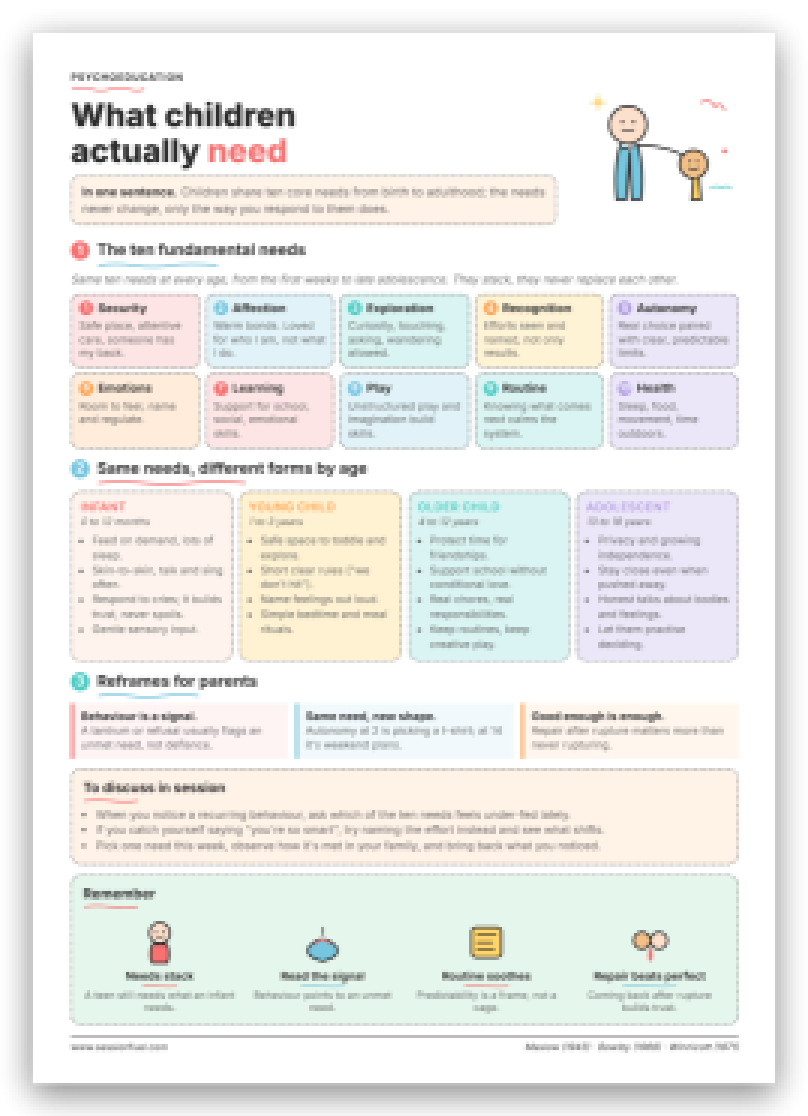
The fiche is organised into three panels. The first lists ten fundamental needs that remain constant from birth through late adolescence: Security, Affection, Exploration, Recognition, Autonomy, Emotions, Learning, Play, Routine, and Health. Each is named and described in one short phrase, the kind that can be read aloud during session and immediately recognised. The fiche states the logic plainly: "same ten needs at every age, from the first weeks to late adolescence. They stack, they never replace each other."
The second panel translates these needs into age-specific responses across four developmental windows: Infant (0-12 months), Young Child (1-3 years), Older Child (4-12 years), and Adolescent (13-18 years). This is the part that reliably shifts something for parents. Seeing that "autonomy at 2 is picking a t-shirt; at 14 it's weekend plans" makes the abstraction concrete without requiring a developmental psychology lecture.
The third panel offers reframes to disrupt common misreadings, particularly the attribution of defiance or manipulation where an unmet need is operating. Three "Remember" anchors close the fiche: needs stack, behaviour points to an unmet need, routine is a frame not a cage, and repair after rupture matters more than never rupturing.
> Key takeaway: The fiche is a visual support that facilitates the explanation of developmental needs in session. It is not a self-administered questionnaire; it is a psychoeducation scaffold you work through with the parent, leaving them a concrete reference to consult between appointments.
Three session prompts at the bottom of the fiche give you ready-made debrief questions: asking which need feels "under-fed" lately, observing effort-praise versus outcome-praise, and bringing back a one-week observation. These feed naturally into the parenting fundamentals program or into the parent-child communication curriculum.
750+ clinical tools
A library built with and for clinicians, ready to use in session and extend between appointments.
Access all the toolsWhen and how to introduce this fiche in session
This fiche fits naturally in the first two or three sessions of any parenting consultation, once the anamnèse has given you a picture of the presenting difficulties. It works across a wide range of presentations: the parent of a strong-willed child, a family navigating childhood anxiety, or a parent presenting with childhood depression concerns. It is equally useful when sibling dynamics or screen dependency are the entry point, because those presentations almost always involve one or more needs running chronically low.
To introduce it without pathologising the parent, you might say: "Before we go further into what's happening with [the child], I'd like us to look at a map of what children need at different ages. It often helps to have a common language." This positions the fiche as a collaborative tool, not an assessment of parental adequacy.
Debrief by asking the parent to point to whichever of the ten needs feels most relevant to the current difficulty. Let them arrive at their own formulation. The fiche carries the structure; your clinical role is to hold the space for what that structure surfaces.
When a coping strategies worksheet for children and adolescents or CBT tools for children come later in the work, the shared vocabulary established with this fiche makes the transition significantly smoother. The fiche does not replace the therapeutic frame; it builds the conceptual ground on which subsequent interventions can stand.
Use it with your patients
Share this tool in the mobile app and follow the work between sessions.
Sources
- Brazelton, T. B., & Greenspan, S. I. (2000). The Irreducible Needs of Children: What Every Child Must Have to Grow, Learn, and Flourish. Perseus Publishing.
- National Research Council and Institute of Medicine (2000). From Neurons to Neighborhoods: The Science of Early Childhood Development. National Academies Press.
- Ryan, R. M., & Deci, E. L. (2017). Self-Determination Theory: Basic Psychological Needs in Motivation, Development, and Wellness. Guilford Press.
Your session continues in your patients' pocket
Use with a patientYour resources, available everywhere
The handouts, exercises, programs and audios above: you choose which ones to make available to your patients, in the mobile app dedicated to them.
And far more than a library
The app goes well beyond resources, to support your patients every day:
Related categories
Explore other clinical resources by category.

Relationships
Clinical worksheets and tools on relational functioning: attachment, schemas, assertiveness, and communication skills for therapists. Printable PDF resources.

Understand
Clinical hub for the therapeutic aim 'Understand': worksheets and tools to build patient insight across CBT, ACT, schema therapy and more.

Humanistic
Printable clinical resources for humanistic therapy: worksheets, exercises, and psychoeducation programs for practitioners using person-centered and experiential approaches.

Integrative
Integrative therapy clinical resources: worksheets, psychoeducation programs, and exercises for eclectic, multimodal practice across orientations.

Systemic & narrative
Systemic family narrative therapy resources for clinicians: worksheets, psychoeducation programs, and exercises for couples, families, and groups.

Anxiety
Clinical hub for anxiety disorders: CBT and ACT worksheets, psychoeducation sheets, and exercises for assessment and treatment across the anxiety spectrum.