
Clinical picture. A mother in her late thirties, referred to here as Ms. T., presented seeking support around her seven-year-old son, whom she described as exhausting, defiant, and impossible to redirect at home and at school. She reported significant guilt about her own negative feelings toward him and questioned whether his behavior reflected poor parenting. The clinician introduced the psychoeducation program on strong-willed children and asked her to complete Lesson 1 before the next appointment, paying particular attention to the adjective-selection prompt and the guided reflection on early temperament signs. At the following session, Ms. T. noted that recognizing stubbornness and intensity as innate temperamental traits, rather than willful misbehavior, had reduced her sense of blame and allowed her to approach their interactions with slightly less reactivity.
Strong-Willed Children: A Parent Psychoeducation Program
A structured 4-lesson program helping parents understand, reframe, and effectively respond to their strong-willed child's temperament and behaviour.
Clinical vignettes
Reframing a Strong-Willed Child
Normalizing Parental Overwhelm
Clinical picture. Mr. R., a father in his mid-forties, was seen following a referral from his son's school after escalating conflicts at home with his nine-year-old daughter, described by both parents as controlling, argumentative, and prone to prolonged emotional outbursts. He minimized his own distress but acknowledged feeling defeated in most interactions with her. The clinician proposed the strong-willed children program as a structured starting point and asked Mr. R. to work through Lesson 1 independently, completing the written prompt about situations in which his daughter imposed her will. He returned having identified three recurrent patterns he had not previously articulated clearly, which gave the subsequent session a concrete behavioural focus and shifted the conversation away from global characterizations of her as a difficult child.

Use this resource with your patients
Handout, exercises and materials ready to use, right inside SessionFuel.
The clinical challenge: what makes this so hard to convey
Parents of strong-willed children arrive exhausted, often guilt-ridden, and frequently convinced that something is either wrong with their child or wrong with their parenting. The difficulty is twofold. First, the concept itself sits on a genuinely complex continuum: what looks like defiance may reflect inborn temperament, emotional immaturity, ADHD, generalised anxiety, or oppositional defiant disorder, and clinicians routinely need to help parents tease these apart without dismissing real distress. Second, explaining that a child's intensity, need for control, and resistance to authority are not character flaws but neurobiological dispositions tends to land very differently when a parent has time to read, reflect, and respond on their own, rather than absorb it verbally in the pressure of a consultation. A structured homework program fills exactly that gap.
750+ clinical tools
A library built with and for clinicians, ready to use in session and extend between appointments.
Access all the toolsWhat the program contains
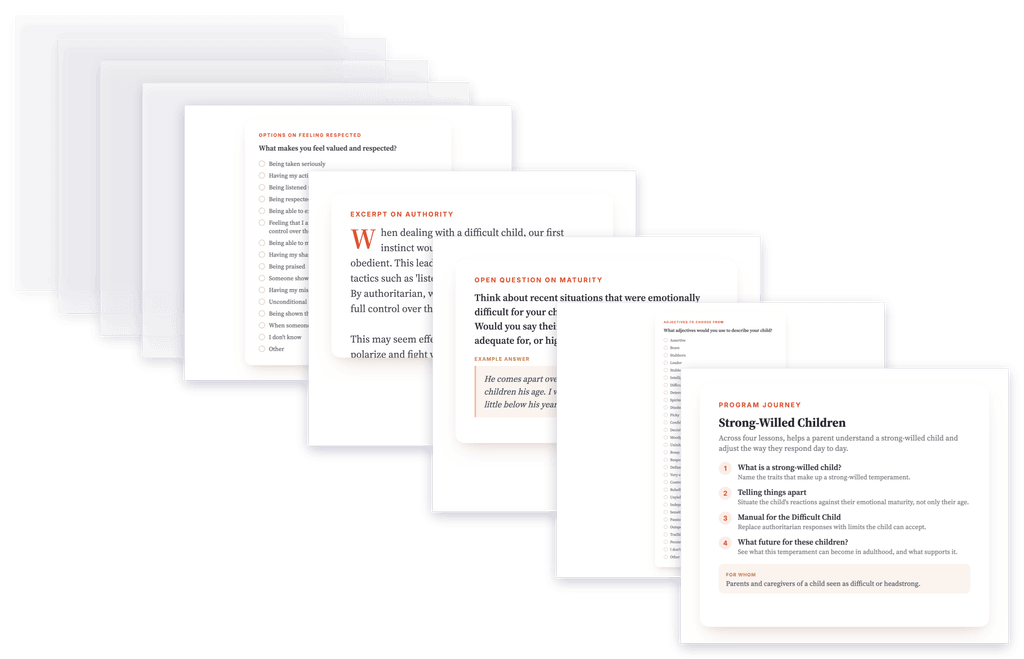
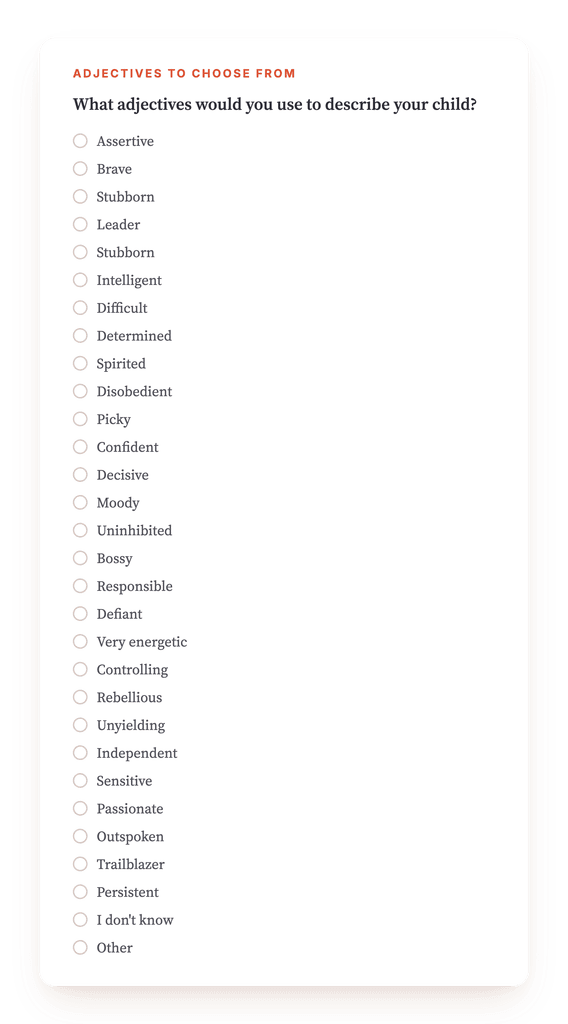
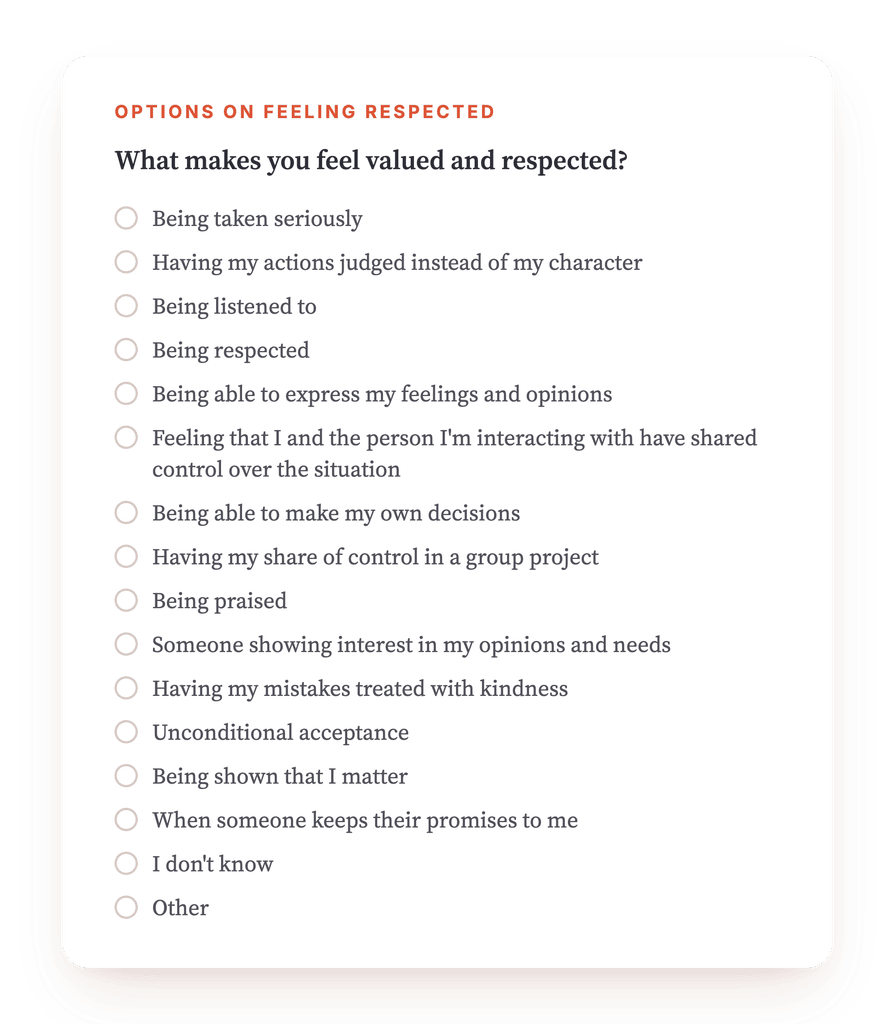
The curriculum unfolds across four lessons, each building on the last. The first lesson anchors the concept: parents identify their child's characteristic traits through a rich multiple-choice checklist of descriptors, trace the temperamental and biological roots of strong will, and are prompted to describe in their own words the specific situations where intensity or tantrums emerge. The second lesson does careful differential work, helping parents distinguish strong-willed behaviour from neurodiversity (ADHD, autism spectrum), emotional immaturity, social phobia, generalised anxiety disorder, and oppositional defiant disorder, using structured symptom checklists and reflective prompts. The third lesson is the practical core: it walks parents through the limits of authoritarian tactics, the clinical importance of acceptance without capitulation, and concrete strategies for giving structured freedom while holding firm boundaries. Guided prompts ask parents to reflect on how they themselves respond to authority, making the parenting shift genuinely experiential rather than merely prescriptive. The fourth lesson turns toward future outcomes: how consistent, respectful parenting shapes a strong-willed child into a confident, self-directed adult, and what happens when that support is absent. Parents are asked to identify ten specific daily situations where they can offer their child meaningful autonomy.
This program is available to patients through the mobile patient app of SessionFuel: once you assign it in your SessionFuel clinician account, your patient receives it directly on their phone and works through each lesson on their own, between appointments.
The embedded overview map and sample lesson cards shown here represent only a small fraction of the program. The complete curriculum contains many more lessons, steps, guided prompts, and multiple-choice exercises than what these preview images display.
Key insight: When parents understand that strong will is a temperamental trait, not a relational attack, the emotional charge around their child's behaviour shifts, and that shift is what makes behavioural change possible.

Use it with your patients
Share this tool in the mobile app and follow the work between sessions.
Integrating it as between-session homework
This program suits parents who describe their child as exhausting, defiant, or "impossible to discipline," as well as parents who suspect something clinical but have not yet had a formal evaluation. It pairs naturally with the The Four Parenting Styles: PDF Worksheet, Tools and Exercises for parents who need to locate their default stance first, and with the ADHD Parenting Tips: PDF Worksheet, Tools and Exercises for Clinical Practice when neurodevelopmental overlap is likely. The Children's Fundamental Needs by Age: PDF Worksheet, Tools and Exercises offers a useful complementary frame for contextualising the child's developmental stage.
Introduce the program by naming the clinical intent plainly: "Between now and our next appointment, I'd like you to work through this on your own, one lesson at a time. There is no rush. Each step has reading, questions, and short written exercises." Assign one or two lessons per interval, not all four at once. When the parent returns, the written prompts become your clinical material: what they wrote about a recent tantrum, which authority-free strategies they identified for daily use, or what they noticed when they reflected on their own reactions to being controlled. These responses open clinical conversations that would take much longer to generate from scratch.
The program connects naturally to broader work on Parenting Fundamentals: A 6-Lesson Psychoeducation Program, on Children's Whining and Complaining: Psychoeducation for Parents, and on Expressing Appreciation to Children: A Clinical Program. When anxiety appears to be driving some of the child's behaviour, the Anxiety in Children and Adolescents: A Parent Psychoeducation Program is a logical next step. For reinforcement strategies to bring home, the Token Reward System: PDF Worksheet, Tools and Exercises for Clinical Practice, Rewards and Consequences: PDF Worksheet, Tools and Exercises, and Using Praise Effectively: PDF Worksheet, Tools and Exercises for Clinical Practice give parents concrete, visual tools they can act on immediately. The Sibling Relationships: A Parent Psychoeducation Program rounds out the family picture when a strong-willed child's dynamics ripple across the whole sibling system.
Your session continues in your patients' pocket
Use with a patientYour resources, available everywhere
The handouts, exercises, programs and audios above: you choose which ones to make available to your patients, in the mobile app dedicated to them.
And far more than a library
The app goes well beyond resources, to support your patients every day:
Related categories
Explore other clinical resources by category.

Behaviours
Clinical hub for behaviors in therapy: worksheets and tools for coping, eating disorders, CBT formulation, and maladaptive behavioral patterns.

Relationships
Clinical worksheets and tools on relational functioning: attachment, schemas, assertiveness, and communication skills for therapists. Printable PDF resources.

Systemic & narrative
Systemic family narrative therapy resources for clinicians: worksheets, psychoeducation programs, and exercises for couples, families, and groups.

Anxiety
Clinical hub for anxiety disorders: CBT and ACT worksheets, psychoeducation sheets, and exercises for assessment and treatment across the anxiety spectrum.
Trauma
Clinical hub on trauma and PTSD: assessment, differential diagnosis, treatment phases, and printable resources for practitioners. 155 chars.

Mood
Evidence-based worksheets and clinical tools for mood disorders: CBT, ACT, and positive psychology resources for psychologists and therapists.