
Clinical picture. A mother in her early forties, referred to here as R., presented with persistent guilt and confusion about her two school-age children's frequent conflicts, convinced she was treating them unequally. Her clinician introduced the sibling relationships psychoeducation program and asked her to work through Lesson 1 before their next appointment. R. engaged readily with the birth-order content and, at the guided prompt asking what child she herself had been, wrote at length about growing up as an eldest and recognising the same rule-bound rigidity in her own older child. At the following session she reported that reframing her children's differences as partly structural, rather than as evidence of her own failings, had reduced her self-critical rumination enough to approach conflicts with slightly more curiosity.
Sibling Relationships and Birth Order: A Parent Program
Help parents decode birth order patterns, sibling rivalry, and family structure so every child feels seen rather than ranked.
Clinical vignettes
Birth Order Framing Reduces Parental Blame
Sibling Rivalry Curriculum Supports a Blended Family
Clinical picture. T., a father in his late thirties, sought consultation after his remarriage produced a household of four children ranging from a youngest of five to an eldest of fourteen, with escalating quarrels that left both adults feeling helpless. The clinician outlined the multi-lesson program and agreed with T. that he would complete one lesson per week, noting observations in the built-in prompts before each session. After working through the lessons on sibling dynamics and conflict sources, T. identified that his youngest, as the only biological child shared by both partners, was inadvertently receiving more parental attention, which the older three perceived as favouritism. This observation gave the clinical work a concrete and testable focus that had been absent in earlier, more general discussions.
Use this resource with your patients
Handout, exercises and materials ready to use, right inside SessionFuel.
The clinical problem: what words alone rarely settle
Parents who come to therapy concerned about their children often describe the same exhausting loop: repeated quarrels, shifting alliances, one child always seeming to bear the brunt. They want to intervene fairly, but they are working without a map. The difficulty is twofold. First, birth order effects and sibling dynamics carry strong affective charge for the parent; they activate their own childhood memories before they can think clearly about their children's. Second, explaining family-systems concepts verbally in a single conversation rarely lands. The idea that a family functions as a system with distinct subsystems (parental unit, sibling unit) needs time, illustration, and personal application to become genuinely useful. A structured take-home program solves exactly that: it gives the parent a graduated, reflective experience they can pace themselves, returning week after week with material grounded in their own household.
This program also sits naturally alongside work on The Four Parenting Styles, Parenting Fundamentals, and Children's Fundamental Needs by Age, all of which address the broader parenting context the sibling dynamic lives inside.
750+ clinical tools
A library built with and for clinicians, ready to use in session and extend between appointments.
Access all the toolsWhat the program contains
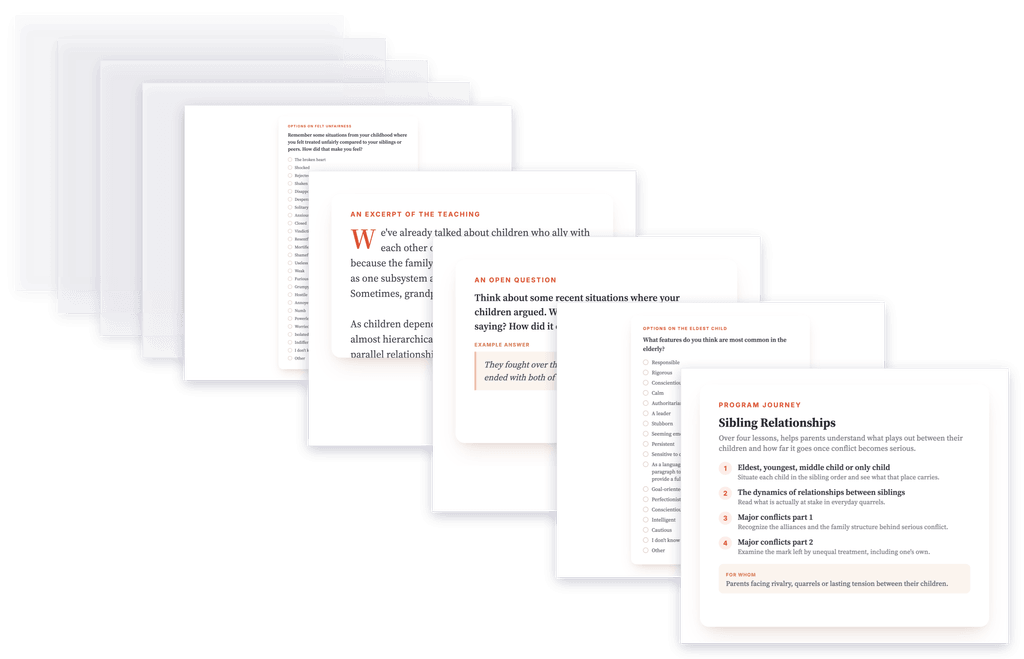
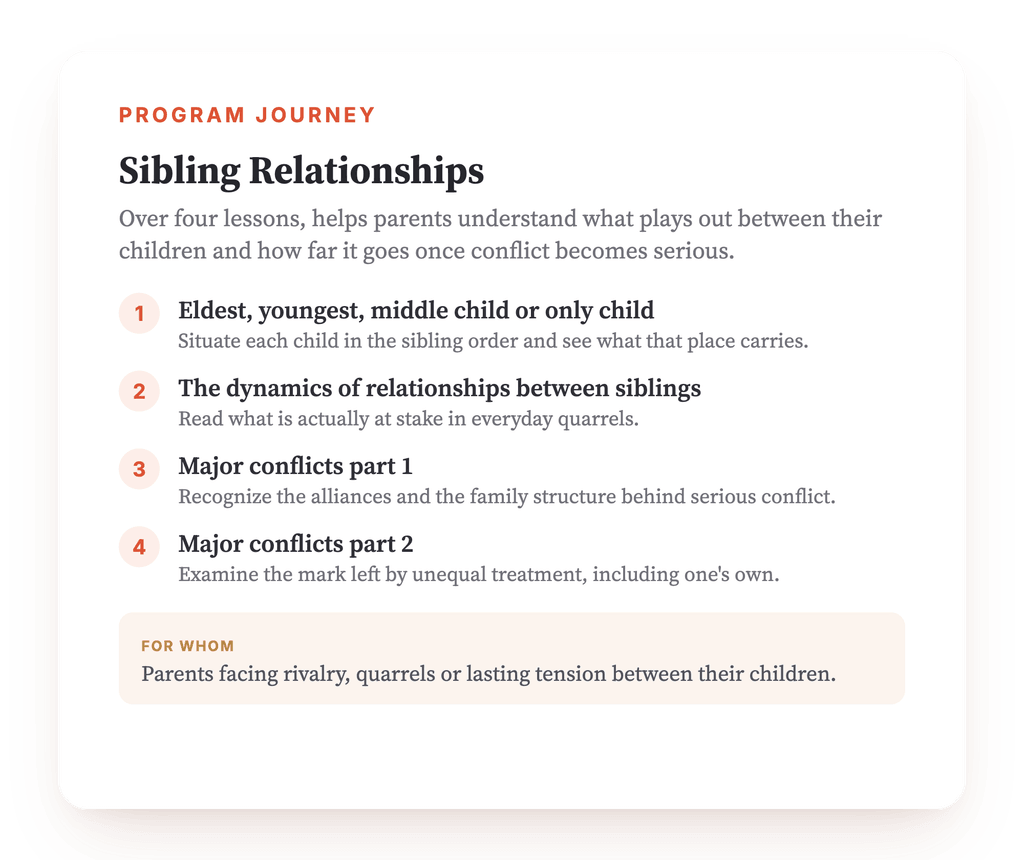
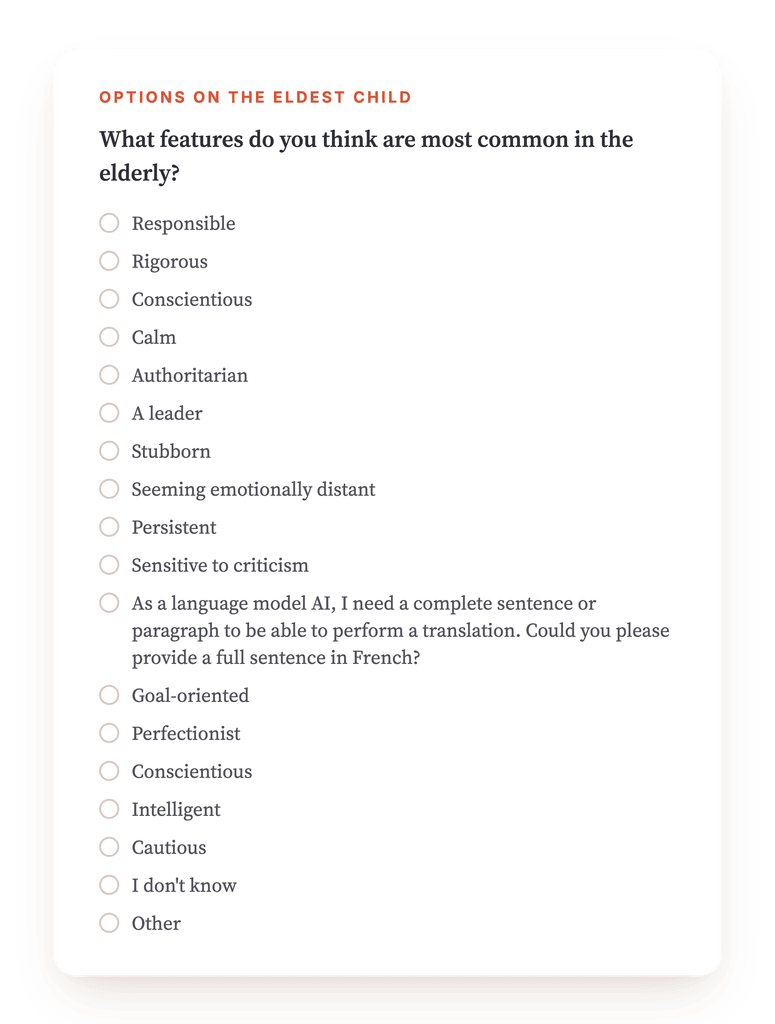
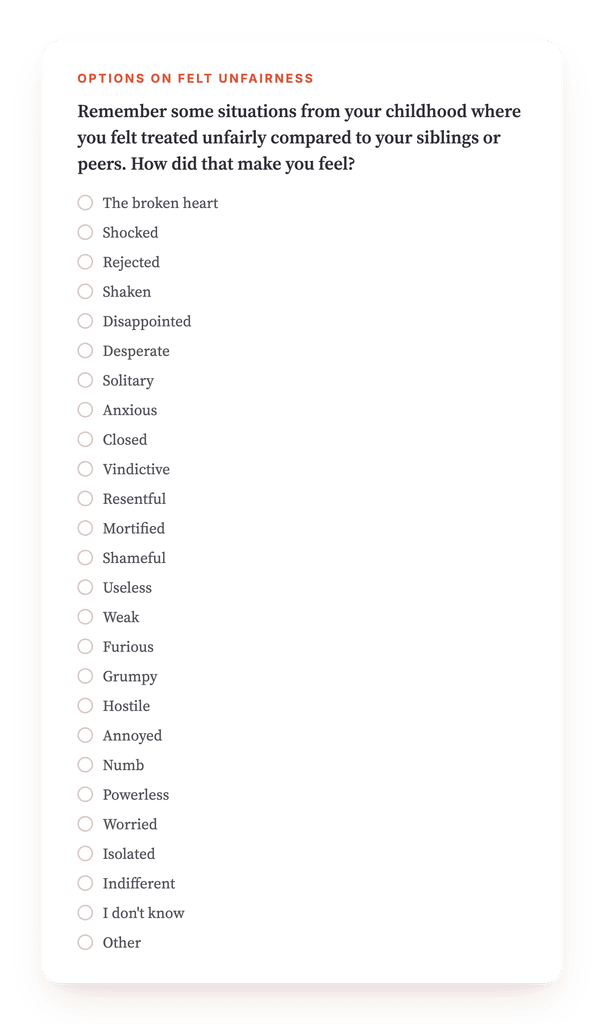
The program is organised as four progressive lessons. The first lesson examines birth order and personality: firstborns, middle children, youngest children, and only children each receive focused psychoeducation text, followed by multiple-choice reflection questions and open writing prompts inviting the parent to connect the theory to their own experience and to their children. The second lesson maps everyday sibling dynamics: quarrels, opposition, alliances, and the subtler problem of children who simply do not integrate with one another. Reflection prompts ask the parent to recall recent incidents concretely and examine their own automatic responses. The third lesson introduces family structure as a system, explores the most common conflict themes, and begins introducing practical guidance. The fourth lesson deepens the work on rivalry, attention-seeking, age and gender dynamics, and parenting consistency; it ends with concrete strategies for managing difficult moments, including the use of structured family conversations.
Throughout, the program weaves guided prompts alongside psychoeducation text, so the parent is never a passive reader. They are constantly applying concepts to real situations in their home.
These preview images show only a small fraction of the full program. The complete curriculum is far richer, with many more lessons, steps, psychoeducation cards, reflection prompts, and multiple-choice questions than what appears in the excerpts here.
This program is available to patients through the mobile application that is the dedicated patient-side interface of SessionFuel: once you assign it inside your SessionFuel account, your patient receives it directly on their phone and completes each lesson autonomously, at their own pace.
Use it with your patients
Share this tool in the mobile app and follow the work between sessions.
Integrating it as between-session homework
Assign this program to parents who present with conflict between children, concerns about favouritism, or difficulty navigating the firstborn-youngest dynamic. It also suits parents whose own sibling history is surfacing as a confounding factor in their parenting decisions. Introduce it after you have established a shared vocabulary around family dynamics; a session where you have worked with Behavior, Emotion, Underlying Need or Nonviolent Communication makes a natural springboard.
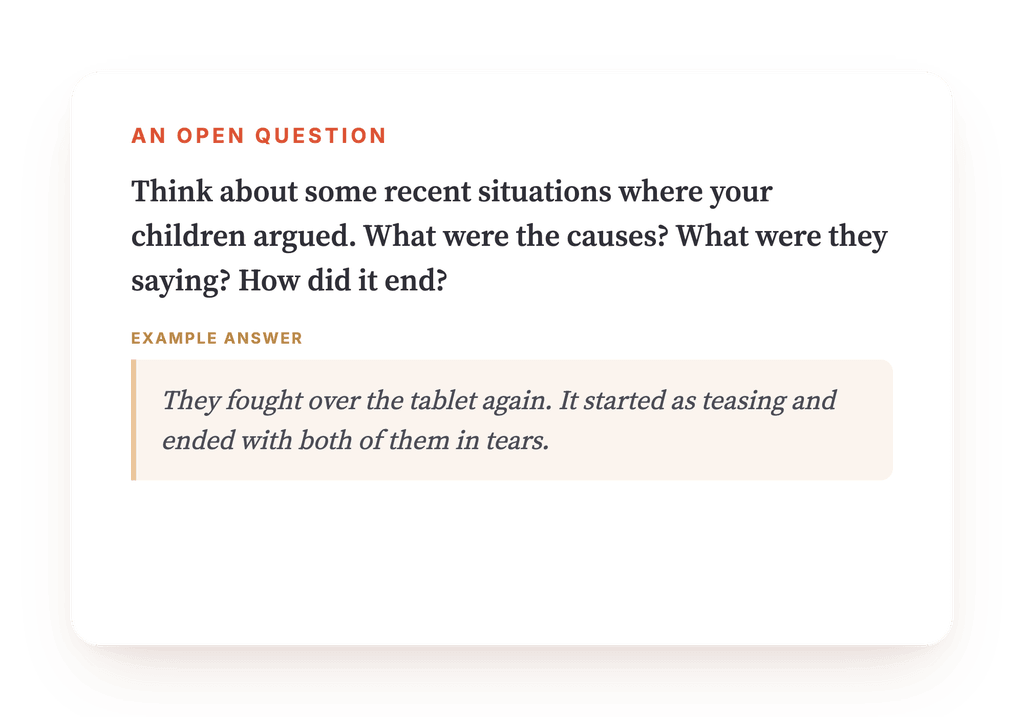
Ask the patient to complete one or two lessons between your appointments. At the next meeting, open with the written prompts they produced: the answers to questions such as "What recurring themes drive your children's disputes?" or "How did you feel when you were treated unfairly as a child?" are rich clinical material. Those responses often surface intergenerational patterns and unresolved sibling wounds that deserve attention in their own right, and they give you a concrete agenda without having to solicit it afresh each time.
Key insight: The program's reflection prompts function as structured clinical intake between two meetings; the parent's written answers arrive at your next conversation already organised and emotionally processed, so you can move directly into the work that matters most.
Pair this program with Expressing Appreciation to Children, Using Praise Effectively, or Strong-Willed Children when the sibling tension is amplified by a child whose temperament makes consistent parenting harder. For parents whose conflict management skills need parallel development, Ten Principles for Healthy Conflict and Children's Whining and Complaining extend the work into adjacent territory. Where the parent's own childhood relational patterns are prominent, Negative Parenting Styles and Assertive Communication can run alongside as complementary assignments.
Your session continues in your patients' pocket
Use with a patientYour resources, available everywhere
The handouts, exercises, programs and audios above: you choose which ones to make available to your patients, in the mobile app dedicated to them.
And far more than a library
The app goes well beyond resources, to support your patients every day:
Related categories
Explore other clinical resources by category.

Relationships
Clinical worksheets and tools on relational functioning: attachment, schemas, assertiveness, and communication skills for therapists. Printable PDF resources.

Understand
Clinical hub for the therapeutic aim 'Understand': worksheets and tools to build patient insight across CBT, ACT, schema therapy and more.

Build skills
Skill-building resources for clinicians: printable worksheets and exercises for coping, assertiveness, and communication skills training in therapy.

Systemic & narrative
Systemic family narrative therapy resources for clinicians: worksheets, psychoeducation programs, and exercises for couples, families, and groups.

Anxiety
Clinical hub for anxiety disorders: CBT and ACT worksheets, psychoeducation sheets, and exercises for assessment and treatment across the anxiety spectrum.
Trauma
Clinical hub on trauma and PTSD: assessment, differential diagnosis, treatment phases, and printable resources for practitioners. 155 chars.