
Clinical picture. M., a man in his early forties, was referred for mild depressive symptoms following a difficult separation; he reported feeling disconnected from his nine-year-old son and uncertain how to express affection without seeming "weak." The clinician introduced the first lesson of the Communicating with Children program, which invites parents to reflect on their own childhood experiences of feeling believed in or overlooked. Between sessions, M. worked through the guided prompts independently, listing what he had wanted as a child and recalling which adults had supported him. At the next appointment, he brought a written list of qualities he appreciated in his son, noting that drafting it had already shifted something in how he spoke to the boy during their shared weekends. No dramatic change was claimed, but M. described a small, concrete reduction in the guardedness he usually felt around expressions of warmth.
Expressing Appreciation to Children: A Clinical Program
A structured 5-lesson program helping parents build appreciation, emotional validation, and lasting connection with their children.
Clinical vignettes
Revisiting Childhood to Support a Son
Parental Ambivalence About Expressing Appreciation
Clinical picture. T., a woman in her mid-thirties with a history of emotionally reserved parenting in her own family of origin, sought support around recurrent conflict with her twelve-year-old daughter, who had begun withdrawing at home. The clinician offered the Communicating with Children program as structured self-guided work, explaining that each lesson was to be completed at T.'s own pace between appointments. Lesson 1 included a multiple-choice question about how it feels when someone expresses belief in you; T. selected "accepted" and "respected," then noted in the free-text prompt that she had rarely felt either as a child. This reflection opened a productive clinical conversation about the link between her own unmet needs and her current hesitancy to offer verbal appreciation to her daughter. T. agreed to read aloud a short appreciation list to her daughter before the next appointment, approaching it as a low-stakes observation rather than a commitment to change.
Use this resource with your patients
Handout, exercises and materials ready to use, right inside SessionFuel.
Why Parent-Child Communication Is Harder to Build Than It Looks
Many parents present with genuine motivation to connect with their children, yet struggle to move from intention to practice. The difficulty is rarely a lack of love: it is the absence of a clear framework for expressing appreciation, validating emotional experience, and adjusting communication to each developmental stage. When parents were not shown these skills in their own childhood, the gap is doubly hard to close through conversation alone. A verbal explanation can name the problem in a session, but it cannot give parents the repeated, structured reflection they need to actually shift ingrained habits. That is precisely what this program is designed to address.

750+ clinical tools
A library built with and for clinicians, ready to use in session and extend between appointments.
Access all the toolsWhat the Program Contains
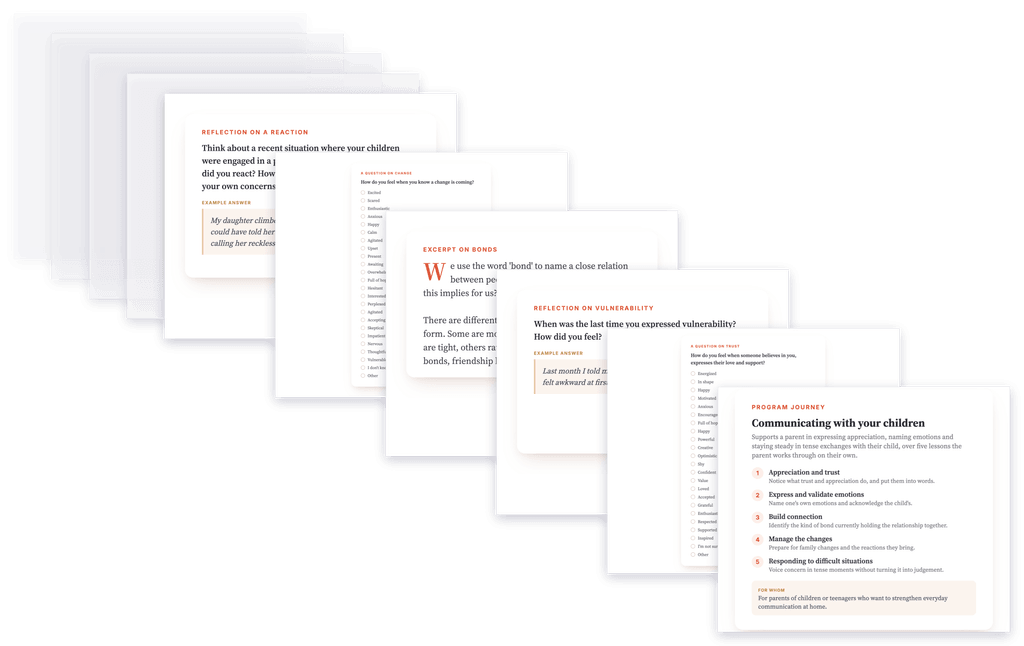
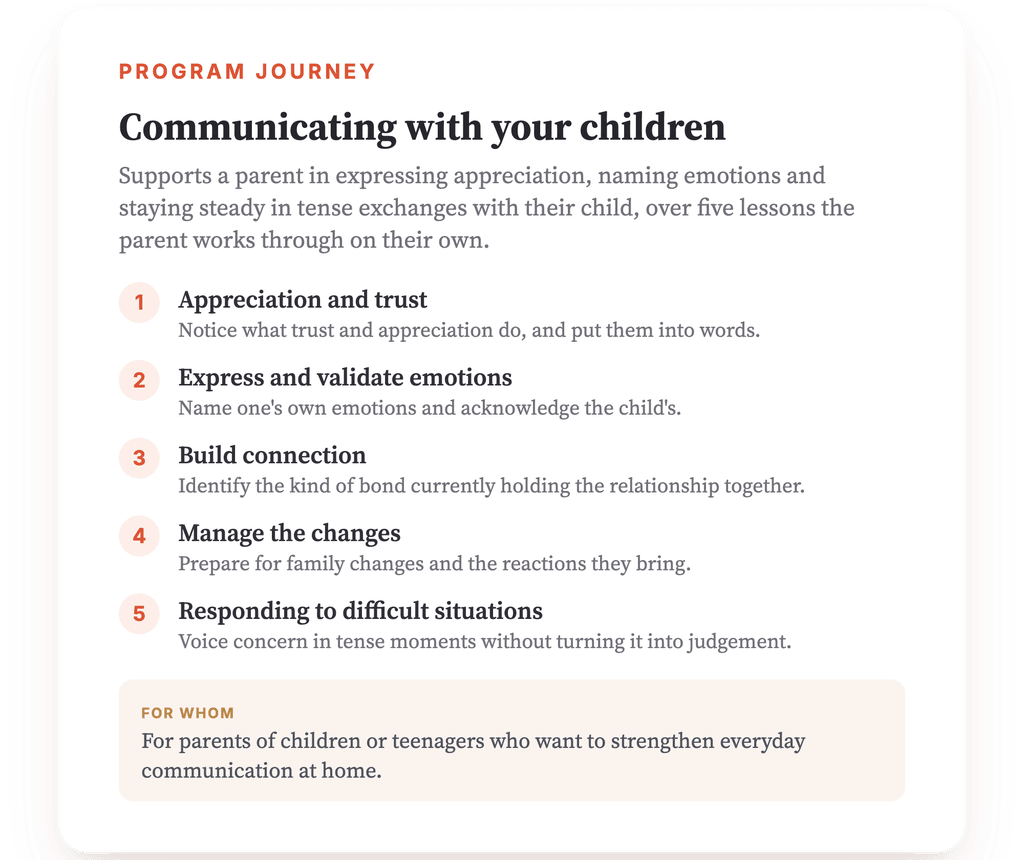
This five-lesson curriculum walks parents through four interlocking domains, step by step, as autonomous homework they complete on their own.
Lesson 1 (Appreciation and Trust) opens by anchoring the parent's own childhood experience, using guided prompts and multiple-choice emotion questions to surface how feeling believed in shaped their development. Parents then build a concrete list of what they appreciate in each of their children, a straightforward but clinically powerful act many have never done explicitly. The link between children's fundamental needs by age and the parent's current relational stance becomes tangible here.
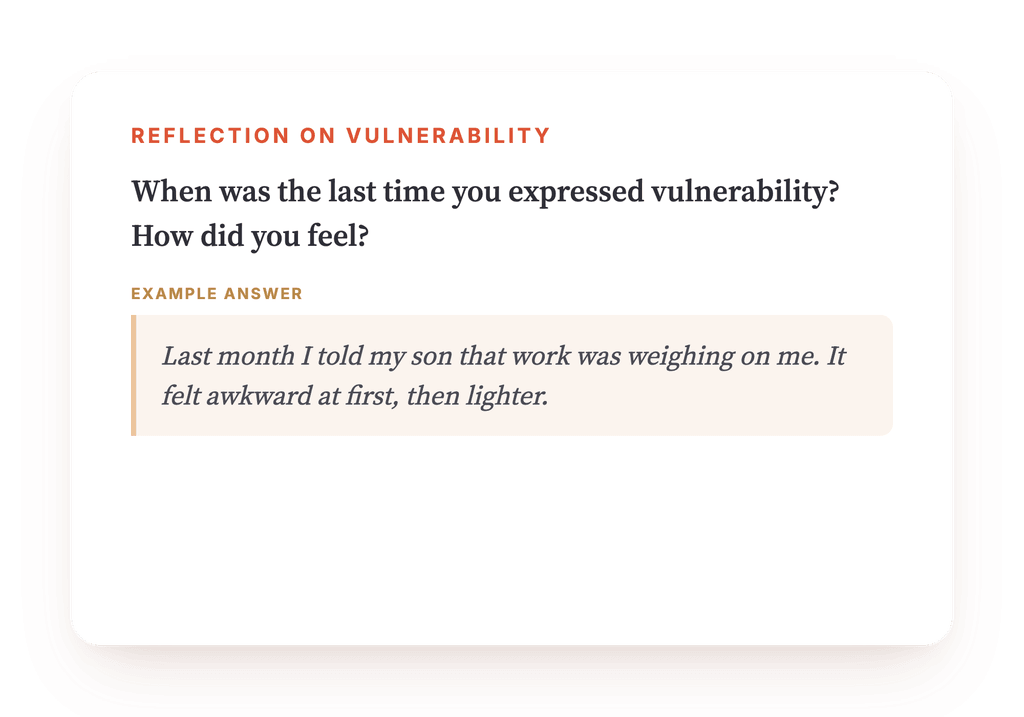
Lesson 2 (Expressing and Validating Emotions) addresses the vulnerability piece directly. Parents explore what emotional expression costs them, then examine how modelling openness creates the conditions for their children to do the same. The connection to self-esteem is made explicit, grounding the work in behavior, emotion, and underlying need rather than surface behavior alone.
Lesson 3 (Building Connection) provides developmental scaffolding from infants and toddlers through adolescents, each stage with its own relational logic. Parents reflect on a recent conflict and are prompted to consider how the child likely experienced it, a perspective-taking exercise that pairs naturally with work done around active listening skills or nonviolent communication.
Lesson 4 (Managing Change) normalizes developmental transitions and examines the parental pull to over-intervene. Parents identify a current challenge for each child and reflect on what genuine support, rather than rescue, looks like in practice.
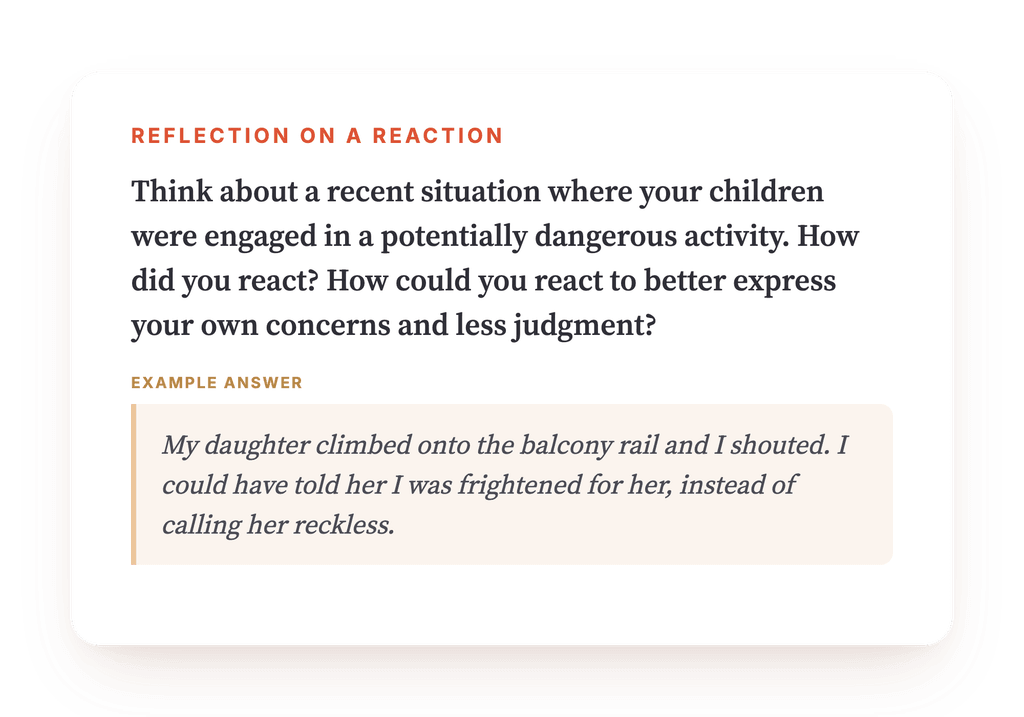
Lesson 5 (Responding in Difficult Situations) introduces non-judgment as a practised skill, with structured I-message-style prompts that complement assertive communication and using praise effectively.
The preview images embedded here show only the overview map and a handful of sample cards. These aperçus ne montrent qu'une fraction du programme: the full curriculum contains many more steps, reflection prompts, guided writing exercises, and multiple-choice check-ins than what is visible in these excerpts.
Key insight: When a parent has no practiced language for appreciation or emotional expression, psychoeducation alone rarely moves the needle. A structured between-session curriculum gives insight traction by turning it into repeated, reflective practice.
This program is available to your patients through the mobile application that is the dedicated patient-side interface of SessionFuel. Once you assign it in your SessionFuel account, your patient works through each lesson directly on their phone, on their own, between appointments.
Use it with your patients
Share this tool in the mobile app and follow the work between sessions.
Integrating This Program Into Your Practice
This program suits parents of children at any developmental stage, including those navigating co-parenting dynamics, attachment repair, or their own emotion regulation difficulties. It also fits parents who present primarily for personal distress but for whom parenting strain is a significant driver. The The Four Parenting Styles fiche and the Parenting Fundamentals program work well as companion resources when a broader parenting curriculum is warranted.
Introduce the program after an early assessment, once you have identified that expressing appreciation, validating emotions, or connecting across developmental change is a live difficulty. Frame it plainly: "Between now and our next appointment, I am asking you to work through the first two lessons and write whatever comes up honestly."
When the patient returns, the written prompts give you immediate clinical material: what they wrote about their own childhood, how they named feelings in the emotion check-ins, what ended up on the appreciation list. That is richer than anything a direct question in session typically yields. From there, the work threads naturally into Sibling Relationships, Strong-Willed Children, Children's Whining and Complaining, or the Expressing Vulnerability in Relationships fiche when emotional disclosure is the sticking point.
Your session continues in your patients' pocket
Use with a patientYour resources, available everywhere
The handouts, exercises, programs and audios above: you choose which ones to make available to your patients, in the mobile app dedicated to them.
And far more than a library
The app goes well beyond resources, to support your patients every day:
Related categories
Explore other clinical resources by category.

Relationships
Clinical worksheets and tools on relational functioning: attachment, schemas, assertiveness, and communication skills for therapists. Printable PDF resources.

Understand
Clinical hub for the therapeutic aim 'Understand': worksheets and tools to build patient insight across CBT, ACT, schema therapy and more.

Build skills
Skill-building resources for clinicians: printable worksheets and exercises for coping, assertiveness, and communication skills training in therapy.

Positive psychology
Positive psychology clinical resources for therapists: worksheets, exercises & programs on well-being, strengths, gratitude, and resilience-based practice.

Systemic & narrative
Systemic family narrative therapy resources for clinicians: worksheets, psychoeducation programs, and exercises for couples, families, and groups.

Anxiety
Clinical hub for anxiety disorders: CBT and ACT worksheets, psychoeducation sheets, and exercises for assessment and treatment across the anxiety spectrum.