
Clinical picture. A., a woman in her early forties, presented with work-related burnout and reported feeling isolated despite living with a partner and having several friends. She described a persistent reluctance to reach out, anchored in the belief that she would be placing an unfair burden on others. The clinician introduced the informational sheet in session, using the four-category framework to help A. distinguish between the emotional support she was avoiding and the tangible help she had never considered requesting. A. identified one friend as a strong candidate for emotional listening and a neighbour she could ask for practical assistance with weekly errands. By the following session she had sent one message, received a warm reply, and noted a modest but genuine reduction in the sense of being entirely alone with her situation.
Social Support: PDF Worksheet, Tools and Exercises for Clinical Practice
A structured visual PDF worksheet to help clinicians explain the four types of social support, dismantle help-seeking barriers, and build a workable network with patients in session.
Clinical vignettes
Mapping Support After Burnout Onset
Rebuilding Connection After Bereavement
Clinical picture. T., a man in his late fifties, was seen eight months after the death of his spouse and described a social world that had progressively contracted since the loss. He acknowledged that several acquaintances had extended invitations he had declined, and he framed this pattern as protecting others from his grief. The clinician used the sheet to normalise the distinction between belonging-type support, which does not require emotional disclosure, and the deeper emotional support T. was not yet ready to seek. A local weekly walking group was identified as a low-demand belonging context, and T. agreed to attend twice before evaluating whether it felt sustainable. At review he reported no dramatic shift in mood, yet noted that the regularity of familiar faces had made two mornings per week feel noticeably less empty.
Patients will readily acknowledge they lack social support, then return the following week having contacted nobody. The obstacle is rarely ignorance. It's a tightly held set of maintenance beliefs that oral psychoeducation alone rarely shifts. This social support PDF worksheet gives you a concrete visual scaffold to work with those beliefs directly in session, rather than leaving the patient with a vague instruction to "reach out more."
Use this resource with your patients
Handout, exercises and materials ready to use, right inside SessionFuel.
Why Social Support Resists a Simple Verbal Explanation
The core clinical difficulty here is that patients conflate four functionally distinct support types and expect any single relationship to supply all of them. When that doesn't happen, the whole support-seeking attempt is experienced as failure. Alongside that, the social isolation schema and patterns consistent with emotional deprivation often coexist with a set of automatic thoughts that actively block help-seeking: "I'd be a burden," "I should handle this alone," "if I ask, I owe them." These are recognizable cognitive distortions, but they tend to stay implicit unless you name them explicitly and early. Without a shared vocabulary for the four support types, patients also misread interpersonal mismatches, asking a practical-fixer friend for emotional validation, for instance, as proof that nobody is available, which reinforces the loneliness-maintaining cycle rather than disrupting it.
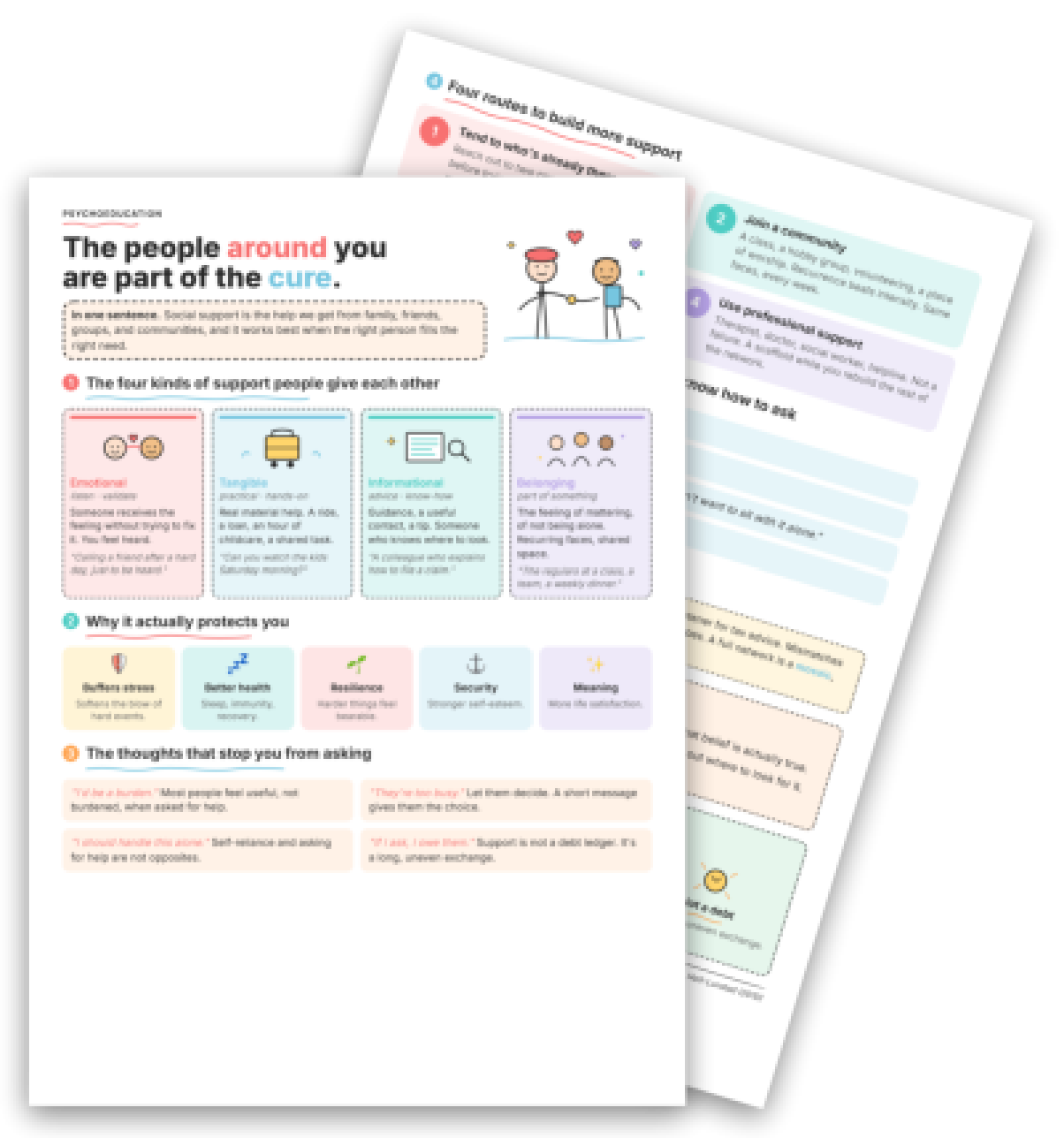
What's Inside the Fiche: A Six-Panel Visual Tool
The fiche is organized into six clearly named sections, each functioning as a distinct discussion anchor you can move through with the patient.
Panel 1 maps the four kinds of support: emotional (listen, validate), tangible (practical help), informational (advice, know-how), and belonging (recurrence, shared space). The visual layout places these side by side so the patient can immediately see they are different, not interchangeable.
Panel 2 names the protective mechanisms, stress buffering, sleep and immune benefits, resilience, security, meaning, linking social connection to concrete physiological and psychological outcomes without requiring you to recite the Uchino or Holt-Lunstad literature from memory.
Panel 3 is the most clinically dense: it surfaces the four help-seeking barriers verbatim. The fiche presents each one with its cognitive reframe already embedded, so you can read aloud, for example, "If I ask, I owe them, support is not a debt ledger, it's a long, uneven exchange" and use the patient's reaction as live material. This is where the beliefs that damage relationships surface naturally for inspection.
Panel 4 offers four concrete routes to build support, including tending existing connections before seeking new ones, joining a community where recurrence matters more than intensity, peer support groups, and professional scaffolding. Panel 5 gives the patient ready-to-borrow phrases ("Can I tell you about something hard without you trying to fix it?") to lower the behavioural entry cost of asking. Panel 6 introduces the mosaic model: a full support network draws on many people, each matched to the right need type.
> Key takeaway: this fiche is a visual support that facilitates the explanation of social support in session. The clinician uses it to name, point, and prompt; the patient leaves with a concrete reference, not a homework assignment to complete alone.
750+ clinical tools
A library built with and for clinicians, ready to use in session and extend between appointments.
Access all the toolsWhen and How to Introduce It in Session
The fiche fits naturally from session two or three onward, once the anamnèse has revealed relational impoverishment, avoidance of help-seeking, or the kind of social withdrawal frequently seen in depression, burnout, or presentations with abandonment-related schemas. It works equally well mid-treatment when a patient reports a conflict with a support figure, as the mosaic model and the mismatch section give you a joint vocabulary to reappraise what happened.
A low-stigma introduction might be: "I'd like to show you a map of the different things people can give each other, it sometimes explains why one relationship can feel like enough and another one frustrating, even if both people mean well."
Debrief by scanning the "To discuss in session" prompts printed at the bottom of the fiche: catching the burden belief in real time, identifying which support type is missing and where to look for it, and unblocking a message the patient has been drafting but cannot send. These make the transition from psychoeducation to functional work seamless. For patients whose network thinness reflects deeper patterns, the fiche pairs cleanly with exploring loneliness, assertiveness tools, or building secure attachment. For adolescents or younger adults, the protective factors framework provides a complementary systemic lens.
The fiche does not replace the therapeutic relationship. It makes one conversation faster, clearer, and easier to return to.
Use it with your patients
Share this tool in the mobile app and follow the work between sessions.
Sources
- House, J. S. (1981). Work Stress and Social Support. Addison-Wesley.
- Cohen, S., Wills, T. A. (1985). Stress, social support, and the buffering hypothesis. Psychological Bulletin.
- Cutrona, C. E., Russell, D. W. (1990). Type of social support and specific stress: Toward a theory of optimal matching. Wiley.
- Holt-Lunstad, J., Smith, T. B., Layton, J. B. (2010). Social relationships and mortality risk: A meta-analytic review. PLoS Medicine.
Your session continues in your patients' pocket
Use with a patientYour resources, available everywhere
The handouts, exercises, programs and audios above: you choose which ones to make available to your patients, in the mobile app dedicated to them.
And far more than a library
The app goes well beyond resources, to support your patients every day:
Related categories
Explore other clinical resources by category.

Emotions
Clinical resources on emotion regulation: worksheets, coping tools, CBT, REBT, and ACT exercises for therapists working across diagnoses and age groups.

Relationships
Clinical worksheets and tools on relational functioning: attachment, schemas, assertiveness, and communication skills for therapists. Printable PDF resources.

Transitions
Clinical hub for life transitions: tools, worksheets and exercises to support psychosocial adjustment, role change and identity work in practice.

Understand
Clinical hub for the therapeutic aim 'Understand': worksheets and tools to build patient insight across CBT, ACT, schema therapy and more.

Build awareness
Clinical worksheets and tools to build awareness in therapy: cognitive distortions, schemas, emotions, ACT and CBT resources for practitioners.

Build skills
Skill-building resources for clinicians: printable worksheets and exercises for coping, assertiveness, and communication skills training in therapy.