
Clinical picture. R., a 41-year-old middle manager, presented with persistent fatigue, low mood, and a report that she had not exercised or seen close friends in several months. She described her weeks as a continuous chain of urgent requests, leaving no time for anything she valued. The clinician introduced the Eisenhower matrix as a psychoeducational worksheet, asking R. to map her previous week across the four quadrants. She quickly recognised that her Q2 column was almost blank, while Q3 held tasks she had never questioned. Over the following fortnight, R. scheduled two exercise slots and one lunch with a friend as fixed Q2 commitments; she noted a modest but perceptible reduction in end-of-week exhaustion.
HandoutEmotions & stressBehaviours & addictionsLife transitionsUnderstandBuild skillsEngage & motivateCBTPositive psychologySolution-focused
Eisenhower Urgency-Importance Matrix: PDF Worksheet, Tools and Exercises
A printable PDF worksheet, concrete clinical tools, and structured exercises for helping patients sort priorities, protect recovery time, and stop the burnout loop.
Clinical vignettes
Reclaiming Q2 in Chronic Overload
Breaking the Q1-Q4 Exhaustion Loop
Clinical picture. T., a 34-year-old graduate student, came to session reporting that he spent most evenings on his phone despite wanting to work on his thesis, a pattern he found demoralising. Mapping his day with the matrix revealed a dense Q1 load through the afternoon followed by an abrupt collapse into Q4 screen time, with no transition space between the two. The clinician used this visual to name the loop without judgement: sustained firefighting depletes the cognitive resources needed for deliberate choice, making passive numbing almost automatic. T. agreed to one small structural change, a ten-minute walk between his last Q1 task and the evening, as a circuit-breaker. At the next session he reported the walk had not solved the scrolling entirely, but had reduced it on three out of five nights.
Patients presenting with chronic overload, burnout, or perfectionism-driven exhaustion almost universally report that everything feels urgent. Explaining the difference between urgency and importance aloud tends to produce polite nodding, not genuine reorganization. This PDF worksheet gives you a visual scaffolding that makes the distinction immediately legible, in session, not as an abstraction the patient decodes alone at home.
Use this resource with your patients
Handout, exercises and materials ready to use, right inside SessionFuel.
Why the Urgency/Importance Distinction Stalls When Explained Verbally
The conceptual split sounds simple. Clinically, it rarely lands that way. Patients caught in the Q1 trap (constant firefighting) have typically merged urgency with importance so thoroughly that separating the two feels either abstract or subtly threatening to their identity as someone who "handles everything." Those who collapse into numbing behaviors at the end of the day are already living the Q4 escape: exhaustion drives avoidance, avoidance inflates tomorrow's backlog, and the loop continues. Patients working through perfectionism or hyper-responsibility will almost always present with a third pattern: Q2 starvation, meaning the things that would actually move their health or relationships or career forward never get scheduled, because they are never loud enough to compete.
Without a shared visual, mapping these three dynamics takes several back-and-forths. With the matrix in hand, you point.
What the Fiche Contains: A Visual Reference for In-Session Explanation
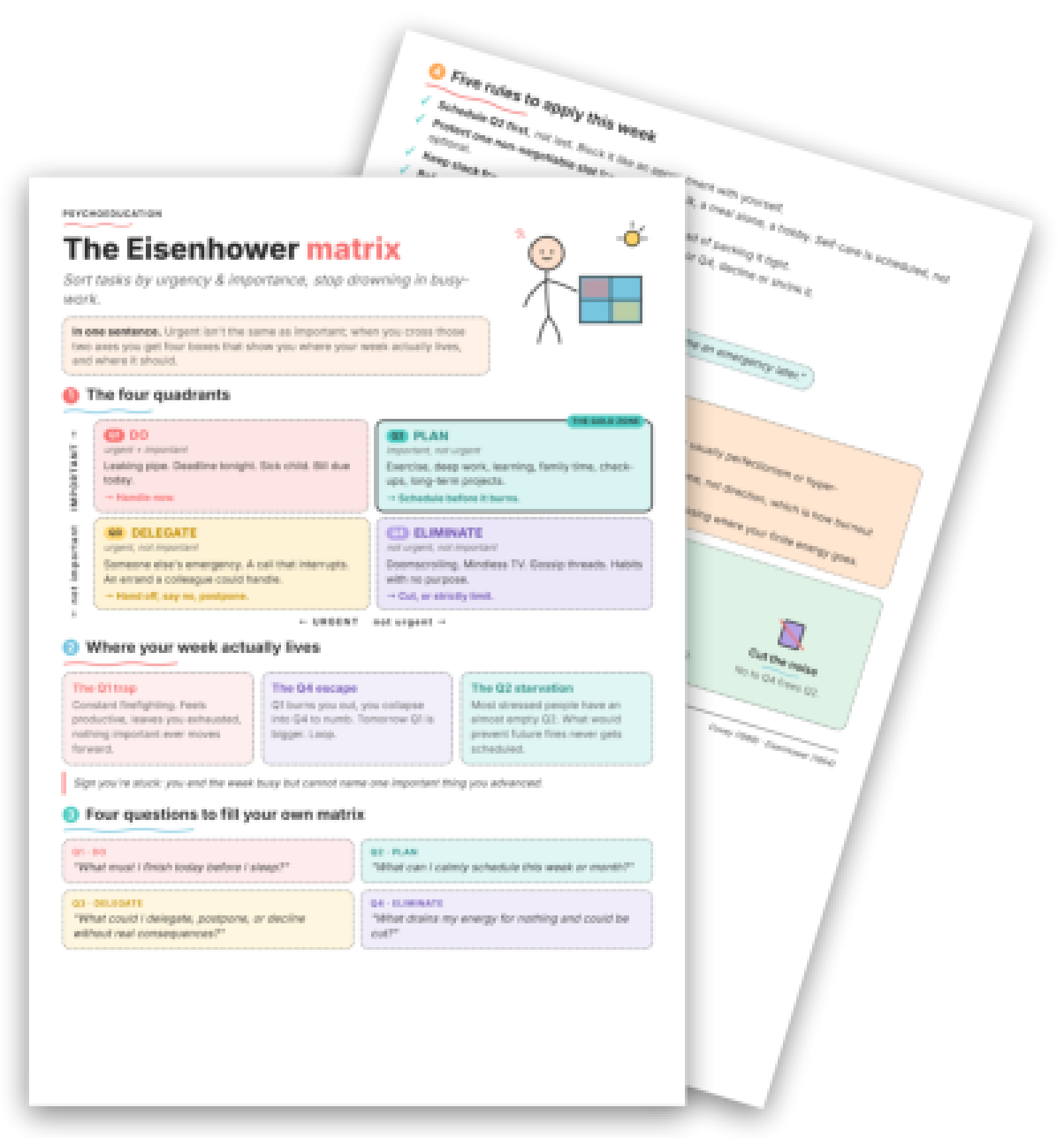
The PDF worksheet is organized across five structured panels. The first draws the four-quadrant grid with its two axes labeled clearly: urgent/not urgent on one, important/not important on the other. Each quadrant carries a directive and grounded, recognizable examples drawn from everyday life:
- Q1: DO ("Leaking pipe. Deadline tonight. Sick child."), handle now.
- Q2: PLAN ("Exercise, deep work, learning, family time."), schedule before it burns.
- Q3: DELEGATE ("Someone else's emergency. An errand a colleague could handle."), hand off or decline.
- Q4: ELIMINATE ("Doomscrolling. Mindless TV. Gossip threads."), cut or strictly limit.
The second panel, titled "Where your week actually lives," names the three clinical patterns directly: the Q1 trap, the Q4 escape, and Q2 starvation. Reading it alongside the patient is often the moment the formulation clicks, because the loop from burnout to numbing to an even bigger backlog is drawn rather than narrated.
A third panel offers four sorting questions the patient can apply to their own task list. A fourth gives five behavioral rules, including the operationally precise instruction to "Schedule Q2 first, not last. Block it like an appointment with yourself." A closing panel provides ready-to-use self-talk phrases ("Urgent for whom?" / "This is loud, not important.") that integrate naturally into cognitive restructuring work between sessions.
> To retain: this fiche is a visual support that facilitates the in-session explanation of the urgency/importance distinction; the clinician uses it to make the model legible and to leave the patient a portable reference, not a self-administered questionnaire to complete alone.
Clinical library
750+ clinical tools
A library built with and for clinicians, ready to use in session and extend between appointments.
Access all the toolsSeveral resource types
Psychoeducation handouts
Understand at a glance
Interactive exercises
To do and fill in
Interactive programs
A structured path
Audios
Meditation and relaxation
Psychometric tests
Automatic scoring
When and How to Propose It
The matrix fits naturally in the early-to-mid phase of work with patients presenting with burnout, chronic overwhelm, procrastination, or any clinical picture where avoidance and overload co-maintain each other. It articulates well with a current activity inventory, with work-life balance self-assessment, and with structured goal-setting exercises. When assertiveness deficits are feeding the Q3 pile-up, combining the matrix with assertiveness training tools or boundary-setting work is a direct next step. For patients managing workplace pressure, the "Urgent for whom?" phrase alone can anchor a full session of cognitive reappraisal.
A simple framing to introduce the fiche: "I want to show you a diagram that many people find useful when everything starts feeling equally urgent. Let's place a few things from your week into it together." Avoid framing it as time-management coaching; anchor it instead in the patient's specific pattern, using the language of Q1 trap or Q2 starvation that already maps onto what they have described in session.
The debrief marker worth tracking across sessions: "Did you touch Q2 at all this week?" The fiche closes with a 1-to-5 daily self-rating on exactly that question, giving you a concrete behavioral index rather than a vague subjective report.
For patients with significant executive dysfunction, the matrix may need additional scaffolding. Pairing it with a weekly work check-in exercise or a behavioral activation planning tool makes Q2 scheduling operationally achievable rather than aspirational. The control, influence, accept framework is also a useful complement for patients who struggle to relinquish Q3 tasks without anxiety.
The fiche does not replace case formulation; it makes one clinically decisive piece of it visible and portable.
Use it with your patients
Share this tool in the mobile app and follow the work between sessions.
Sources
- Covey, S. R. (1989). The 7 Habits of Highly Effective People. Simon and Schuster.
- Covey, S. R., Merrill, A. R., Merrill, R. R. (1994). First Things First. Simon and Schuster.
- Columbia University School of Professional Studies (2023). The Eisenhower Matrix.
- Todoist. Avoid the Urgency Trap with the Eisenhower Matrix.
Patient mobile app
Your session continues in your patients' pocket
Use with a patientYour resources, available everywhere
The handouts, exercises, programs and audios above: you choose which ones to make available to your patients, in the mobile app dedicated to them.
Psychoeducation handoutsInteractive exercisesInteractive programsAudiosPsychometric tests
And far more than a library
The app goes well beyond resources, to support your patients every day:
Standardized tests
Therapy journal
Gamification
Wellbeing challenges
Introspection prompts
Therapist homework
Related categories
Explore other clinical resources by category.

Emotions
Clinical resources on emotion regulation: worksheets, coping tools, CBT, REBT, and ACT exercises for therapists working across diagnoses and age groups.

Behaviours
Clinical hub for behaviors in therapy: worksheets and tools for coping, eating disorders, CBT formulation, and maladaptive behavioral patterns.

Transitions
Clinical hub for life transitions: tools, worksheets and exercises to support psychosocial adjustment, role change and identity work in practice.

Understand
Clinical hub for the therapeutic aim 'Understand': worksheets and tools to build patient insight across CBT, ACT, schema therapy and more.

Build skills
Skill-building resources for clinicians: printable worksheets and exercises for coping, assertiveness, and communication skills training in therapy.

Engage & motivate
Clinical hub: printable worksheets and exercises to build therapeutic engagement and motivation across ACT, CBT, and integrative practice. For clinicians.