
Clinical picture. M., a woman in her early forties, presented with a persistent low mood following a professional redundancy, describing herself as having "nothing to offer" in sessions. The clinician introduced the strengths exploration worksheet, framing it explicitly as a data-gathering exercise rather than a positivity exercise. Working through the menu together, M. circled perseverance, empathy, and humor, then paused at humor, saying she had not thought of it as a skill. She was asked to recall one specific moment when humor had changed something in a relationship; she described defusing tension at a difficult family dinner six months prior. The following week she reported having used that moment as a reference point when self-critical thoughts arose, which did not resolve the low mood but introduced a small degree of internal counter-evidence.
Strengths Exploration: PDF Worksheet, Tools and Exercises for Clinical Practice
A printable PDF worksheet with concrete tools and exercises helping clinicians guide patients through naming, recalling, and deliberately applying their personal strengths.
Clinical vignettes
Naming What Was Already There
Anchoring a Strength to a Specific Moment
Clinical picture. T., a university student in his mid-twenties, was seen for generalized anxiety with marked avoidance of group academic work, which he attributed to being "less capable than others." The clinician used the worksheet's three-step method, focusing on the work and studies area: T. named curiosity and common sense, then was guided to recall a concrete instance in which curiosity had helped him, settling on a research project he had independently extended beyond the assignment brief. From that recall, he identified one specific action for the coming week: to open the group chat he had been muting and respond to one message using a question rather than an opinion. He followed through and noted, briefly, that the interaction had felt less threatening than anticipated.
Telling a patient to "focus on their strengths" without a structured anchor rarely lands. The concept is so familiar it has lost clinical traction, and patients with low self-esteem, persistent depression, or a defeatist fixed mindset will dismiss it in seconds. This Strengths Exploration fiche PDF gives you a concrete visual support to do the actual psychoeducation work in session, rather than leaving the patient to interpret an abstract invitation on their own.
Use this resource with your patients
Handout, exercises and materials ready to use, right inside SessionFuel.
Why Strengths Exploration Resists Oral Explanation
The most common obstacle is not that patients refuse to believe they have strengths. It is that they cancel each one as they find it. The fiche names this directly: "Notice the move. It quietly cancels each strength as you find it." That metacognitive move, what the fiche calls the "yes, but anyone could do that" pattern, maps cleanly onto the disqualifying the positive distortion documented in CBT literature. Without a visual structure to catch it in real time, the moment passes.
A second difficulty is more conceptual. Patients who have spent months working on deficits and symptoms often conflate strength-naming with positive thinking, which they correctly distrust. The fiche reframes it immediately: a strength is "data. Naming a real capacity you have." That single distinction, set out in a NOT THIS / RATHER THIS table, does more work in thirty seconds than a verbal explanation typically achieves in five minutes.
A third friction point is scope. Patients frequently limit strengths to exceptional performances. The visual menu in the fiche counteracts this by surfacing ordinary, taken-for-granted capacities that feel too unremarkable to mention, precisely because they are so familiar.
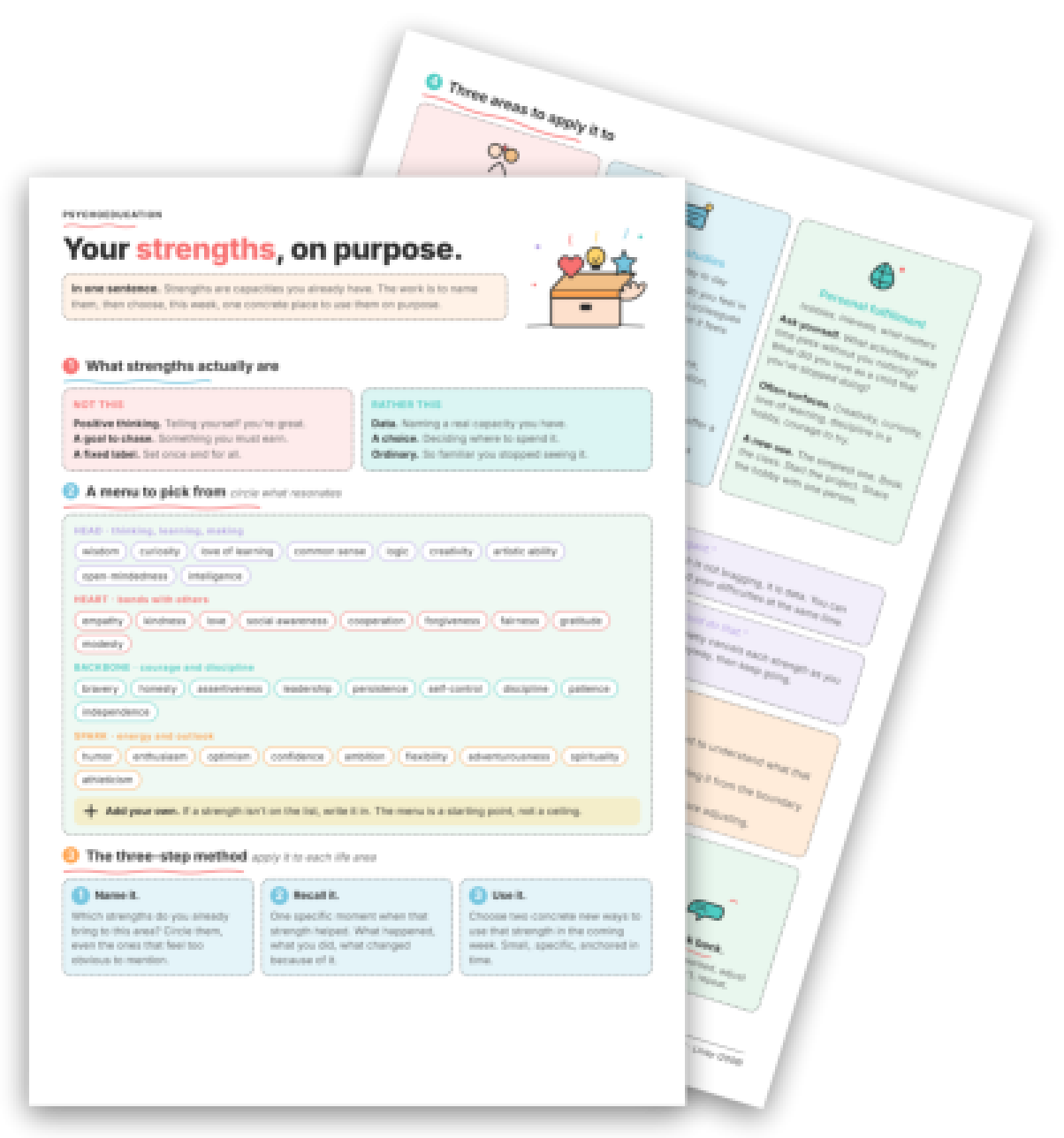
What the Fiche Contains: A Visual Tool for In-Session Psychoeducation
The fiche organizes five structured sections designed to move from concept to application within a single consultation.
- Section 1 presents a two-column contrast between what strengths are not (positive thinking, goals to chase, fixed labels) and what they are (data, choice, ordinary and familiar). Use this panel to reframe the concept before anything else.
- Section 2 is a strengths menu organized into four named clusters: HEAD (thinking, learning, making), HEART (bonds with others), BACKBONE (courage and discipline), and SPARK (energy and outlook). Patients circle resonant items. The format resembles the VIA Classification framework (Peterson & Seligman, 2004; Niemiec, 2018), which clinicians working in positive psychology will recognize immediately. An open line invites patients to add unlisted strengths.
- Section 3 introduces a three-step method: Name it, Recall it (one specific memory in which that strength operated), and Use it (two concrete applications in the coming week). This structure bridges psychoeducation and behavioral commitment in one visual sequence.
- Section 4 applies the three steps across three life domains: relationships, work or studies, and personal fulfillment. Each domain includes a worked example to orient the patient, such as "I'll use my humor on Sunday to lighten the family lunch, instead of going silent."
- Section 5 maps four common resistance patterns with direct responses: inability to find any strengths, feeling arrogant, strengths contaminated by fear or obligation, and the discounting move described above.
> To retain: the fiche is a visual support that facilitates the explanation of strengths work in session; it is not a self-help exercise the patient completes alone. The clinician walks through the panels, names the concept, and leaves the patient with a concrete reference.
The "To discuss in session" checklist at the bottom functions as a natural debriefing scaffold, flagging three situations worth returning to: discounting moves, strengths contaminated by obligation or guilt, and new uses that did not go as planned.
750+ clinical tools
A library built with and for clinicians, ready to use in session and extend between appointments.
Access all the toolsWhen and How to Introduce the Fiche
This support fits naturally in mid-phase work, once the formulation is established and the therapeutic alliance is solid enough to carry a reorientation toward resources. It is particularly well-suited for patients presenting with low self-esteem symptoms, burnout recovery, post-depressive consolidation, or schema work targeting defectiveness and failure schemas. Used alongside the List of 100 Strengths and Qualities or the Positive Traits Checklist, it gains specificity without duplication.
A simple introduction might be: "We've spent time mapping what makes things difficult. I'd like to look at what you already bring, concretely. This fiche will help us do that together." Framing it as data-gathering rather than cheerleading will matter to patients who are skeptical of anything resembling positive reframing.
For couples work, the Couple's Strengths Exploration version extends the same structure to the relational dyad. For patients working on values clarification in ACT, pairing this fiche with Exploring Values builds a coherent bridge between strengths and committed action. Patients rebuilding self-efficacy after a difficult period may also benefit from the Celebrating Personal Successes exercise as a follow-up, and those with behavioral withdrawal from depression will find the strengths menu useful in building a meaningful activity menu.
Debrief the following session around the "new use" the patient chose: whether it happened, what got in the way, and what that obstacle reveals. The fiche does not replace the clinical frame. It makes the explanation cleaner, faster, and leaves the patient with something tangible to return to between sessions.
Use it with your patients
Share this tool in the mobile app and follow the work between sessions.
Sources
- Peterson, C., & Seligman, M. E. P. (2004). Character Strengths and Virtues: A Handbook and Classification. Oxford University Press / American Psychological Association.
- Niemiec, R. M. (2018). Character Strengths Interventions: A Field Guide for Practitioners. Hogrefe Publishing.
- Niemiec, R. M., & McGrath, R. E. (2019). The Power of Character Strengths: Appreciate and Ignite Your Positive Personality. VIA Institute on Character.
- VIA Institute on Character. VIA Classification of Character Strengths: The 24 Character Strengths.
Your session continues in your patients' pocket
Use with a patientYour resources, available everywhere
The handouts, exercises, programs and audios above: you choose which ones to make available to your patients, in the mobile app dedicated to them.
And far more than a library
The app goes well beyond resources, to support your patients every day:
Related categories
Explore other clinical resources by category.

Identity
Clinical resources for self-identity work in therapy: CBT, ACT, schema tools for clinicians addressing self-concept, core beliefs, and identity disruption.
Relationships
Clinical worksheets and tools on relational functioning: attachment, schemas, assertiveness, and communication skills for therapists. Printable PDF resources.

Transitions
Clinical hub for life transitions: tools, worksheets and exercises to support psychosocial adjustment, role change and identity work in practice.
Build awareness
Clinical worksheets and tools to build awareness in therapy: cognitive distortions, schemas, emotions, ACT and CBT resources for practitioners.

Engage & motivate
Clinical hub: printable worksheets and exercises to build therapeutic engagement and motivation across ACT, CBT, and integrative practice. For clinicians.

Positive psychology
Positive psychology clinical resources for therapists: worksheets, exercises & programs on well-being, strengths, gratitude, and resilience-based practice.