
Clinical picture. M., a 38-year-old project manager, presented after a prolonged sick leave for burnout, reporting low motivation and difficulty envisioning any satisfying professional future. The clinician introduced the Best Possible Self worksheet, inviting M. to write, in present tense, a realistic Tuesday morning in a work life that had gone as well as it plausibly could. M. produced a short but specific scene: a quieter role, collaborative rather than hierarchical, with a commute replaced by a short walk. Revisiting that written scene for five minutes each morning over two weeks, M. began distinguishing concrete steps toward that picture from vague wishes, which gave the subsequent session more usable material. The exercise did not resolve ambivalence, but it shifted the therapeutic conversation from exhaustion to direction.
Best Possible Self Visualization: PDF Worksheet, Tools and Exercises
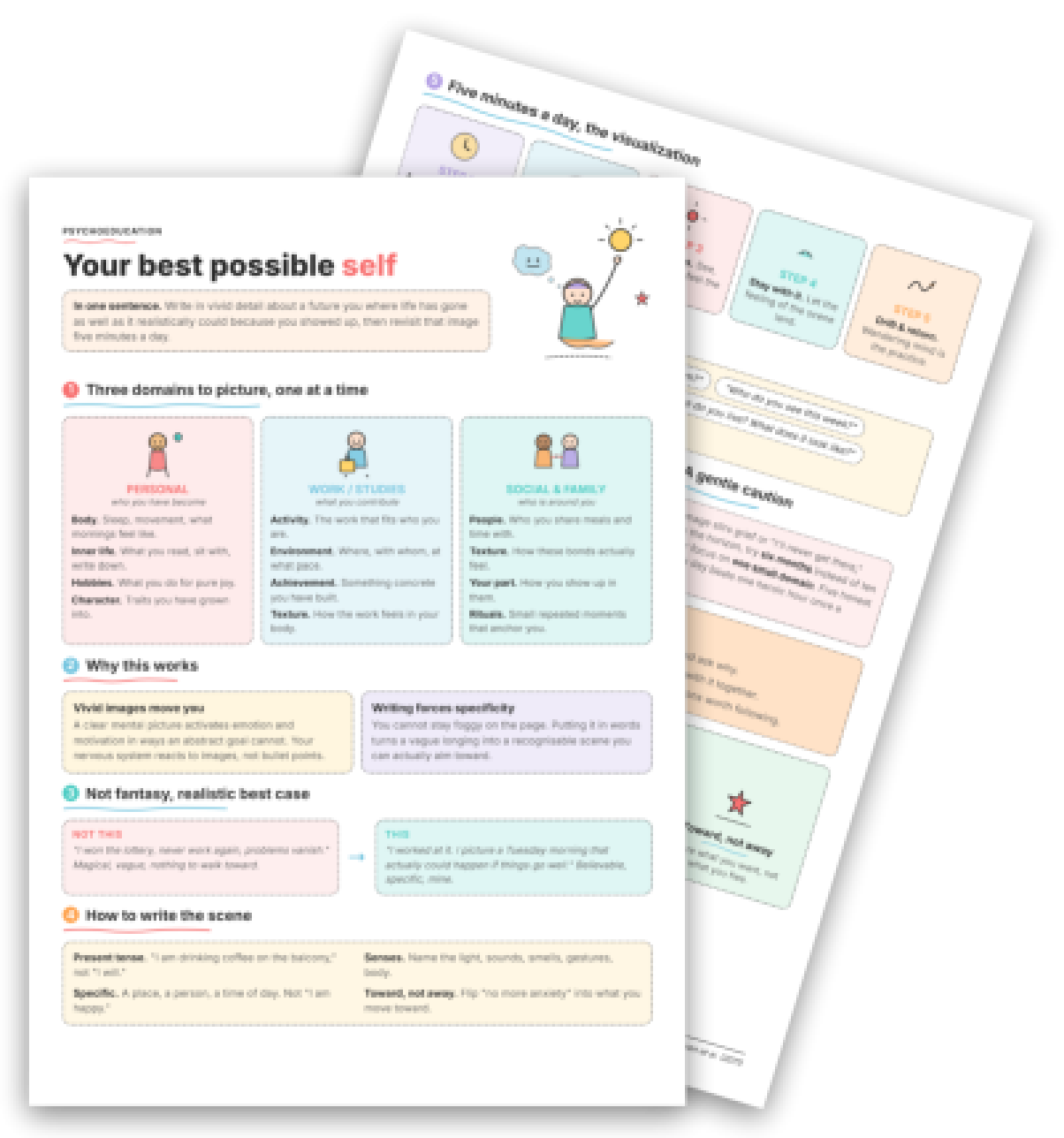
A structured visual fiche PDF to help clinicians introduce the Best Possible Self exercise in session, with domain-by-domain prompts, writing guidelines, and a daily visualization protocol.
Clinical vignettes
Reorienting After Occupational Burnout
Anchoring Identity in Early Recovery
Clinical picture. P., a 27-year-old in outpatient follow-up for alcohol use disorder at eight months of abstinence, described feeling caught between a past self he rejected and a future self he could not yet picture. The clinician offered the Best Possible Self visualization as a structured writing task, asking P. to address each domain separately: personal, occupational, and relational, staying with what was realistic rather than wished-for. P. struggled initially with the social domain, noting that most of his written details defaulted to isolation. That observation became the focus of the next session, where relational avoidance could be named and worked with directly. The worksheet functioned less as a motivational tool and more as a projective surface that surfaced clinically relevant material.
Introducing Best Possible Self (BPS) in session often stalls at the fantasy-versus-reality boundary: patients produce either magical wish lists or pessimistic foreclosure, and the oral explanation rarely closes that gap. This fiche PDF gives you a structured visual scaffold to walk through the exercise alongside the patient, so the psychoeducation happens on the page rather than in the air.
Use this resource with your patients
Handout, exercises and materials ready to use, right inside SessionFuel.
Why Best Possible Self Resists a Purely Verbal Explanation
The concept sounds deceptively straightforward: imagine a future self where life has gone as well as it realistically could. In practice, patients oscillate between two unhelpful poles. Some inflate the image into pure fantasy with no behavioral traction. Others, particularly those carrying depressive schemas or low self-worth, deflate it before it takes shape, because their core belief actively resists the premise that a good outcome is possible for them.
There is also a specificity problem that an oral explanation cannot easily solve. Clinicians working within positive psychology, ACT, or behavioral activation frameworks know that vague future orientation produces weak motivational pull. The nervous system responds to images, not abstractions, which is precisely why telling a patient to "picture your best future self" remains cognitively underspecified. A structured visual that shows exactly what level of sensory detail is expected changes the exercise entirely.
750+ clinical tools
A library built with and for clinicians, ready to use in session and extend between appointments.
Access all the toolsWhat the Fiche Contains, and Why the Visual Layout Matters
The printable organises the exercise around three life domains, explored one at a time: Personal (who you have become), Work/Studies (what you contribute), and Social & Family (who is around you). Each domain is broken into sub-dimensions that enforce the sensory granularity the exercise requires. Under Personal, for instance, the fiche prompts: "Sleep, movement, what mornings feel like" and "What you do for pure joy." Under Social & Family: "How these bonds actually feel" and "Small repeated moments that anchor you." That level of specification, laid out visually, does more to orient the patient than a verbal instruction to "be specific."
A dedicated panel contrasts what BPS is not ("I won the lottery, never work again, problems vanish") against what it actually targets: "I worked at it. I picture a Tuesday morning that actually could happen if things go well." Patients see the distinction immediately on the page, without you having to argue for it.
Beyond the domain structure, the fiche includes:
- Writing guidelines: present tense, sensory anchoring, toward-not-away framing ("flip 'no more anxiety' into what you move toward")
- A five-step daily visualization protocol covering how to re-enter the written scene, sustain sensory contact, and work with mind-wandering
- Seven starter prompts to break writing block ("What are you doing at 10am?" / "What feels easy now that was hard before?")
- A weekly domain rotation schedule and a "To discuss in session" block with three ready-made debrief angles
> Key point: this fiche is a visual psychoeducation support to use alongside the patient in session, not a questionnaire to send home cold. The schemas and contrast panels do the explaining; your role is to guide the clinical meaning, not to reproduce it verbally.
Use it with your patients
Share this tool in the mobile app and follow the work between sessions.
When and How to Introduce It in Session
BPS work fits best in mid-treatment, once the case formulation is established and the patient has enough alliance and psychological stability to orient toward the future. It pairs naturally with values clarification, behavioural activation planning, and structured goal-setting exercises. For patients stuck in ruminative or depressive constriction, it can serve as a behavioural activation entry point that sidesteps the usual avoidance arguments by grounding forward movement in imagery rather than obligation.
A light introduction works well: "I have a structured exercise that helps us map the direction you want to move toward, domain by domain. It's not a wish list; it's more like a realistic rehearsal." Walk through the domains together using the fiche visually before the patient writes anything.
For patients carrying impostor-syndrome dynamics or low self-esteem presentations, hold the exercise a session longer. The "realistic best case" frame can misfire when the core belief actively rejects the premise that a good future is available to them. In those cases, pair BPS with cognitive work on negative core beliefs first, and use the fiche's own caution: shorten the time horizon and narrow to a single domain if the image stirs grief rather than aspiration.
The "To discuss in session" block offers three specific debrief angles (a domain that stays blank, the inner voice of "I'll never get there," small spontaneous actions that have already started). Combined with a ten-year projection exercise or a future inventory, BPS becomes a living reference across the treatment rather than a one-time homework item.
The fiche doesn't replace the therapeutic work; it makes the direction concrete enough that both you and the patient can actually see it.
Your session continues in your patients' pocket
Use with a patientYour resources, available everywhere
The handouts, exercises, programs and audios above: you choose which ones to make available to your patients, in the mobile app dedicated to them.
And far more than a library
The app goes well beyond resources, to support your patients every day:
Related categories
Explore other clinical resources by category.

Mood
Evidence-based worksheets and clinical tools for mood disorders: CBT, ACT, and positive psychology resources for psychologists and therapists.

Identity
Clinical resources for self-identity work in therapy: CBT, ACT, schema tools for clinicians addressing self-concept, core beliefs, and identity disruption.

Transitions
Clinical hub for life transitions: tools, worksheets and exercises to support psychosocial adjustment, role change and identity work in practice.

Build awareness
Clinical worksheets and tools to build awareness in therapy: cognitive distortions, schemas, emotions, ACT and CBT resources for practitioners.

Engage & motivate
Clinical hub: printable worksheets and exercises to build therapeutic engagement and motivation across ACT, CBT, and integrative practice. For clinicians.

CBT
CBT worksheets, cognitive restructuring exercises & behavioral tools for clinicians. Evidence-based resources for every phase of cognitive behavioral therapy.