
Clinical picture. M., a 41-year-old project manager, presented with persistent low mood and a sense of purposelessness following a period of occupational overload. He described feeling trapped by professional obligations yet unable to articulate what he actually wanted instead. The clinician introduced the elder-self letter as a structured writing exercise, framing it explicitly as a backward gaze rather than goal-setting. M. completed all five prompts longhand over one session, and his letter returned repeatedly to having been emotionally absent from his children during their primary-school years. From that single observation, he identified one concrete behavior: leaving his phone in the hallway from dinner until bedtime, starting that evening. At the following appointment he reported that the exercise had clarified his priorities more quickly than several weeks of direct values discussion had done.
Your Wisest Self: PDF Worksheet, Tools and Exercises for Clinical Practice
A structured fiche PDF helping clinicians guide patients through the elder-self letter exercise, a powerful values clarification and meaning-making tool grounded in ACT and existential therapy.
Clinical vignettes
Reordering Priorities After Burnout
Grief-Adjusted Use of the Exercise
Clinical picture. A., a 55-year-old woman, was seen eight months after the sudden death of her adult son. Residual grief was prominent but she was no longer in acute crisis, and she had begun exploring questions of meaning and continued identity. The clinician considered the elder-self worksheet but softened the frame, as the fiche recommends: rather than imagining the very end of life, A. was invited to picture herself ten years forward, in a period of relative settledness. She wrote to her present self about the relationships she did not want to let erode further, naming her surviving daughter specifically. The resulting letter was modest in scope but gave A. a self-generated rationale for re-engaging socially, which she and the clinician then translated into one phone call planned for the following week.
Ask a patient to name their core values, and most will produce a rehearsed list that sounds more like a LinkedIn bio than a lived life. The Your Wisest Self fiche PDF sidesteps that trap entirely, giving you a concrete visual support to introduce the elder-self letter technique and make genuine values work happen in session.
Use this resource with your patients
Handout, exercises and materials ready to use, right inside SessionFuel.
Why Direct Values Questioning So Often Fails
Proximity to current distress is the main culprit. Patients under chronic stress or in acute symptom phases literally cannot see past the inbox-and-irritations zoom level, as the fiche names it. Ask them what matters and they reflect back what feels urgent, not what is actually meaningful. The result is values lists that drift toward social approval ("being a good parent," "being productive") with no behavioral traction.
The elder-self perspective resolves this by shifting the temporal frame entirely. Yalom's existential work, Hayes's ACT framework, and Bronnie Ware's research on end-of-life regrets all converge on the same finding: mortality salience, when introduced carefully, reorganises priorities quickly and honestly. The cognitive distance of "looking back from the end of a long life" produces the same effect that ACT defusion techniques aim for with thoughts: the patient steps outside their current frame and sees it as a frame.
This is a difficult move to engineer through conversation alone. A visual support that sequences the rationale and the prompts makes the shift far more reliable.
750+ clinical tools
A library built with and for clinicians, ready to use in session and extend between appointments.
Access all the toolsWhat the Fiche Contains, and What the Visual Layout Does
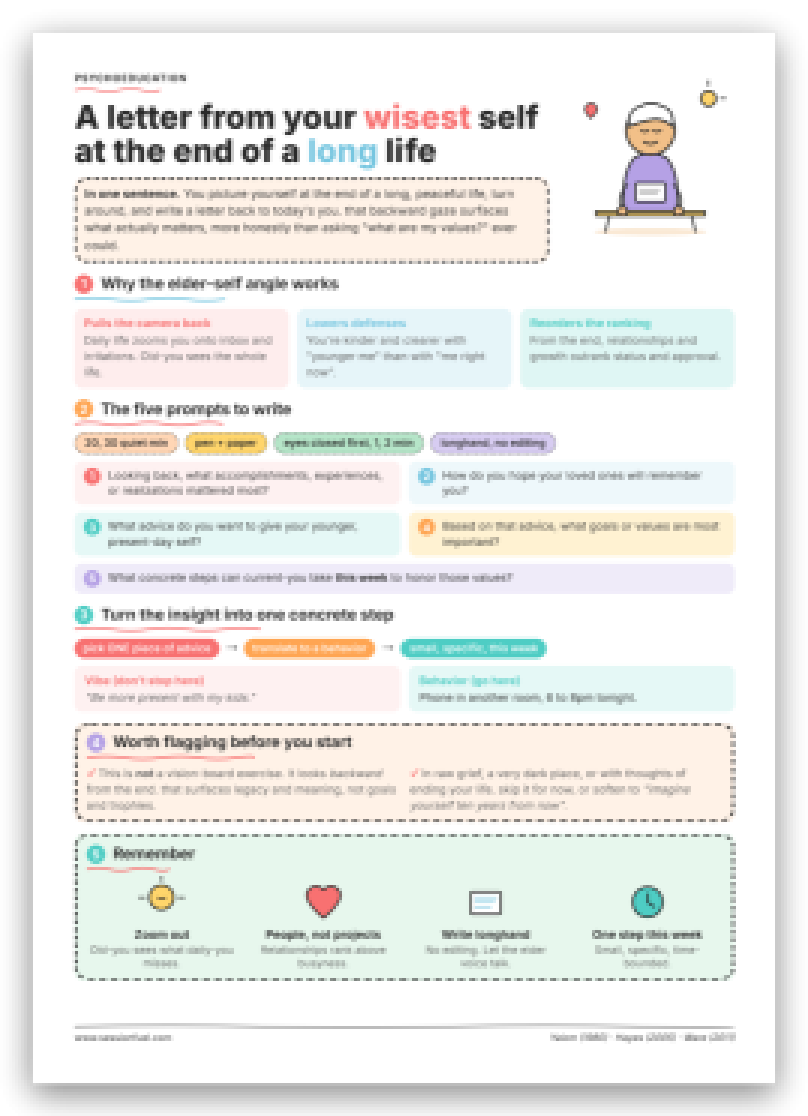
The fiche opens with a one-sentence orienting frame: "You picture yourself at the end of a long, peaceful life, turn around, and write a letter back to today's you." That framing, visible on the page throughout the exercise, anchors the patient's perspective and the clinician's guidance simultaneously.
Section 1 presents three mechanistic reasons the elder-self angle works, each in a compact paired format:
- Pulls the camera back: daily life zooms onto inbox and irritations; old-you sees the whole life.
- Lowers defenses: patients are kinder and clearer with "younger me" than with "me right now."
- Reorders the ranking: from the end, relationships and growth outrank status and approval.
Seeing these three levers laid out before writing helps the patient understand why the exercise asks for the specific perspective it does, not just that it does.
Section 2 presents five writing prompts with concrete logistics (20-30 quiet minutes, pen and paper, eyes closed for 1-2 minutes before starting, longhand with no editing). The prompts move from backward-looking accomplishment ("what experiences or realisations mattered most?") through relational legacy ("how do you hope your loved ones will remember you?") to forward-facing behavioral translation ("what concrete steps can current-you take this week?").
Section 3 is the clinically decisive piece: the vibe-to-behavior translation grid. The fiche contrasts "Be more present with my kids" (a vibe that stops at insight) with "Phone in another room, 6 to 8pm tonight" (a behavior that is small, specific, and time-bounded). That two-column visual carries the same message that values-to-committed-action work in the ACT Hexaflex takes several sessions to establish verbally.
Section 4 flags contraindications directly on the page: raw grief, a very dark clinical state, or active suicidal ideation all call for skipping the exercise or softening it to a ten-year horizon. Having that caveat printed means you do not need to deliver it as an improvised disclaimer.
> Key point: the fiche is a visual support that facilitates the explanation of the elder-self technique in session. It is not a standalone questionnaire the patient fills out alone: it scaffolds your explanation, sequences the rationale, and leaves the patient with a concrete reference to carry home.
Use it with your patients
Share this tool in the mobile app and follow the work between sessions.
When and How to Propose It in Session
Timing: this fiche fits best in the middle phase of a therapeutic trajectory, once the presenting symptoms are stable enough that the patient has bandwidth for reflective work. It pairs naturally with values exploration exercises in ACT practice and with long-term goal-setting tools.
For patients stuck in avoidance-driven depression, it complements behavioral activation work by providing a why to anchor the behavioral prescription.
Introducing it: a low-resistance framing is simply: "There's a technique I'd like to walk you through together, it uses a specific perspective to help us get clearer on what actually matters to you, separate from the noise of day-to-day stress." You do not need to label it existential, and you do not need to mention mortality unless the patient's presentation makes that relevant.
Debrief: the vibe-to-behavior section (Section 3) is where the clinical work consolidates. After the patient writes, direct attention there first. Ask them to pick one piece of advice the elder self gave, and work together to translate it into the most specific, time-bounded behavior they can name this week. That step is also available as a standalone future-focused values exercise if you want to extend the work between sessions.
Contraindications to watch: beyond the flags printed on the fiche itself, be cautious with patients whose attachment to an idealised future self is already rigid, since the exercise could reinforce the self-punitive gap between current-self and imagined-self seen in perfectionism and unrelenting standards schemas.
The fiche does not replace clinical formulation or the relational work of the therapeutic alliance. What it does is compress a complex psychoeducational sequence into a format the patient can engage with during the session and revisit at home, without losing the clinical precision that makes the technique work.
Your session continues in your patients' pocket
Use with a patientYour resources, available everywhere
The handouts, exercises, programs and audios above: you choose which ones to make available to your patients, in the mobile app dedicated to them.
And far more than a library
The app goes well beyond resources, to support your patients every day:
Related categories
Explore other clinical resources by category.

Mood
Evidence-based worksheets and clinical tools for mood disorders: CBT, ACT, and positive psychology resources for psychologists and therapists.

Identity
Clinical resources for self-identity work in therapy: CBT, ACT, schema tools for clinicians addressing self-concept, core beliefs, and identity disruption.

Transitions
Clinical hub for life transitions: tools, worksheets and exercises to support psychosocial adjustment, role change and identity work in practice.

Build awareness
Clinical worksheets and tools to build awareness in therapy: cognitive distortions, schemas, emotions, ACT and CBT resources for practitioners.

Engage & motivate
Clinical hub: printable worksheets and exercises to build therapeutic engagement and motivation across ACT, CBT, and integrative practice. For clinicians.

ACT
Clinical hub for Acceptance and Commitment Therapy (ACT): worksheets, exercises, programs and audio resources for practitioners using the ACT model.