
Clinical picture. M., a man in his early forties, presented with recurrent couple conflict centred on his partner's response time to text messages. He described a firm expectation that she reply within the hour and experienced any delay as indifference. The clinician introduced the relationship values framework and invited M. to look at his rule as a signal rather than a standard: what quality of connection was he actually seeking? M. identified reliability and emotional closeness as the underlying values, a shift that moved the conversation away from monitoring his partner's behaviour and toward articulating what feeling close genuinely meant to him. In the following session he reported having initiated one explicit conversation about connection needs, which he found less escalating than the previous pattern of complaint.
Relationship Values: PDF Worksheet, Tools and Exercises
A visual PDF worksheet, tools and exercises to help patients clarify how they want to show up in their relationships and turn recurring complaints into workable directions.
Clinical vignettes
Naming the Value Behind the Rule
Distinguishing Chosen from Inherited Values
Clinical picture. T., a woman in her mid-thirties, was exploring what she wanted from a new long-term relationship after a difficult separation. Using the nine-domain mapping section of the worksheet as a starting point, she noticed that several of her assumptions about autonomy, specifically that a devoted partner should share all leisure time, felt more familiar than chosen. The clinician prompted her to ask, for each item, whether she actually wanted this or had absorbed it from her family of origin. T. identified that she genuinely valued some degree of separate social space but had treated the opposite as a rule without ever examining it. She left with a clearer, if still tentative, picture of what she was orienting toward rather than what she felt obligated to replicate.
When patients describe relational pain, what fills the room is almost always a grievance: "they never listen," "we keep fighting about the same thing," "nothing changes." The complaint loops. What rarely surfaces on its own is what the patient actually wants to move toward. This fiche PDF on relationship values is a visual tool you can use in session to make that pivot concrete, fast, and shared.
Use this resource with your patients
Handout, exercises and materials ready to use, right inside SessionFuel.
Why Relationship Values Are Hard to Explain Verbally
The ACT concept of values as chosen qualities of action (as opposed to goals or outcomes) is deceptively simple to describe and genuinely difficult for most patients to grasp without a visual anchor. When you explain it orally, patients tend to conflate three things that the fiche keeps visually separate: a value (a direction, a way of showing up), a goal (a concrete step in the value's service), and a rule (a demand placed on the other person).
That last conflation is the clinically costly one. A patient who says "I value honesty" but means "my partner must tell me everything immediately" is operating from a rule, not a value. Working through early maladaptive schemas around mistrust or attachment anxiety often stalls precisely because this distinction hasn't been named. The same dynamic appears in the Four Horsemen patterns: contempt and criticism frequently mask an unnamed value underneath a demand.
An oral explanation of this distinction tends to produce polite nodding. A side-by-side comparison on paper holds the patient's attention differently.
What the Fiche Contains, and Why the Visual Layout Does the Work
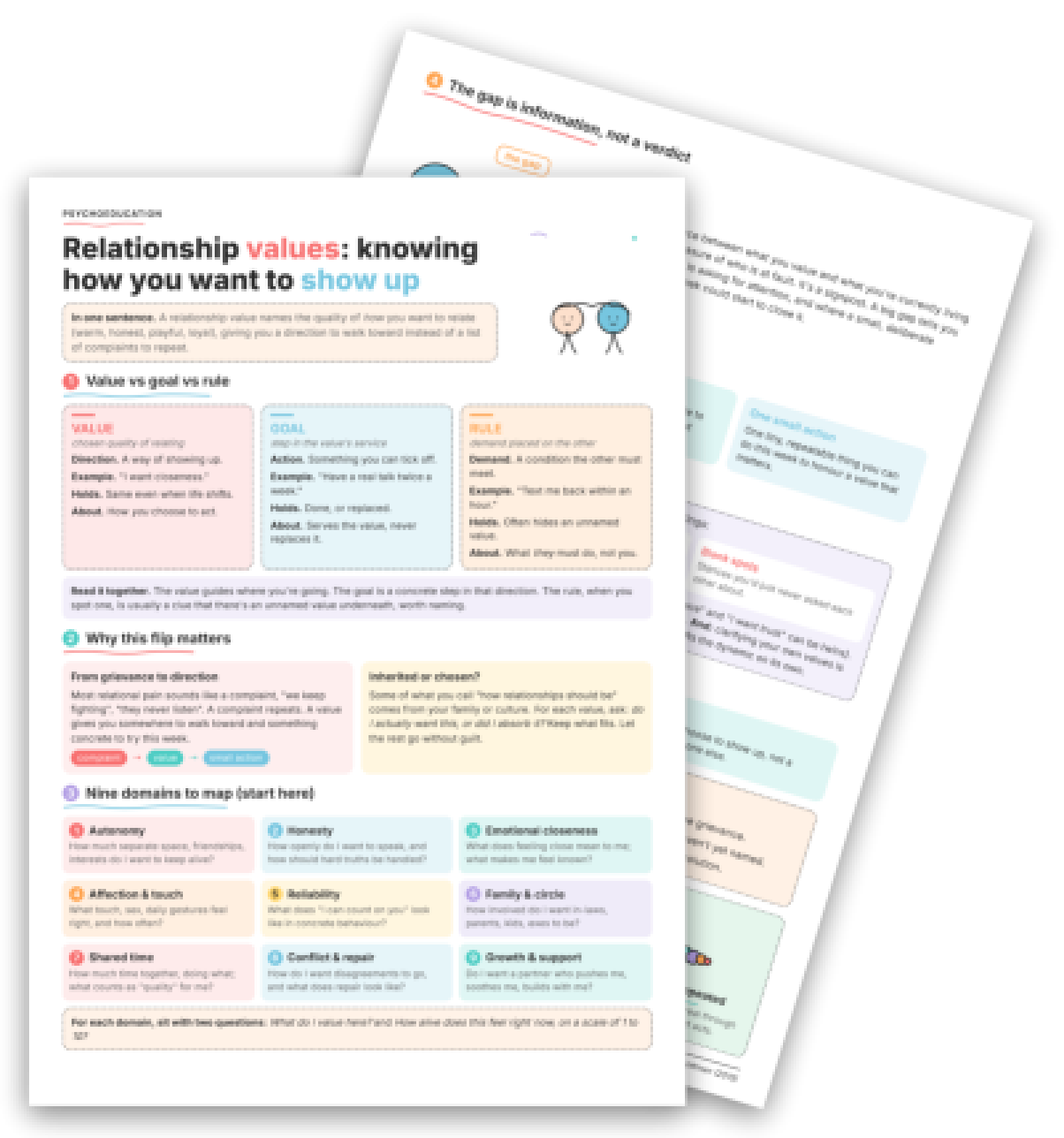
The fiche PDF is structured across seven panels, grounded in the ACT framework (Hayes, Wilson, Gottman).
The first panel presents a three-column comparison table: value vs. goal vs. rule, each broken down by direction, durability, and focus. The fiche states it plainly: "A rule, when you spot one, is usually a clue that there's an unnamed value underneath." Seen side by side on a printed sheet, the distinction lands in a way that a verbal explanation rarely achieves.
Panel 2 formalizes the clinical pivot you are likely already attempting: "complaint → value → small action." It also introduces a brief but useful prompt on inherited vs. chosen values, asking whether what a patient calls "how relationships should be" was absorbed from family or culture rather than actively chosen. This is particularly useful with patients working through limiting relational beliefs or schema-level assumptions.
Panel 3 maps nine relational domains (autonomy, honesty, emotional closeness, affection and touch, reliability, family and circle, shared time, conflict and repair, growth and support). For each domain the fiche invites two questions: what do I value here, and how alive does this feel right now on a scale of 1 to 10? That rating makes the fiche an active mapping tool, not a passive reading exercise, and gives you a concrete picture of where the patient's relational life is misaligned.
Panel 4 presents a simple gap diagram: what I value / what I live / the gap. The fiche frames it as "a signpost, not a verdict", which is worth quoting directly when debriefing. Panel 5 offers three reflection prompts (most neglected value, already-alive value, one small action). Panels 6 and 7 address partner use and the central trap: turning a value into a demand on the other.
> Key takeaway: The fiche is a visual support that facilitates the explanation of relationship values in session. It is not a questionnaire patients complete alone. The layout holds the value/goal/rule distinction, the nine domains, and the gap diagram in one place, giving you a shared reference point throughout the conversation.
750+ clinical tools
A library built with and for clinicians, ready to use in session and extend between appointments.
Access all the toolsWhen and How to Propose the Fiche
This fiche PDF sits naturally in individual therapy from the second or third session onward, once the presenting complaint has been mapped and the patient is ready to move from description to direction. It is especially well suited to:
- Couples seen individually, where clarifying values before joint sessions prevents the partner discussion from becoming a dispute about who is right
- Patients stuck in repetitive relational conflict, as a complement to nonviolent communication work or fair fighting tools
- ACT-oriented work where you are already using tools like the ACT Hexaflex or values clarification exercises
A low-threshold introduction: "I'd like us to look at something together. It's a map of what might actually matter to you in your relationship, separate from what you want the other person to do differently."
In couples sessions, Panel 6 of the fiche structures the joint exercise explicitly: each partner fills it in alone, then you compare. The fiche names three types of findings (quiet overlap, real differences, blank spots), which gives you a ready-made debrief framework. For ongoing relational monitoring, pairing it with a weekly couple check-in exercise extends the work between sessions.
One limit worth noting: patients in acute relational crisis or those with active attachment dysregulation may need somatic stabilization before this kind of values mapping is productive. For those profiles, exploring vulnerability in relationships or building secure attachment skills may come first.
The fiche leaves patients with a concrete reference they can return to. That is its clinical point: it converts a session conversation into a portable direction-finder.
Use it with your patients
Share this tool in the mobile app and follow the work between sessions.
Sources
- Dahl, J., Stewart, I., Martell, C., & Kaplan, J. S. (2014). ACT and RFT in Relationships: Helping Clients Deepen Intimacy and Maintain Healthy Commitments Using Acceptance and Commitment Therapy and Relational Frame Theory. New Harbinger Publications.
- Dahl, J. C., Plumb, J. C., Stewart, I., & Lundgren, T. (2009). The Art and Science of Valuing in Psychotherapy: Helping Clients Discover, Explore, and Commit to Valued Action Using Acceptance and Commitment Therapy. New Harbinger Publications.
- Gottman, J. M., & Silver, N. (1999). The Seven Principles for Making Marriage Work. Crown Publishers.
- Kirschenbaum, H. (2013). Values Clarification in Counseling and Psychotherapy: Practical Strategies for Individual and Group Settings. Oxford University Press.
Your session continues in your patients' pocket
Use with a patientYour resources, available everywhere
The handouts, exercises, programs and audios above: you choose which ones to make available to your patients, in the mobile app dedicated to them.
And far more than a library
The app goes well beyond resources, to support your patients every day:
Related categories
Explore other clinical resources by category.

Identity
Clinical resources for self-identity work in therapy: CBT, ACT, schema tools for clinicians addressing self-concept, core beliefs, and identity disruption.

Relationships
Clinical worksheets and tools on relational functioning: attachment, schemas, assertiveness, and communication skills for therapists. Printable PDF resources.

Build awareness
Clinical worksheets and tools to build awareness in therapy: cognitive distortions, schemas, emotions, ACT and CBT resources for practitioners.

Engage & motivate
Clinical hub: printable worksheets and exercises to build therapeutic engagement and motivation across ACT, CBT, and integrative practice. For clinicians.

ACT
Clinical hub for Acceptance and Commitment Therapy (ACT): worksheets, exercises, programs and audio resources for practitioners using the ACT model.

Emotion-focused
Emotion-focused therapy clinical resources: worksheets, exercises & programs for EFT practitioners working with individuals and couples.