
Clinical picture. A., a man in his early 40s, presented with chronic occupational dissatisfaction and a pattern of deferring major decisions; he described his values in every session as "family and hard work" without apparent reflection. His therapist introduced the Values Exploration Discussion Cards mid-treatment, drawing three cards at random and asking A. to respond to the story prompts before attempting any label. When the card asked him to describe a day he would want to relive, A. recounted an afternoon spent restoring a vintage bicycle in his garage, alone, with no particular outcome in mind. The value he named from that story, "making things whole," had never appeared in his earlier rehearsed lists, and he sat quietly for a moment after saying it aloud. In the following session he used that phrase unprompted to explain why a recent promotion had felt hollow rather than satisfying.
Values Exploration Discussion Cards: PDF Worksheet, Tools and Exercises
A printable card-based PDF tool clinicians can use in session to surface patients' genuine values through narrative, bypassing the socially polished answers that make direct questioning unreliable.
Clinical vignettes
Indirect Prompts Bypass a Rehearsed Self-Image
Clarifying Direction in Prolonged Grief Work
Clinical picture. M., a woman in her late 50s, was seen eighteen months after the death of her adult daughter; she reported feeling directionless and described her only remaining goal as "getting through each day." Her clinician introduced the card exercise as a low-pressure activity, framing it explicitly as exploratory rather than prescriptive. The card drawn asked M. to describe a person she had always admired and what that person consistently did. She spoke at length about a neighbour who had quietly supported others through hardship without drawing attention to herself. M. identified the value herself as "bearing witness," and over subsequent weeks she began volunteering at a bereavement telephone line, citing that phrase when asked what drew her to the role. The exercise did not resolve her grief, but it offered a usable direction where previously none had been visible.
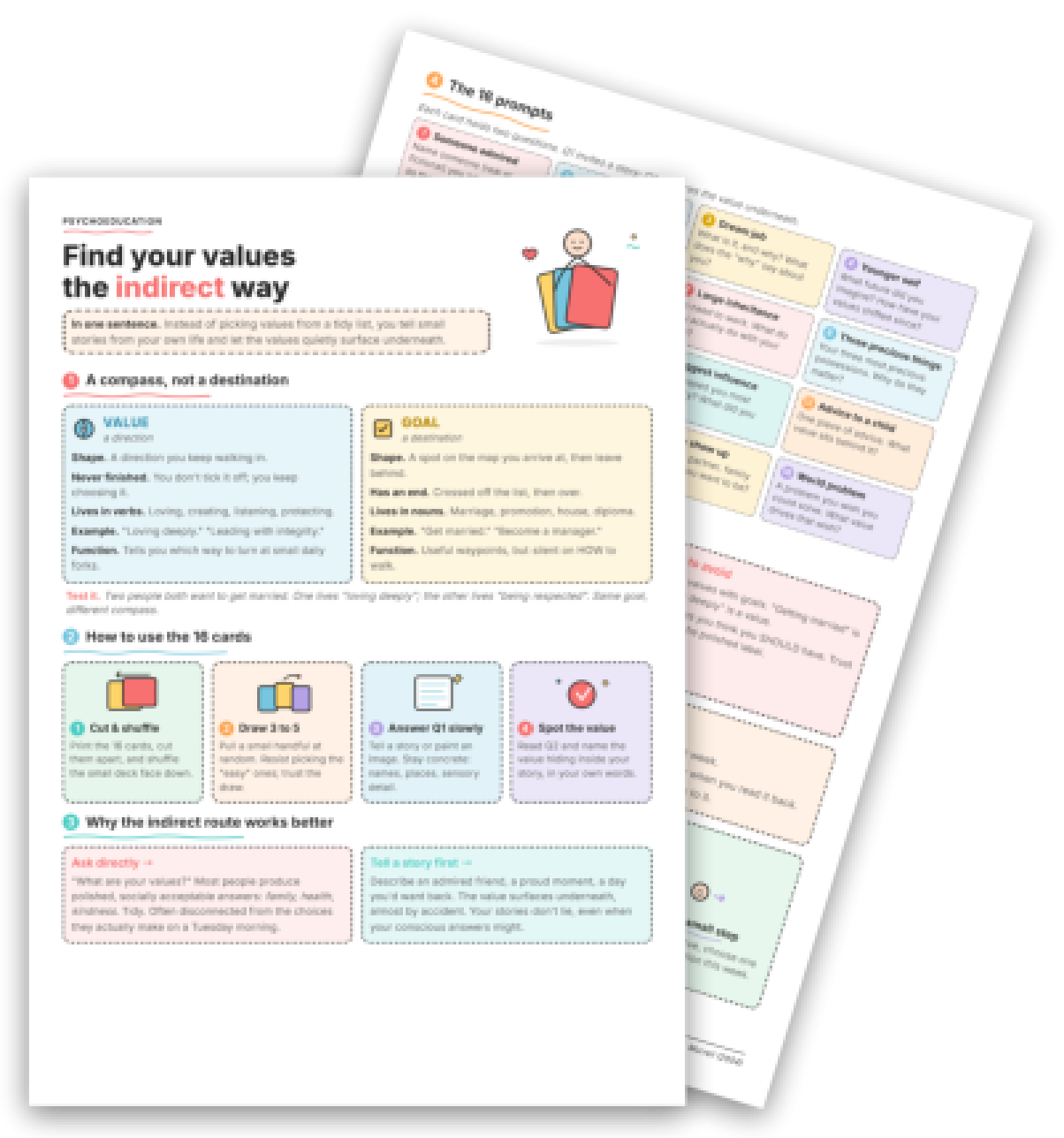
Ask a patient directly what their values are and you will almost certainly get a tidy, socially acceptable list, family, health, honesty, that tells you very little about how they actually move through a Tuesday. This PDF worksheet was designed for exactly that impasse: it gives you a concrete visual support you can open in session, hand across the table, and use to draw out genuine values through story rather than declaration.
Use this resource with your patients
Handout, exercises and materials ready to use, right inside SessionFuel.
Why Direct Values Questioning Tends to Fail in Session
Within the ACT framework (Hayes, 2005; Harris, 2009), values clarification is a cornerstone of committed action. But the gap between a patient's stated values and their lived behaviour is frequently the most clinically productive terrain. The problem is access. When you ask directly, the patient's verbal repertoire produces rule-governed responding rather than genuine contact with what matters. The answer sounds right; it just doesn't move anything.
The fiche addresses a second layer of confusion: patients routinely conflate values with goals. Explaining the distinction verbally in session ("a value is a direction, a goal is a destination") rarely lands with enough clarity to stick. A patient can paraphrase it back and still be working from goals throughout the remainder of the case. You need something they can see.
> Key point: This fiche is a visual support that facilitates the explanation of values in session, not an autonomous questionnaire to complete at home, but a psychoeducational anchor the clinician uses with the patient to make a notoriously slippery distinction concrete and personally owned.
What the Fiche Contains
The support opens with a values versus goals panel, a side-by-side visual contrast that the fiche frames as "compass versus destination." Values are described as "a direction you keep walking in," living in verbs (loving, creating, protecting); goals as waypoints that are crossed off and left behind. A brief test case is included: two people both want to get married, one living "loving deeply," the other "being respected", same goal, different compass. This single diagram does more clinical work than five minutes of Socratic explanation.
The core of the tool is 16 discussion cards, each carrying two questions. Q1 invites a concrete story or image ("Name someone you admire. What do they live by?" / "Describe a time you felt genuinely proud. What were you living out?"). Q2 asks the patient to name the value surfacing underneath the story in their own words. The fiche includes a brief rationale for the indirect route: "Your stories don't lie, even when your conscious answers might." This framing is one you can read aloud to the patient before drawing a first card, it normalises the method and invites a slower, more honest kind of reflection.
A closing "reading your own answers" section guides the patient to look for recurring threads across cards, aiming for five to eight core values written in their own words. It names two traps explicitly: confusing values with goals, and choosing values the patient thinks they should hold. A short "to discuss in session" panel signals the moments most worth returning to together, including when a stated value is barely visible in the current week, or when a polished answer produces no somatic resonance at all.
The fiche pairs cleanly with the ACT Hexaflex visual, the Valued Domains worksheet, and the Choice Point tool for moving from clarification into committed action.
750+ clinical tools
A library built with and for clinicians, ready to use in session and extend between appointments.
Access all the toolsWhen and How to Introduce It
The cards work best once the therapeutic alliance is established and the patient has already articulated some sense of being stuck, directionless, or living in ways that feel misaligned. Mid-treatment is the natural entry point: after initial formulation, when avoidance patterns are visible, before building a committed action plan with something like the Values Cultivation exercise or the Personal Values Clarification homework.
For patients with significant approval-seeking schemas or rigid perfectionism, the indirect format is particularly useful, it sidesteps the performance pressure of a direct question. For patients presenting with low mood and behavioural withdrawal, connecting the cards to behavioural activation or the Future Inventory exercise gives the values work an immediate practical outlet.
A simple introduction: "Instead of asking you what your values are, which often produces answers that sound right but don't quite fit, we're going to try a different route. You'll draw a card, tell me a story, and we'll see what surfaces underneath." Print the cards beforehand, cut them, and shuffle them. Drawing three to five at random, rather than letting the patient select, reduces the pull toward self-presentation.
Debrief by asking which story felt most alive, and whether any value that appeared across multiple cards is genuinely visible in the current week. That gap, when it appears, is the clinical material. The fiche doesn't replace the therapeutic frame; it makes the explanation clear and leaves the patient with a concrete map of their own compass.
Use it with your patients
Share this tool in the mobile app and follow the work between sessions.
Sources
- Hayes, S. C., Smith, S. (2005). Get Out of Your Mind and Into Your Life: The New Acceptance and Commitment Therapy. New Harbinger Publications.
- Harris, R. (2021). The Happiness Trap: How to Stop Struggling and Start Living (2nd ed.). Shambhala Publications.
- Harris, R. (2019). ACT Made Simple: An Easy-to-Read Primer on Acceptance and Commitment Therapy (2nd ed.). New Harbinger Publications.
- Wilson, K. G., Sandoz, E. K., Kitchens, J., Roberts, M. E. (2010). The Valued Living Questionnaire: Defining and Measuring Valued Action within a Behavioral Framework. The Psychological Record.
Your session continues in your patients' pocket
Use with a patientYour resources, available everywhere
The handouts, exercises, programs and audios above: you choose which ones to make available to your patients, in the mobile app dedicated to them.
And far more than a library
The app goes well beyond resources, to support your patients every day:
Related categories
Explore other clinical resources by category.

Identity
Clinical resources for self-identity work in therapy: CBT, ACT, schema tools for clinicians addressing self-concept, core beliefs, and identity disruption.

Transitions
Clinical hub for life transitions: tools, worksheets and exercises to support psychosocial adjustment, role change and identity work in practice.

Build awareness
Clinical worksheets and tools to build awareness in therapy: cognitive distortions, schemas, emotions, ACT and CBT resources for practitioners.

Engage & motivate
Clinical hub: printable worksheets and exercises to build therapeutic engagement and motivation across ACT, CBT, and integrative practice. For clinicians.

ACT
Clinical hub for Acceptance and Commitment Therapy (ACT): worksheets, exercises, programs and audio resources for practitioners using the ACT model.

Positive psychology
Positive psychology clinical resources for therapists: worksheets, exercises & programs on well-being, strengths, gratitude, and resilience-based practice.