
Clinical picture. P., a woman in her early forties, presented with persistent low mood and avoidance following a burnout episode that had led to a six-month sick leave from a middle-management role. She described her work identity as central to her self-worth, yet felt unable to think about her professional future without acute anxiety. The clinician introduced the My work life exercise as between-session homework, inviting her to work through the five structured questions at her own pace. When she returned the following week, her written responses to questions 3 and 4 revealed a pattern she had not previously articulated: several past roles had offered genuine skill development that she had systematically discounted. This recognition shifted the session away from rumination and toward a more differentiated appraisal of her professional history, providing a concrete starting point for vocational goal-setting.
Professional Life Assessment: A Structured Reflection Tool
Help patients map their work situation, past learnings, and professional aspirations with a guided five-question homework exercise.
Clinical vignettes
Reframing Work After Burnout
Clarifying Ambivalence in Career Transition
Clinical picture. T., a man in his mid-thirties, was seen in the context of a generalised anxiety disorder and reported growing dissatisfaction with his current role as a software developer, though he struggled to say what he actually wanted. The clinician proposed the My work life exercise as a structured way to externalise thoughts that had remained diffuse and circular. T. completed questions 1, 2, and 5 with relative ease, but left question 3 largely blank, noting in session that he had difficulty identifying any meaningful learning from two earlier positions he considered failures. This gap became the clinical focus: exploring the conditions under which he discounted experience, a theme that resonated directly with his broader pattern of self-invalidation. The exercise did not resolve his vocational uncertainty, but it gave both clinician and patient a shared, concrete map from which to work.
Why professional identity resists a simple conversation
Work occupies a paradoxical place in many patients' lives: central enough to structure their entire week, yet rarely examined with any real precision. When you ask a patient directly what work means to them, you often receive a flat answer, a shrug, or a rehearsed complaint. Professional identity is built from accumulated experiences, unspoken expectations, and half-formed aspirations that patients have rarely been invited to articulate in an ordered way.
This difficulty compounds when the clinical picture involves burnout, a motivational dip, or a career transition. Patients sense that something is off in their professional life but struggle to locate exactly what, or to distinguish a temporary frustration from a genuine values mismatch. A structured written reflection, completed autonomously at home, gives the patient the distance and time that a spoken exchange in the consulting room rarely allows.
The My work life exercise exists precisely for this gap. It guides patients through five sequential questions that move from a concrete description of the present situation to a forward-looking articulation of aspirations, passing through a retrospective scan of past experience.
Use this resource with your patients
Handout, exercises and materials ready to use, right inside SessionFuel.
What the exercise contains
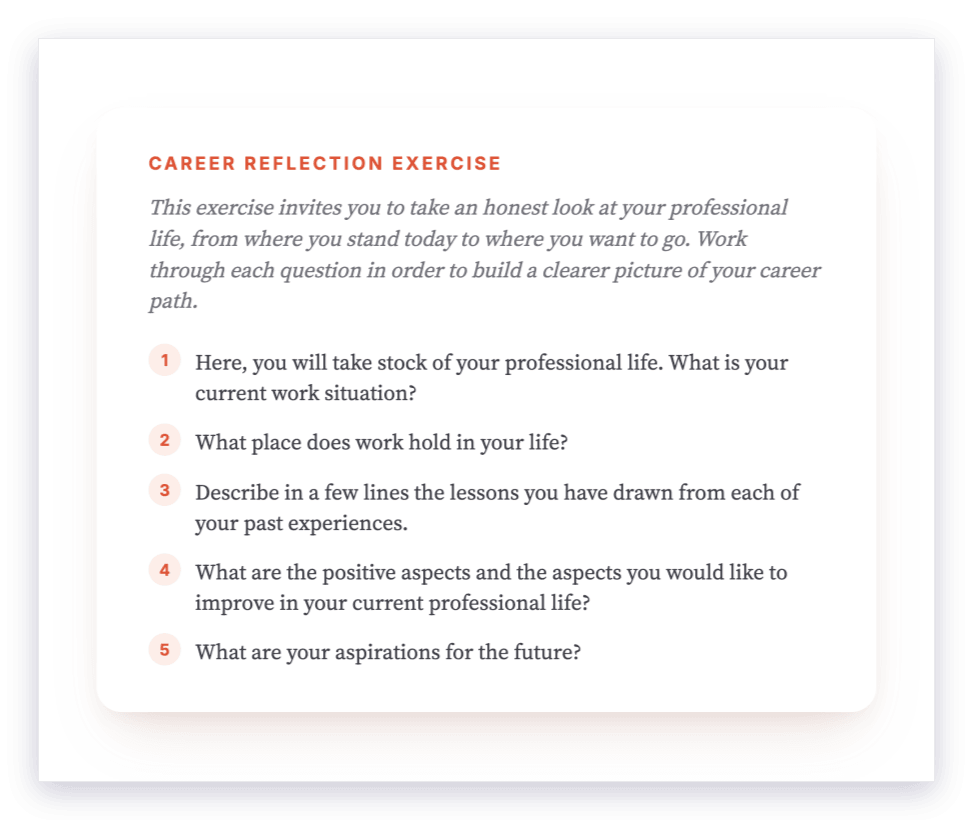
The image above lists the five questions in order. Note that this image is a static preview of the question set only; the full guided exercise, with patient-facing instructions and space to write, is experienced by the patient directly in the app, on their own, not in this image.
The exercise opens with an honest stocktake: the patient names their current situation plainly, without interpretation. Question 2 shifts the lens, asking what place work actually holds in their life overall, a question that surfaces overinvestment, underinvestment, and values conflicts that are hard to catch any other way.
Question 3 is the retrospective pivot: the patient describes, in a few lines for each past experience, what they learned from it. This is not a CV exercise. It is closer to the narrative work supported by the Life Story: Past, Present, Future fiche, inviting the patient to extract meaning rather than just list roles. Question 4 asks for a balanced audit of the current situation, naming both positives and areas the patient would like to improve. This mirrors the structure of a SWOT Analysis and keeps the reflection from tipping into pure complaint. The exercise closes with question 5: aspirations for what comes next, a forward pull that connects naturally to the goal-setting work you may already be doing with tools like 6- and 12-Month Goal Setting or 10-Year Goals.
This exercise is available to patients through the SessionFuel patient app, the mobile interface reserved for patients of clinicians who use SessionFuel: you assign the exercise from your side, and your patient completes it directly on their phone, on their own, between appointments.
Key insight: The five-question arc is deliberately progressive. Each answer prepares the ground for the next, so that by question 5 the patient's aspiration is anchored in a realistic self-reading rather than a fantasy disconnected from actual history and current constraints.
750+ clinical tools
A library built with and for clinicians, ready to use in session and extend between appointments.
Access all the toolsUse it with your patients
Share this tool in the mobile app and follow the work between sessions.
Integrating this as between-session homework
This exercise suits a wide range of profiles: patients navigating a career crossroads, those presenting with diffuse dissatisfaction that may or may not reach clinical burnout thresholds, patients in whom work stress is feeding anxiety or low mood, and any patient for whom psychosocial risks at work are part of the clinical picture.
Introduce it between two sessions by framing it as a structured self-inventory, not a test. A simple formulation works well: "Before we next meet, I'd like you to take some time with these five questions about your professional life. There are no right answers. Just answer as honestly as you can." Patients with perfectionist tendencies may benefit from a brief reassurance that a few lines per question is entirely sufficient.
When the patient returns with their completed exercise, the most productive entry points are usually questions 3 and 5: the gap between the learnings they have named and the aspirations they articulate often reveals either a coherent developmental thread or a striking discontinuity that becomes the therapeutic focus. From there, you can anchor concrete next steps using Setting Life Goals or Goal-Setting and Motivation, examine the values dimension through Exploring Values or Personal Values Clarification, or explore the balance question further with the Work-Life Balance Assessment.
For patients who find question 5 particularly difficult, the My Future Inventory exercise makes a useful companion assignment in a subsequent interval. And for those whose professional difficulties are entangled with self-worth, the Impostor Syndrome and Strengths Exploration resources complement the picture well.
Your session continues in your patients' pocket
Use with a patientYour resources, available everywhere
The handouts, exercises, programs and audios above: you choose which ones to make available to your patients, in the mobile app dedicated to them.
And far more than a library
The app goes well beyond resources, to support your patients every day:
Related categories
Explore other clinical resources by category.

Transitions
Clinical hub for life transitions: tools, worksheets and exercises to support psychosocial adjustment, role change and identity work in practice.

Engage & motivate
Clinical hub: printable worksheets and exercises to build therapeutic engagement and motivation across ACT, CBT, and integrative practice. For clinicians.

Positive psychology
Positive psychology clinical resources for therapists: worksheets, exercises & programs on well-being, strengths, gratitude, and resilience-based practice.

Solution-focused
Clinical hub for Solution Focused Therapy resources: worksheets, exercises and programs for goal-oriented, strengths-based practice across individual and couple work.

Anxiety
Clinical hub for anxiety disorders: CBT and ACT worksheets, psychoeducation sheets, and exercises for assessment and treatment across the anxiety spectrum.

Trauma
Clinical hub on trauma and PTSD: assessment, differential diagnosis, treatment phases, and printable resources for practitioners. 155 chars.