
Clinical picture. R., a 38-year-old nurse working in a high-turnover emergency unit, presents with persistent sleep difficulties, irritability, and a growing sense of dread before each shift. She describes the problems as personal failings: she feels she "used to cope" and now cannot. The clinician introduces the six PSR families using the informational sheet, and together they map her situation: sustained emotional demands from daily trauma exposure, unpredictable shift patterns cutting into rest, and almost no autonomy over care decisions. Reframing her distress as a predictable response to cumulative occupational exposure rather than a sign of diminished resilience visibly shifts her posture; she discloses for the first time that three colleagues left the unit in the past four months for similar reasons. The session closes with a shared working hypothesis centred on exposure load, not character, which she agrees to bring to the next appointment.
Psychosocial Risks at Work: PDF Worksheet, Tools and Exercises
A structured visual reference helping clinicians name, map, and work with workplace exposures in session, moving patients from vague exhaustion to concrete clarity.
Clinical vignettes
Naming the Exposure, Not the Fragility
Value Conflict Recognised Late
Clinical picture. M., a 45-year-old project manager in a consulting firm, was referred by his GP after a second episode of adjustment disorder in three years. He reports low-grade cynicism, difficulty concentrating, and a growing disconnection from his work, yet cannot articulate a clear precipitant. During the session the clinician uses the PSR framework to review each risk family systematically, and M. pauses at the value-conflict section: he has been required for over a year to present client data in ways he considers misleading, without any internal channel to raise the concern. He had not labelled this as an occupational risk, having attributed his discomfort to a vague sense of personal dissatisfaction. Identifying the specific mechanism does not resolve the situation, but it allows the clinical work to shift toward clarifying his options, including whether the conditions are modifiable, rather than continuing to focus solely on symptom management.
Patients struggling with work-related distress often arrive with a fragmented picture: fatigue they can't locate, guilt about "not coping," and a narrative that collapses structural exposure and personal failure into one undifferentiated mass. Sorting that out verbally takes time that clinical sessions rarely spare. This psychosocial risks at work PDF worksheet gives you a shared visual map to do it faster, and more precisely.
Use this resource with your patients
Handout, exercises and materials ready to use, right inside SessionFuel.
Why Workplace Distress Resists Verbal Explanation
The core difficulty is not conceptual complexity. Most patients can understand what a "risk factor" is. The problem is internalization: patients routinely absorb systemic dysfunction as a personal deficiency. They arrive having already diagnosed themselves with low resilience, insufficient drive, or an inability to cope with what "everyone else handles fine."
When that narrative is addressed only through dialogue, it tends to survive intact. The clinician explains the structural/individual distinction; the patient nods; the self-blame reconstitutes itself by the next session. What is missing is a concrete taxonomy the patient can look at, point to, and recognize themselves in, something that externalizes the exposure before any cognitive work begins.
This is particularly visible when burnout is already present: the cognitive depletion that characterizes late-stage exhaustion makes verbal psychoeducation even harder to retain. A structured visual reference reduces the processing load.
750+ clinical tools
A library built with and for clinicians, ready to use in session and extend between appointments.
Access all the toolsWhat the Fiche Contains: A Structured Visual Map for In-Session Use
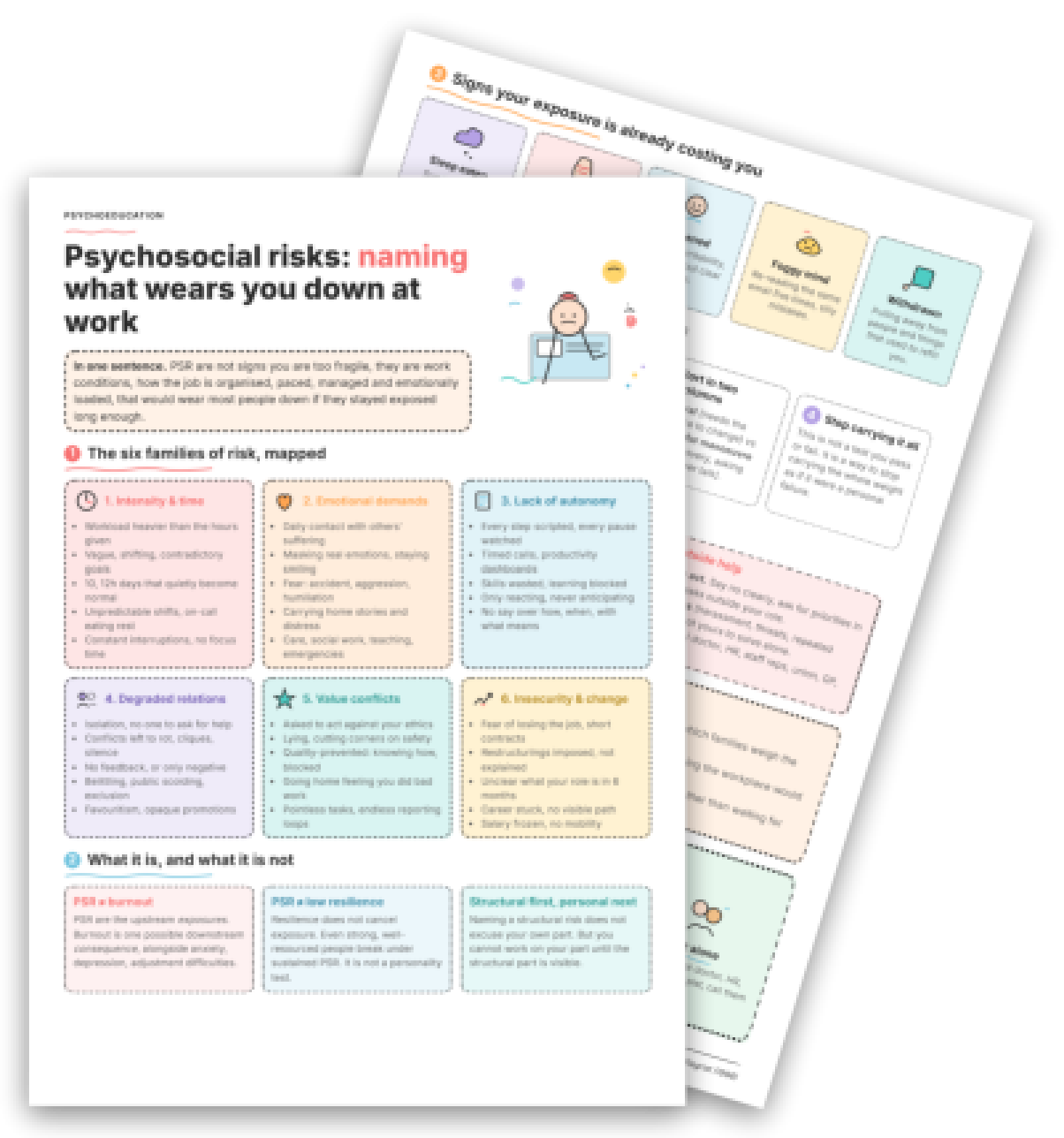
The fiche PDF is organized across five numbered panels, designed to be walked through with the patient during the session rather than handed out as independent reading.
Panel 1 presents the six families of psychosocial risk in a compact mapped layout: Intensity & time, Emotional demands, Lack of autonomy, Degraded relations, Value conflicts, and Insecurity & change. Each family lists four to five concrete markers. Having all six families visible simultaneously allows the patient to scan across domains, which oral enumeration does not. You can observe in real time where recognition lands, where it stalls, and which items produce the strongest non-verbal response.
Panel 2 clarifies three critical distinctions: PSR versus burnout (upstream exposure versus downstream consequence), PSR versus low resilience, and the primacy of structural factors over personal ones. The phrase "PSR are not signs you are too fragile" functions as a direct counter to the internalization pattern described above. Reading it on the page carries a different weight than hearing it in conversation.
Panel 3 lists five somatic and behavioral warning signs that exposure is already accruing: disrupted sleep, physical tension, emotional flattening, cognitive fog, and social withdrawal. This panel pairs naturally with a structured body-stress psychoeducation tool and supports an early conversation about adaptive versus maladaptive coping.
Panel 4 introduces a four-step self-mapping exercise: rating each recognized factor from 0 to 10, writing one recent concrete situation for the top exposures, then "sorting in two columns: Structural (needs the workplace to change) vs my room for manoeuvre." That two-column sort is the operative clinical move. It gives the patient a framework for identifying where work is genuinely theirs to do, and where waiting for personal change will not be enough.
Panel 5 maps concrete resources: the occupational physician, a written log for escalating situations, recovery basics, and explicit guidance on asserting boundaries at work. A dedicated "To discuss in session" section invites the patient to bring the map back with specific families circled, making the between-session and in-session work continuous.
> Key takeaway: this fiche is a visual support that facilitates the explanation of psychosocial risks in session. It does not replace clinical formulation; it provides the shared vocabulary and structure that make formulation faster and more precise.
Use it with your patients
Share this tool in the mobile app and follow the work between sessions.
When and How to Introduce the Fiche
This resource fits best after initial anamnèse, once the occupational context has been broadly sketched but before a full case formulation has been built. It works particularly well when the presenting complaint is diffuse: "I'm exhausted but I don't know why," "I can't take it anymore but I feel like I'm exaggerating," "I think I'm just not cut out for this."
You can introduce it with something like: "I want to look at something with you, a map of the types of pressures that wear people down at work. I'd like you to tell me which ones you recognize." That framing positions the patient as informant rather than patient, which reduces the shame load from the outset.
The four-step exercise in Panel 4 is a natural debrief scaffold: ask which families scored highest, what the concrete situation was, and whether it lands in the structural or personal column. The professional life assessment exercise and the weekly work check-in both work well as follow-up tools, extending the mapping into between-session monitoring. For patients whose work pressure has crossed into dysregulation or acute distress, the structural column also prepares the ground for a concrete conversation about what is and is not within their sphere of influence.
One limit to name: the fiche maps exposures, it does not resolve them. For patients in genuinely severe situations (harassment, repeated threats, organizational crisis), the panel on external resources must be engaged actively in session rather than left as a take-home item.
The fiche does not replace the therapeutic framework. It makes one of its most necessary early steps, naming what is structural and what is personal, concrete enough to actually stick.
Your session continues in your patients' pocket
Use with a patientYour resources, available everywhere
The handouts, exercises, programs and audios above: you choose which ones to make available to your patients, in the mobile app dedicated to them.
And far more than a library
The app goes well beyond resources, to support your patients every day:
Related categories
Explore other clinical resources by category.

Emotions
Clinical resources on emotion regulation: worksheets, coping tools, CBT, REBT, and ACT exercises for therapists working across diagnoses and age groups.

Transitions
Clinical hub for life transitions: tools, worksheets and exercises to support psychosocial adjustment, role change and identity work in practice.

Understand
Clinical hub for the therapeutic aim 'Understand': worksheets and tools to build patient insight across CBT, ACT, schema therapy and more.

CBT
CBT worksheets, cognitive restructuring exercises & behavioral tools for clinicians. Evidence-based resources for every phase of cognitive behavioral therapy.

Anxiety
Clinical hub for anxiety disorders: CBT and ACT worksheets, psychoeducation sheets, and exercises for assessment and treatment across the anxiety spectrum.

Trauma
Clinical hub on trauma and PTSD: assessment, differential diagnosis, treatment phases, and printable resources for practitioners. 155 chars.