
Clinical picture. A., a 28-year-old doctoral candidate, was referred for perfectionism and chronic sleep disruption during thesis writing. She reported spending four to six hours each evening revising paragraphs she had already revised the previous night, and described a persistent sense that her work was never ready to submit. The clinician introduced the inverted-U model during a psychoeducation session, using the worksheet to map A.'s current effort level onto the right slope of the curve. A. identified several behavioural markers from the worksheet, including compulsive re-reading and an inability to close her document at night, as consistent with over-arousal rather than insufficient effort. Over the following two weeks she experimented with capping daily revision to one focused pass; output quality, by her supervisor's account, remained unchanged while her sleep improved modestly.
Yerkes-Dodson Law & Performance: PDF Worksheet, Tools and Exercises
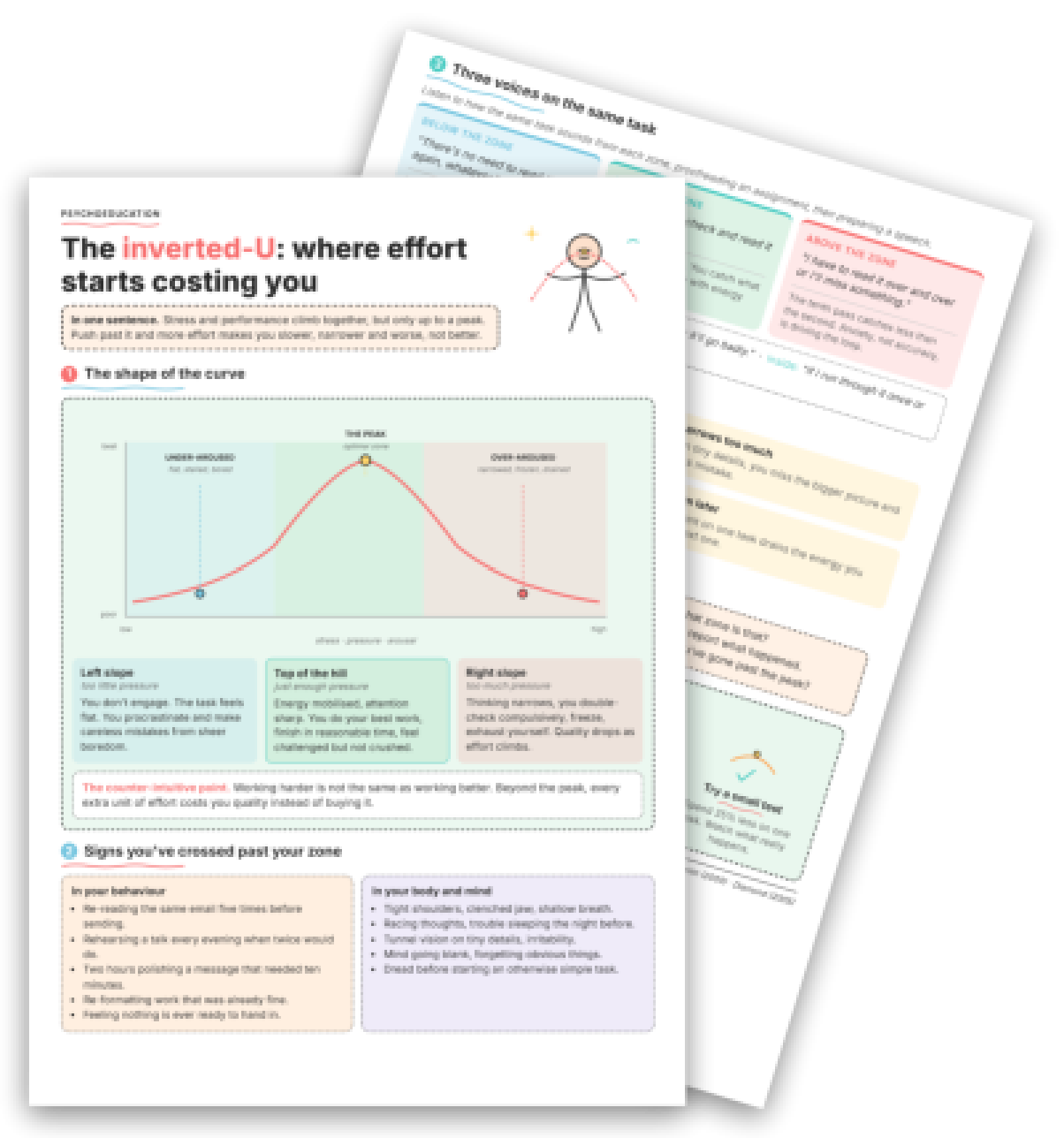
A printable PDF fiche, clinical tools, and in-session exercises to help patients understand why working harder past a certain point actively undermines performance.
Clinical vignettes
Over-Arousal Blocking a Graduate Student
Under-Arousal in a Mid-Career Professional
Clinical picture. T., a 44-year-old project manager seen for low mood and occupational disengagement, described his work as 'flat' and reported frequent careless errors on routine reports he found unstimulating. He had interpreted this pattern as a symptom of depression rather than a mismatch between task demand and arousal level. The clinician used the Yerkes-Dodson worksheet to distinguish under-arousal from anhedonia, noting that T.'s errors occurred specifically on low-stakes, repetitive tasks where he felt no pressure at all. T. agreed to trial modest self-imposed constraints, such as a brief time limit per report, to shift himself leftward on the curve toward the optimal zone. At review three weeks later he noted fewer careless slips and slightly more engagement, though broader mood work continued in parallel.
Explaining the Yerkes-Dodson curve verbally tends to produce polite agreement in session and zero behavioural change outside it. The claim is genuinely counter-intuitive, and a two-minute oral explanation rarely dislodges a belief patients have held for years. This fiche PDF gives the concept a visual anchor that stays with the patient well after the session ends.
Use this resource with your patients
Handout, exercises and materials ready to use, right inside SessionFuel.
Why the Inverted-U Resists Verbal Explanation
The model carries one central counter-intuitive claim: beyond a certain arousal level, additional effort degrades performance rather than improving it. Most patients who need this information, particularly those presenting with perfectionism, compulsive re-checking, or early-stage burnout, hold a deeply embedded linear assumption: working harder equals working better. That rule often functions as a schema-level belief, not a conscious strategy, which is why verbal challenge bounces off it.
The checking-anxiety loop the fiche names in its fourth panel maps directly onto the maintaining cycle described in the Checking, Certainty, and Doubt resource: rising anxiety triggers more checking, which feeds more anxiety. Without a visual, most patients hear the clinician's account as reassurance. A curve changes that.
> Key takeaway: The fiche is a visual support that facilitates the explanation of the Yerkes-Dodson Law in session. It is not a self-assessment questionnaire; it is a psychoeducation tool the clinician uses at the table to make a counter-intuitive principle visible, and to leave the patient with a concrete reference point to return to between appointments.
750+ clinical tools
A library built with and for clinicians, ready to use in session and extend between appointments.
Access all the toolsWhat the Fiche Contains
Five panels, structured for clinical use. Panel 1 presents the inverted-U itself, with labelled axes (stress, pressure, arousal on the horizontal; performance quality on the vertical) and three named zones: under-aroused, peak, over-aroused. The shape makes the non-linearity literal in a way that words do not.
Panel 2 lists observable signs of having crossed past the optimal zone, split into behavioural markers ("Re-reading the same email five times before sending") and somatic-cognitive ones (tunnel vision, racing thoughts, mind going blank). For patients presenting with demanding standards or workplace pressure, this panel moves the conversation from global self-criticism to precise zone-identification.
Panel 3 is the most clinically generative section. Three parallel voices narrate the same task (proofreading an assignment, preparing a speech) from each zone. The above-zone voice reads: "I have to read it over and over or I'll miss something." Immediately beside it, the in-zone voice: "I'll run a spell-check and read it through once." Seeing the anxious loop named as a pattern rather than a virtue tends to shift something quickly in patients who have only ever experienced it as diligence. The perfectionism ratchet often becomes visible to patients for the first time through this panel.
Panel 4 explains the four mechanisms behind effort backfire: attentional fatigue (the tenth re-read catches less than the second), focus narrowing, the anxiety-checking loop, and cross-task resource depletion. Panel 5 closes with three discussion prompts and four short aphorisms, including "Good enough ships. On time beats perfect, never," which anchor a debrief without sounding prescriptive.
Use it with your patients
Share this tool in the mobile app and follow the work between sessions.
When and How to Introduce It
The fiche is well placed from the second or third session, once the formulation is taking shape. Strong indications include patients presenting with what keeps perfectionism going, performance anxiety, study-related or test anxiety, and the early stages of burnout. It also pairs naturally with the Comfort, Stretch & Panic Zones fiche when building a shared vocabulary around arousal and regulation, and with stress management work when the clinical goal is reducing effort-driven overactivation.
A low-barrier introduction: "I want to show you a diagram that explains something counter-intuitive about effort. It's not a questionnaire, just a shape we can look at together." Most patients engage immediately because the curve confirms something they have felt but never had language for.
After Panel 3, the first discussion prompt from the fiche works directly as a Socratic question: "When you notice yourself re-checking the same task more than twice, what zone is that?" The built-in behavioural experiment, spending 25% less time on one low-stakes task, doubles as a graded exposure exercise consistent with perfectionism-focused CBT work. For patients embedded in psychosocial workplace pressure, name the zone explicitly before assigning the experiment. The fiche does not replace the therapeutic frame; it makes one piece of it concrete and leaves a usable reference in the patient's hands.
Your session continues in your patients' pocket
Use with a patientYour resources, available everywhere
The handouts, exercises, programs and audios above: you choose which ones to make available to your patients, in the mobile app dedicated to them.
And far more than a library
The app goes well beyond resources, to support your patients every day:
Related categories
Explore other clinical resources by category.

Anxiety
Clinical hub for anxiety disorders: CBT and ACT worksheets, psychoeducation sheets, and exercises for assessment and treatment across the anxiety spectrum.

Identity
Clinical resources for self-identity work in therapy: CBT, ACT, schema tools for clinicians addressing self-concept, core beliefs, and identity disruption.

Emotions
Clinical resources on emotion regulation: worksheets, coping tools, CBT, REBT, and ACT exercises for therapists working across diagnoses and age groups.

Transitions
Clinical hub for life transitions: tools, worksheets and exercises to support psychosocial adjustment, role change and identity work in practice.

Understand
Clinical hub for the therapeutic aim 'Understand': worksheets and tools to build patient insight across CBT, ACT, schema therapy and more.

Engage & motivate
Clinical hub: printable worksheets and exercises to build therapeutic engagement and motivation across ACT, CBT, and integrative practice. For clinicians.